Oct 14, 2026
Classroom rules by grade: examples for K-12 and how to teach them
Five or fewer rules for each grade band, from kindergarten to high school, with what each rule looks like in the room and how to teach it in the first week.

Teddy Lane | School Success Lead at Flint

Most lists of classroom rules give you 25 or 36 options and leave the choosing to you. This post gives you one short set for each grade band, written the way students will hear them, with what each rule looks like in the room and how to teach it during the first week. Every set follows the same research-backed recipe: five rules or fewer, each one stating what to do, each one specific enough that you can see whether a student is following it.
Make a set for your class
Sparky asks your grade, subject and school-wide expectations, then writes a set of classroom rules with what each one looks like and how to teach it in the first week. You get an editable document you can print or export, and Sparky can turn the rules into a one-page poster.
Write five rules or fewer, and make each one visible
The IRIS Center at Vanderbilt University, which writes teacher training modules with U.S. Department of Education funding, recommends no more than five classroom rules. It gives four tests for each rule. Here they are with examples of our own:
| Test | Weak version | Stronger version |
|---|---|---|
| Names the behavior you want | Be respectful. | Let classmates finish before you talk. |
| Says what to do, not what to stop | No shouting out. | Raise your hand during whole-class discussion. |
| Uses plain, specific words | Respect personal space. | Keep your hands and feet in your own space. |
| Can be seen or counted | Be ready to learn. | Be at your desk with your notebook open when the timer ends. |
IRIS adds two more points. Classroom rules should line up with your school-wide expectations, so if your school posts "Be safe, be respectful, be responsible," sort your five rules under those three headings. And students can help write the rules. IRIS notes that students often propose the rules you would have written anyway, and follow them more willingly because they had a say.
The research has one limit you should know about before you spend an evening on a poster. In 2017, Peter Alter and Todd Haydon compared the advice in classroom management textbooks with studies that tested rules directly. Their review found that the two features with real evidence behind them were teaching the rules to students and tying the rules to consequences, positive or negative. The evidence for the rest of the common advice was mixed. A clear poster helps most when you teach the rules in week one and respond to them the same way every day after.
Rules cover the whole day; procedures cover one task
A rule applies all day, in every activity: "Keep your hands and feet in your own space." A procedure is the step-by-step way one job gets done, such as lining up, handing in papers or getting a tissue. Keep rules to five and let procedures carry the rest; you teach both the same way. Our classroom management strategies guide covers routines and procedures in more depth.
Classroom rules for kindergarten, 1st and 2nd grade
Children in K-2 need short rules, a picture for each one, and a lot of practice at the moment the rule applies. IRIS recommends photos or drawings for this age. Photos of your own students acting out each rule are easy to take in the first week, and children recognize themselves in them. In kindergarten, start with the first three rules and add the last two in the second week.
1. Walking feet inside.
- Looks like: walking from the rug to the tables, to the sink and down the hallway.
- Teach it: Walk from the rug to a table while the class watches. Then speed-walk the same path and ask for thumbs up or thumbs down. Send five children at a time to their tables while the rest give a thumbs up for walking feet.
2. Hands and feet in your own space.
- Looks like: sitting on your own spot at the rug, and leaving a gap the size of a lunchbox between you and the next person in line.
- Teach it: Mark rug spots with tape or carpet squares. On the first day, practice sitting down at the rug and lining up at the door two or three times each, before the class needs to do either for real.
3. Voices off when someone is talking.
- Looks like: lips closed and body turned toward the speaker, whether that's you or a classmate sharing at the rug. Turning toward the speaker is enough; you don't need to require eye contact.
- Teach it: Ask one child to tell the class about their favorite animal while you chat loudly with another child. Ask the speaker how that felt, then run it again with every voice off.
4. Raise a quiet hand to talk at the rug.
- Looks like: hand up, mouth closed, waiting to be called on during carpet time. At centers, children talk with their group without raising hands.
- Teach it: Show both modes side by side. Say "rug time" and have children practice raising a quiet hand, then say "center time" and have them chat with a partner. Name the mode at the start of each activity for the first few weeks.
5. Put things back where they live.
- Looks like: crayons back in the caddy, books back in the bin, chair pushed in before leaving the table.
- Teach it: Label shelves and bins with a picture of what goes there. Give each table a "last one up" checker who looks for loose crayons and pushed-out chairs before the table leaves, and rotate the job daily so every child has it in the first week.
The first week in K-2
- Day 1: Teach rules 1 to 3, each at the first moment it applies: walking feet at the first move to tables, own space at the first trip to the rug, voices off at the first time you give the signal.
- Days 2 and 3: Remind before every transition ("We're lining up. Walking feet, own space.") rather than after a mistake.
- Days 4 and 5: Catch children following a rule and name it out loud: "Mateo walked all the way to the sink. That's walking feet."
- For the first month: Review the rules every Monday and after any long break, in two minutes at the rug.
Classroom rules for 3rd, 4th and 5th grade
IRIS notes that students in grades 3 to 5 usually need only a written list posted where everyone can see it. They're also old enough to help write the list. A 20-minute class meeting in the first two days works well: ask what helps them learn and what gets in the way, sort their sticky notes into groups, and turn each group into one rule, keeping the students' own words where they are clear.
1. Start the morning task as soon as you're unpacked.
- Looks like: backpack hung up, folder in the bin, seated and working on the task on the board within three minutes of walking in.
- Teach it: In week one, make the morning task short and easy enough that every student can start without help, such as a drawing or a two-question survey. Stand at the door and give each student the first step as they come in.
2. Use the voice level posted for the activity.
- Looks like: a chart from 0 to 3 on the board (0 silent work, 1 whisper to a partner, 2 table talk, 3 presenting to the class), with a clip showing the current level.
- Teach it: Have everyone say the same sentence at each level, from 0 to 3, so the difference is clear. Move the clip at the start of every activity in week one and say the level out loud.
3. Start a direction right away, and ask if you're not sure.
- Looks like: materials out and work started within a minute of the direction, or a hand up with a question.
- Teach it: Give a three-step direction ("Take out your math notebook, write today's date, and draw a line under yesterday's work"). Time how long the class takes, then ask two students to repeat the steps back before you give the next one.
4. Keep hands, feet and supplies in your own space.
- Looks like: borrowing a marker only after asking, and keeping chairs on the floor and feet under the desk.
- Teach it: Act out two quick non-examples yourself (reaching across a desk for a glue stick, tipping back in a chair) and have students tell you the fix.
5. Talk about ideas, not people.
- Looks like: "I agree with Sam because…", "I see it differently because…", "Can you say more about…".
- Teach it: Post the sentence starters. Practice with a low-stakes question, such as which is the best season, before using them in a real discussion.
The first week in grades 3 to 5
Write the rules with the class on day one or two, then have every student sign the finished poster. Practice rule 1 at every arrival and rule 2 at every change of activity. By Friday, give students two short scenarios ("A classmate grabs your eraser without asking") and have pairs name the rule and what to do.
Made in Flint: classroom rules for a 3rd grade class
We sent this post's starter message to Sparky on Flint's staging site and said the class was a self-contained 3rd grade of 24 students at a school whose PBIS expectations are Be Safe, Be Kind, Be Responsible. Sparky wrote a document with six rules, each tagged with the PBIS expectation it supports, with four "what it looks like" lines and three first-week teaching steps per rule. Six is one more than IRIS recommends, so we asked Sparky to cut the set to five and make a poster to print. It merged two rules in the same document and made the poster as a second, one-page document.
Made in Flint: a classroom rules poster for 3rd grade
Our Classroom Rules
Be Safe · Be Kind · Be Responsible
- Move safely and take care of our classroom. I walk, keep my hands and feet to myself, and put things back where they belong.
- Listen, take turns, and join in. I listen when others are talking, wait for my turn, and share my ideas.
- Use kind words and actions. I use kind words and include others.
- Be ready, organized, and on time for learning. I come ready to learn and take care of my things.
- Keep trying, ask for help, and make things right. I keep trying, ask for help when I need it, and help fix problems.
We follow these rules every day so everyone can learn and feel safe.
From the teaching guide, rule 1, first week: "Show a safe and unsafe example of moving between desks, lining up, and handling shared supplies; ask students to identify the difference. … Give specific feedback during practice, and review the expectations before the class moves to a new activity or location."
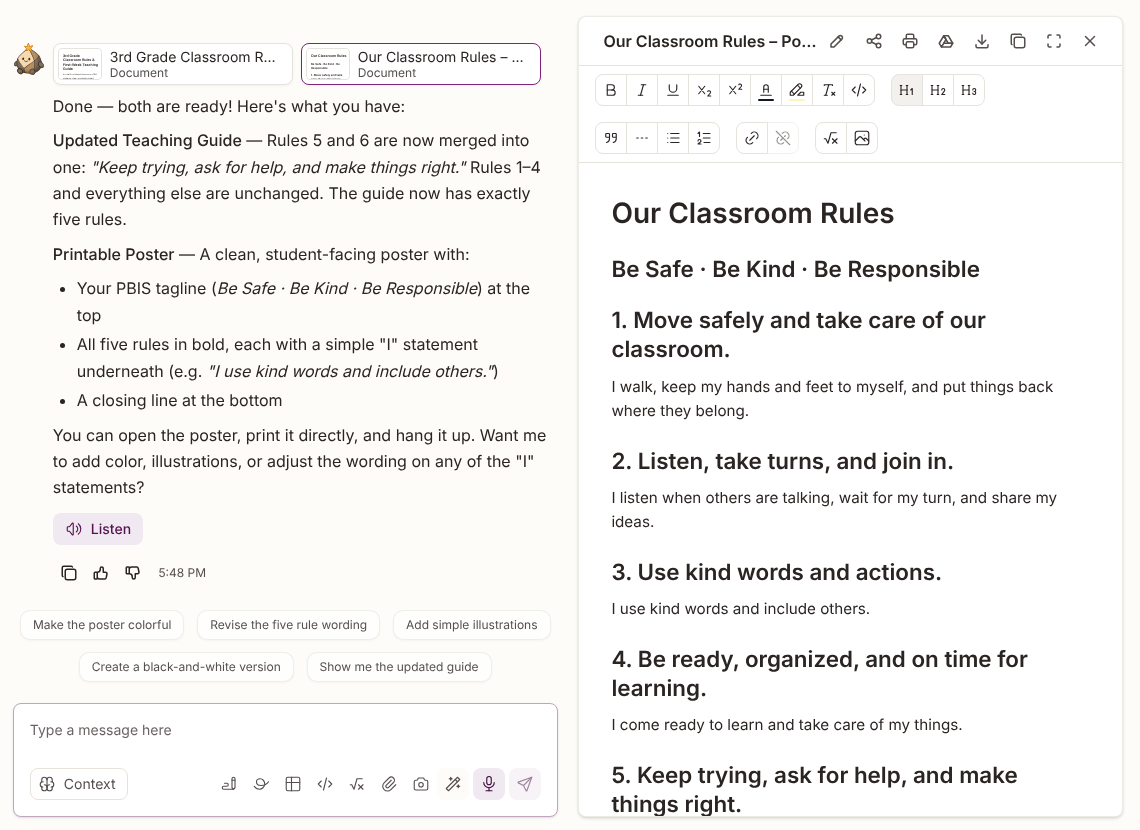
Read the output the way you would read a colleague's draft. Rule 5 now bundles three behaviors (keep trying, ask for help, repair harm), which is a lot for a third grader to hold as one rule, so you might split it or drop the repair part into your consequences plan. "On time" in rule 4 depends partly on families at this age. The poster is plain text; Sparky offered to add color or simple illustrations, and you can edit any wording in the document yourself.
Classroom rules for middle school
In middle and high school, IRIS suggests ordering rules by the behaviors that cause the most trouble at that age. For middle school, that is often talking without raising a hand and not following directions. Give a one-sentence reason with each rule: IRIS lists talking about why a rule matters as the second of its steps for teaching rules, after stating the rule.
1. Be in your seat working on the warm-up when the bell rings.
- Looks like: in a seat, notebook open, pencil moving at the bell.
- Why: "The first five minutes are when I check who needs help."
- Teach it: Have the warm-up on the board before students arrive every day of week one, short enough to finish in five minutes. Tell the class each day how many students were working at the bell.
2. Raise your hand in whole-class discussion; talk freely in partner time.
- Looks like: you name the mode at the start of each activity ("Hands up for this one" or "Turn and talk"), and students follow it.
- Why: "Some of you think out loud and some of you need quiet to think. This gives both a turn."
- Teach it: Switch between the two modes three or four times in one lesson on day two, so students hear the cue and practice the switch.
3. Keep your phone in your bag on silent from bell to bell, unless the task needs it.
- Looks like: the phone stays out of sight for the whole period.
- Why: Use your school's phone policy and its reasons, word for word, so the rule is the same in every room.
- Teach it: On day one, show where phones go and say what happens if one comes out. Then follow through the same way every time.
4. Bring a pencil, your notebook and your charged device every day.
- Looks like: all three on the desk when the warm-up starts. Drop the device if your school doesn't issue one.
- Why: "If you don't have them, you lose time you can't get back."
- Teach it: Tell students where the spare pencils are and how to borrow one without asking. Do a quick materials check at the bell for the first week.
5. Disagree with the idea, not the person.
- Looks like: "I disagree because…", and using a classmate's name, not a nickname or a label.
- Why: "You'll learn more if people aren't afraid to be wrong out loud."
- Teach it: Hold a two-minute debate on a silly question (is cereal a soup?) and stop it once to point out a good example of disagreeing with the idea.
The first week in middle school
Teach each rule where it applies, not all five in one speech on day one. Model the non-examples yourself, with some humor: walk in late with a snack and a phone in hand, and let students name everything that went wrong. Re-teach the rules after the first long weekend; IRIS recommends reviewing rules often, especially before transitions and when several students are struggling with one.
Classroom rules for high school
By high school, students have heard classroom rules every year. What changes behavior in your room is enforcing the same rule the same way for everyone. IRIS lists arriving on time and appropriate language as common issues at this age, which is why the first two rules below address them.
1. Be in your seat with the warm-up started when the bell rings.
- Looks like: seated and writing at the bell, not walking in as it rings.
- Teach it: Say on day one exactly what happens at the bell, then do it from the first day. Students learn the rule from what you do at the first late arrival, not from the poster.
2. Use language that would be fine in front of any adult in the building.
- Looks like: the same words a student would use with a coach or a teacher, including in jokes between friends.
- Teach it: Say on day one that slurs, put-downs and profanity are out, without reading a list of examples. Address the first slip in private, and address every slip.
3. Phones go in your bag when the bell rings.
- Looks like: phones out of sight until the end of class, except when an activity calls for them.
- Teach it: Follow your school's policy exactly so students hear one rule across their schedule.
4. Turn in your own work, and name any help you used, including AI.
- Looks like: a note at the end of an assignment listing a tutor, a classmate or an AI tool and what it helped with.
- Teach it: On day three or four, show two short examples of a help note, one complete and one vague, and have students say which one is honest.
5. If you miss class, check the class page and see me within two school days.
- Looks like: the student comes to you with questions, instead of you chasing them for missing work.
- Teach it: Show where the class page is and walk through it once on day one.
The first week in high school
Put the rules in the syllabus, but don't stop at reading them aloud. Give the reason for each rule in one sentence on day one, then spend the rest of the week enforcing them the same way for every student. A calm, predictable response each time teaches more than a long speech on the first day.
Short rule sets for labs, gym, art, music and online class
Some rooms need two or three rules of their own on top of your main set.
- Science lab: Goggles on from the start of the lab until every material is put away. Read the whole procedure before you touch any equipment. Tell the teacher about a spill or broken glass right away.
- PE: Freeze and hold your equipment still when you hear the whistle. Use each piece of equipment only for its game.
- Art: Return tools clean, to the labeled bin.
- Music: Instruments in rest position whenever someone is talking.
- Online class: Keep your mic off unless you're speaking. Type questions in the chat, and the teacher answers them at each pause.
Classroom rules for AI use
If your students use AI in class, three rules cover most situations. Pair them with your school's AI policy, or with a poster like The Stony Brook School's AI traffic light, which shows when AI is allowed for each kind of task.
- Use AI only when the assignment says you can.
- Check what the AI tells you against your notes or textbook before you use it.
- Say how you used AI: what you asked it and what you kept.
Flint makes the third rule easy to check. When students work in a Flint activity, the teacher who owns the activity can open each student's conversation with Sparky, and a student can click Cite session to get a citation for their conversation.
FAQ
How many classroom rules should you have?
Five or fewer. The IRIS Center at Vanderbilt University recommends no more than five, so students can remember them. Put everything else, such as lining up or handing in work, into procedures that you teach the same way.
What are 5 good classroom rules?
A set that works in most grades: be in your seat and working when class starts; raise your hand during whole-class discussion; keep hands, feet and supplies in your own space; talk about ideas, not people; put materials back where they belong. Adjust the wording for your students' age and sort the rules under your school-wide expectations.
Should students help write classroom rules?
Yes. In K-2, ask the class what helps them learn and turn their answers into rules yourself. From third grade up, students can draft the wording in a short class meeting. IRIS notes that students often suggest the same rules a teacher would, and follow them more willingly because they had a say. Keep any rule your school requires.
What is the difference between classroom rules and procedures?
A rule applies all day, in every activity, such as keeping your hands and feet in your own space. A procedure is the step-by-step way one task gets done, such as lining up or handing in papers. Keep rules to five or fewer and let procedures cover everything else.