ComparisonSep 29, 2026
Flint vs. Zero Gravity: exam-board tutor or whole-school AI platform?
Zero Gravity is an AI tutor built around UK exam board specifications for Years 7 to 13. Flint is a platform where teachers build AI activities on their own curriculum, from Reception to Year 13. A factual comparison for UK schools and trusts.

Zero Gravity and Flint both put an AI tutor in front of pupils, and both are in the government's AI Tutoring Pioneers programme. They start from different places. Zero Gravity is built around UK exam board specifications and mark schemes for Years 7 to 13. Flint is a platform where teachers build AI activities on their own curriculum, from Reception to Year 13, and can read every conversation pupils have.
The short version
- Zero Gravity suits secondary schools that want an exam-prep tutor for GCSE, A-level, IB or SQA pupils, with content already mapped to AQA, Edexcel, OCR and other boards, and answers checked against those boards' mark schemes.
- Flint suits schools and trusts that want one AI platform across every key stage, shaped by their own teachers and schemes of work, with pupil data stored in London, AI processing in the EU, and staff able to read every pupil conversation.
What each one is
Zero Gravity: an AI tutor built on exam board specifications
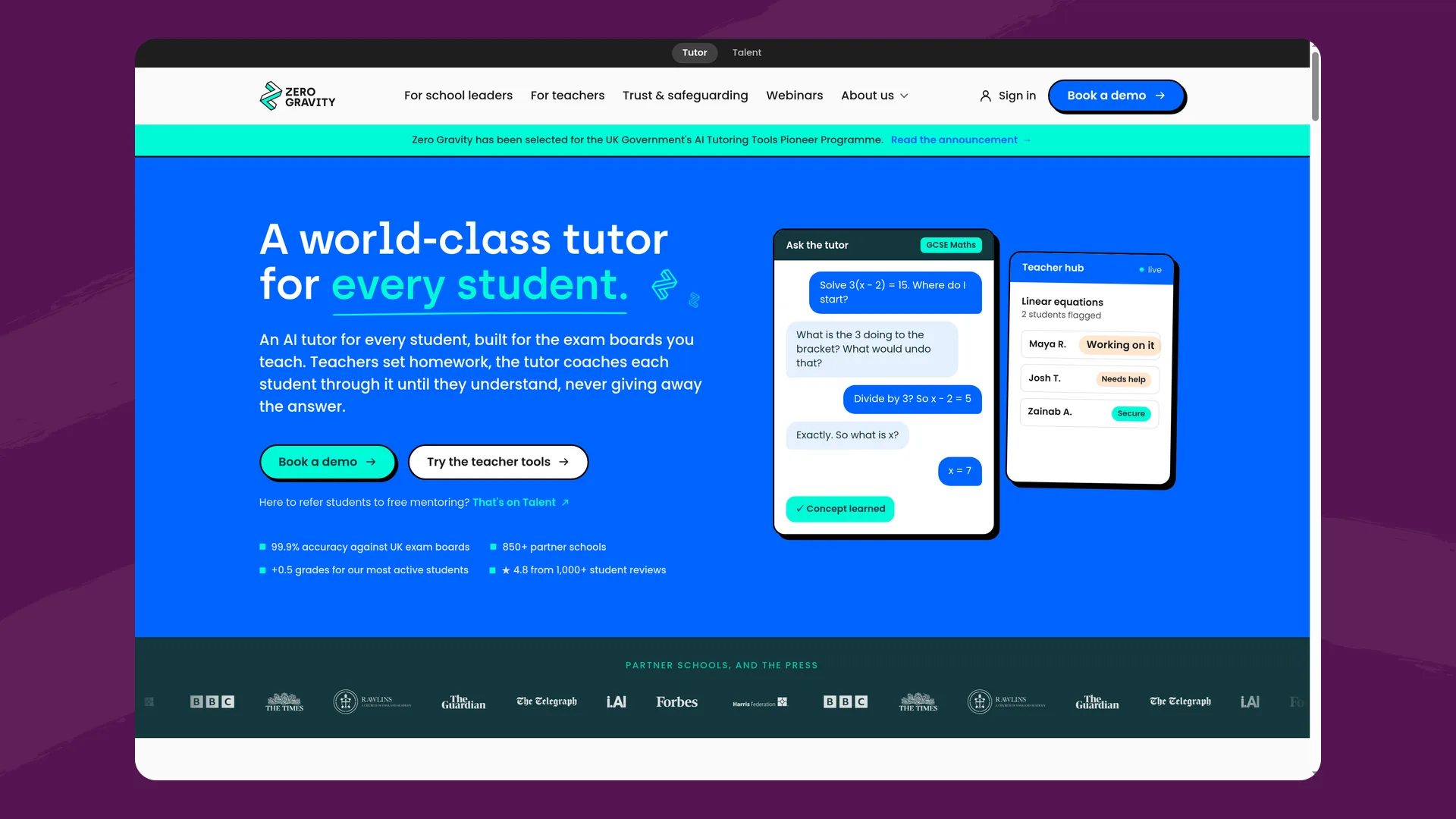
Zero Gravity's tutor page (zerogravity.co.uk/tutor), captured September 2026.
Zero Gravity describes its tutor as "an AI tutor for every student, built for the exam boards you teach". Pupils can ask the tutor for help, work through a short lesson on any topic in their specification, practise exam-style questions, or complete homework their teacher has set. The tutor coaches rather than giving answers.
It covers 40 subjects across seven exam boards (AQA, Edexcel, OCR including MEI, WJEC, Cambridge IGCSE, IB and SQA) and five routes: GCSE, IGCSE, A-level, IB and SQA. Zero Gravity says AQA, Edexcel and OCR "are complete at GCSE and A-level", while WJEC, Cambridge, IB and SQA "cover the core subjects". It's aimed at Year 7 to Year 13.
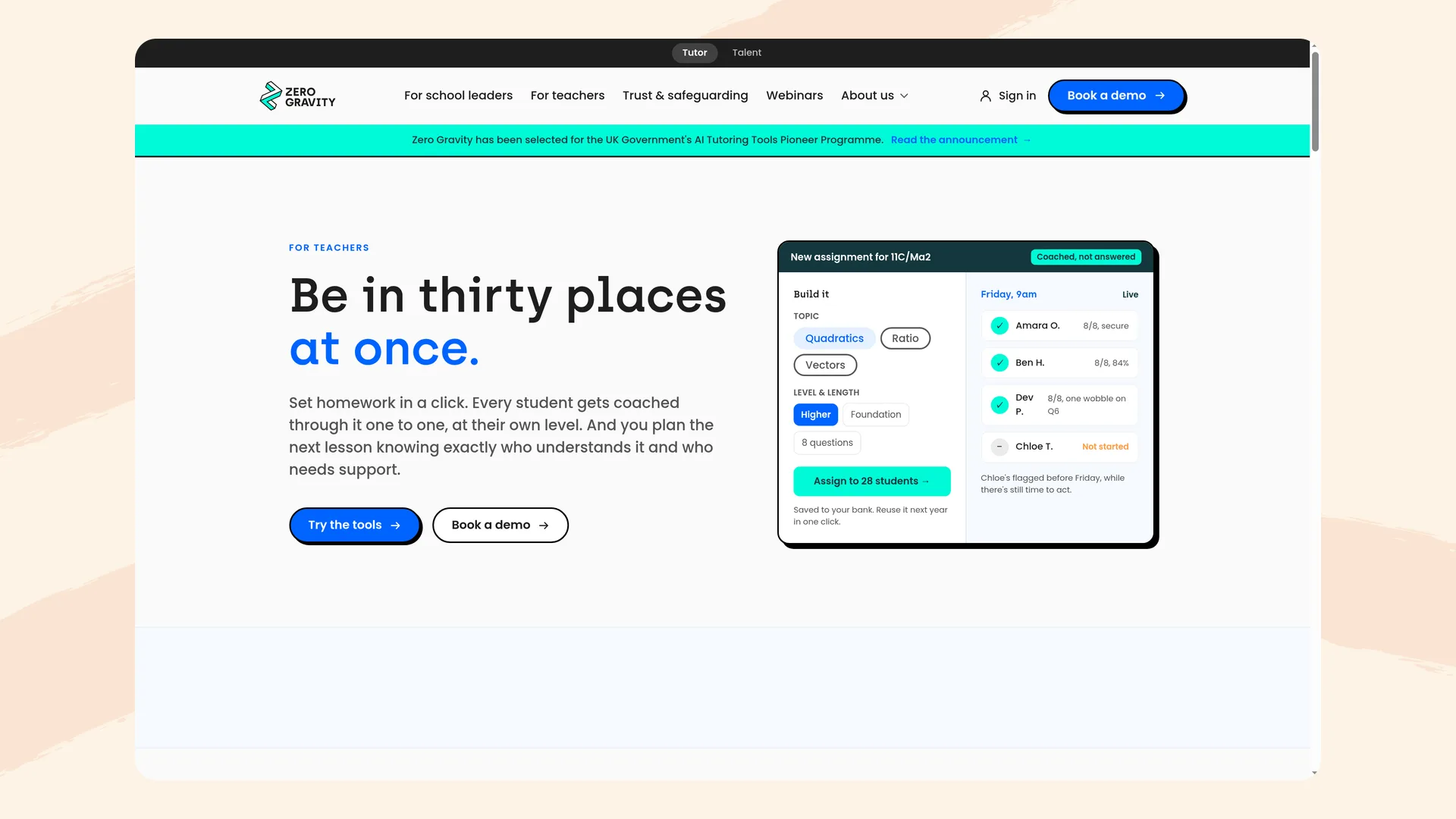
Zero Gravity's page for teachers (zerogravity.co.uk/tutor/teachers), captured September 2026.
For teachers, Zero Gravity sets homework in a click, generates "a full lesson plan, editable slides and a worksheet, grounded in your specification", and shows a live view of how each pupil is getting on and what to reteach. It says pupils at 850+ UK schools use it. The company also runs a free mentoring and scholarships programme that helps pupils from low-opportunity backgrounds into top universities and careers.
Flint: a platform where teachers build the AI activities
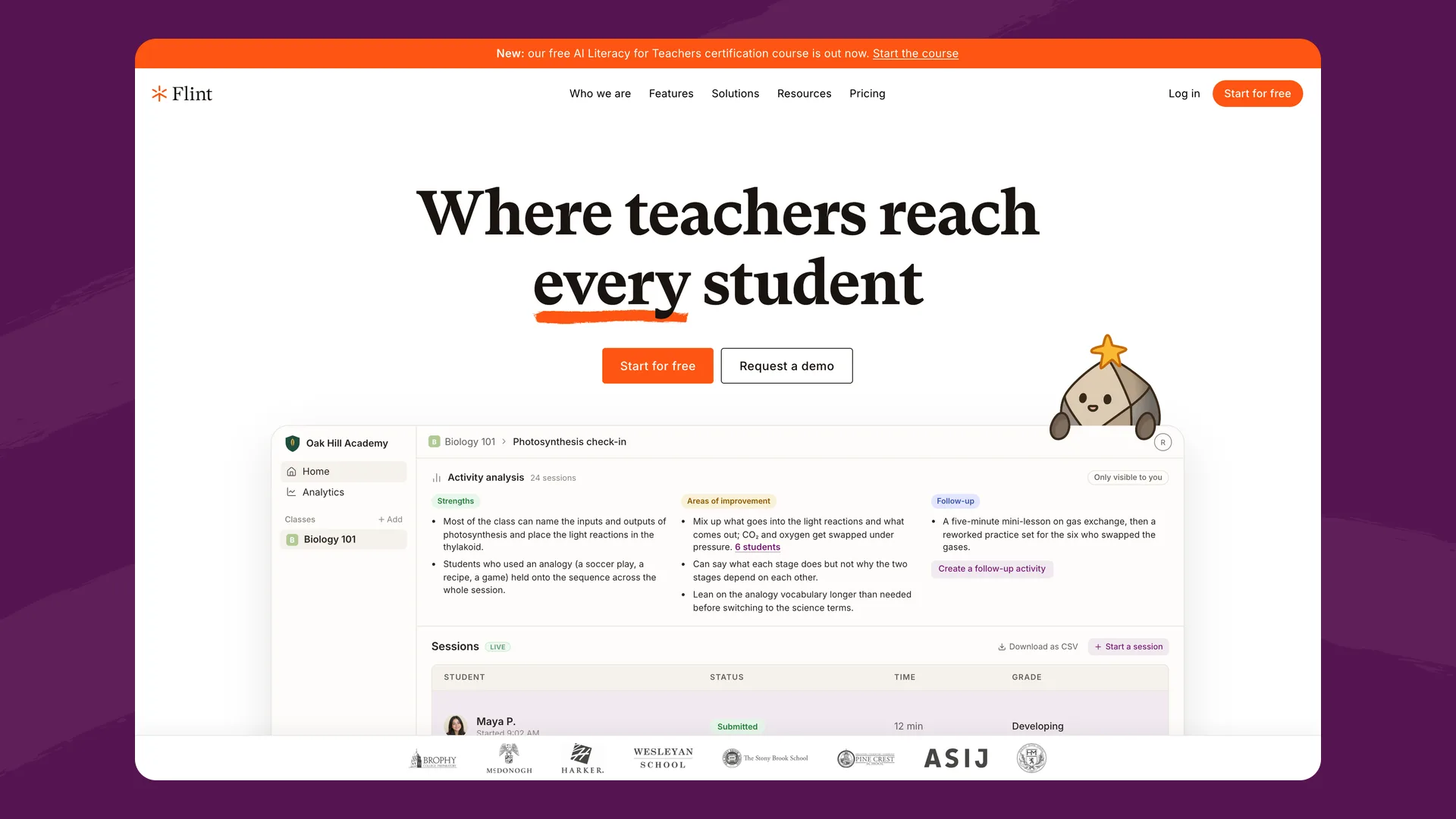
The Flint homepage (flintk12.com), captured September 2026.
Flint is a personalised learning platform. Teachers build AI activities (Socratic discussions, essay feedback, maths practice, revision, speaking practice) by describing what they're teaching and adding their own materials, and pupils work through them with Sparky, Flint's AI tutor. Sparky guides with questions and doesn't hand over answers or write work a pupil could hand in.

A pupil asks Sparky to write their thesis statement, and Sparky coaches them to write it themselves. The pupil is an example.
Teachers and school leaders can read every pupil conversation. Sparky marks pupils' work against the teacher's rubric, and the Outcomes view in analytics shows which curriculum objectives each class has covered and where the gaps are. Trust leaders see analytics across every school, while each school sets its own AI guidelines and moderation rules.
UK schools use a separate UK deployment at uk.flintk12.com, with UK year groups from Nursery and Reception to Year 13.
Comparison table
| Flint | Zero Gravity | |
|---|---|---|
| Main job | AI activities teachers build on their own curriculum | Exam-prep tutor built on exam board specifications |
| Year groups | Nursery and Reception to Year 13 | Year 7 to Year 13 |
| Ready-made curriculum | National Curriculum programmes of study (KS1 to KS4) and DfE GCSE subject content for 33 subjects | 40 subjects across 7 exam boards: GCSE, IGCSE, A-level, IB, SQA |
| A school's own curriculum | Upload schemes of work or exam board specifications; Flint pulls out the objectives for teachers to check | Homework built from teachers' own material (Zero Gravity); no scheme-of-work import described |
| Marking | Sparky marks work against the teacher's rubric | Answers checked against exam board mark schemes |
| Teacher tools | Activity builder, conversation review, rubric marking, curriculum analytics | Homework assignments, lesson and worksheet generation, class gap analysis |
| Staff view of pupil conversations | Teachers and admins can read every conversation | Teachers can open any pupil's full conversation, plus a summary; access scoped by role (Zero Gravity) |
| Safeguarding alerts | Email to chosen staff; up to 20 custom categories; self-harm alerts always immediate | Three-level crisis protocol with alerts to the DSL |
| Pupil data stored | London | London, including backups |
| AI processing | EU (Claude via Amazon Bedrock EU, OpenAI EU) | Anthropic, OpenAI and Google in the US |
| Sign-in and rostering | Google and Microsoft; SIMS, Bromcom, Google Classroom, Microsoft Teams | Google and Microsoft; MIS integration such as Bromcom or Arbor |
| Published prices | Free up to 80 users; from $3,000£2,234 a year | None published |
Curriculum and marking
This is where the two differ most, and where UK schools should look hardest.
Zero Gravity's curriculum is the exam specification. Its content is organised by board, qualification and topic, and it says every answer is grounded in the specification and mark scheme. For a Year 11 pupil revising AQA Chemistry, that's a close fit out of the box. Zero Gravity reports 99.9% accuracy "against UK exam board mark schemes on our 2026 benchmark", compared with about 67% for general AI tools, and says its most active pupils gained half a grade in summer 2026 exams against classmates who didn't use it. Both are Zero Gravity's own figures; the benchmark methodology is available from Zero Gravity rather than published.
Flint's curriculum is whatever the school teaches. A school can adopt the National Curriculum programmes of study for KS1 to KS4, or the DfE's GCSE subject content for 33 subjects, in one click. A department can also upload its own scheme of work or its AQA, Edexcel or OCR specification, and Flint pulls out the learning objectives for a teacher to check. Activities are then tagged to those objectives, and Sparky assesses each pupil's work against them as well as against the teacher's rubric. The Outcomes view shows heads which objectives each class has covered, which is evidence of curriculum coverage rather than a count of logins.

Adopting National Curriculum in England programmes of study in Flint. Captured September 2026.
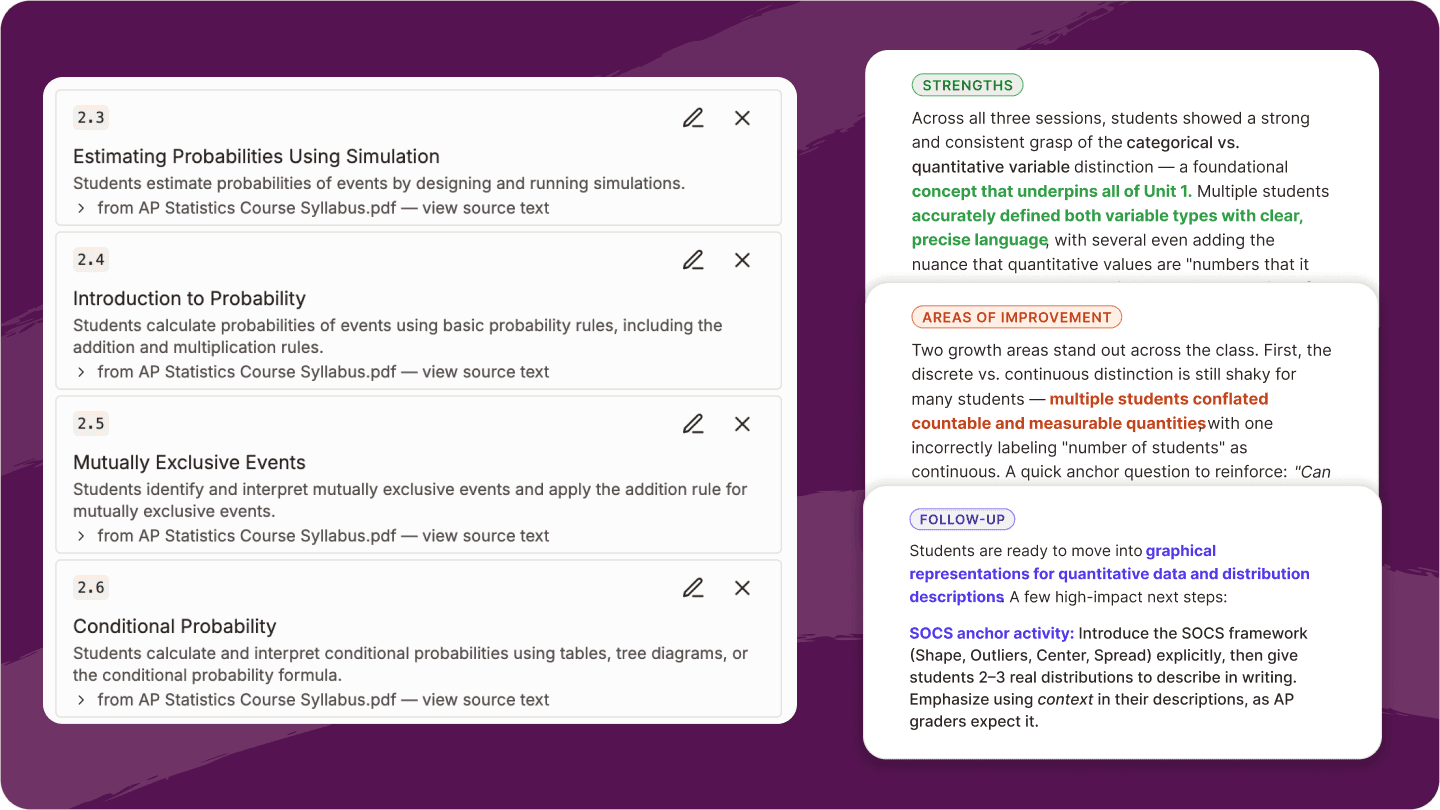
Learning objectives Flint pulled out of an uploaded syllabus (left), and Sparky's summary of what the class has grasped and where it's still shaky (right). Shown with a US AP Statistics syllabus.
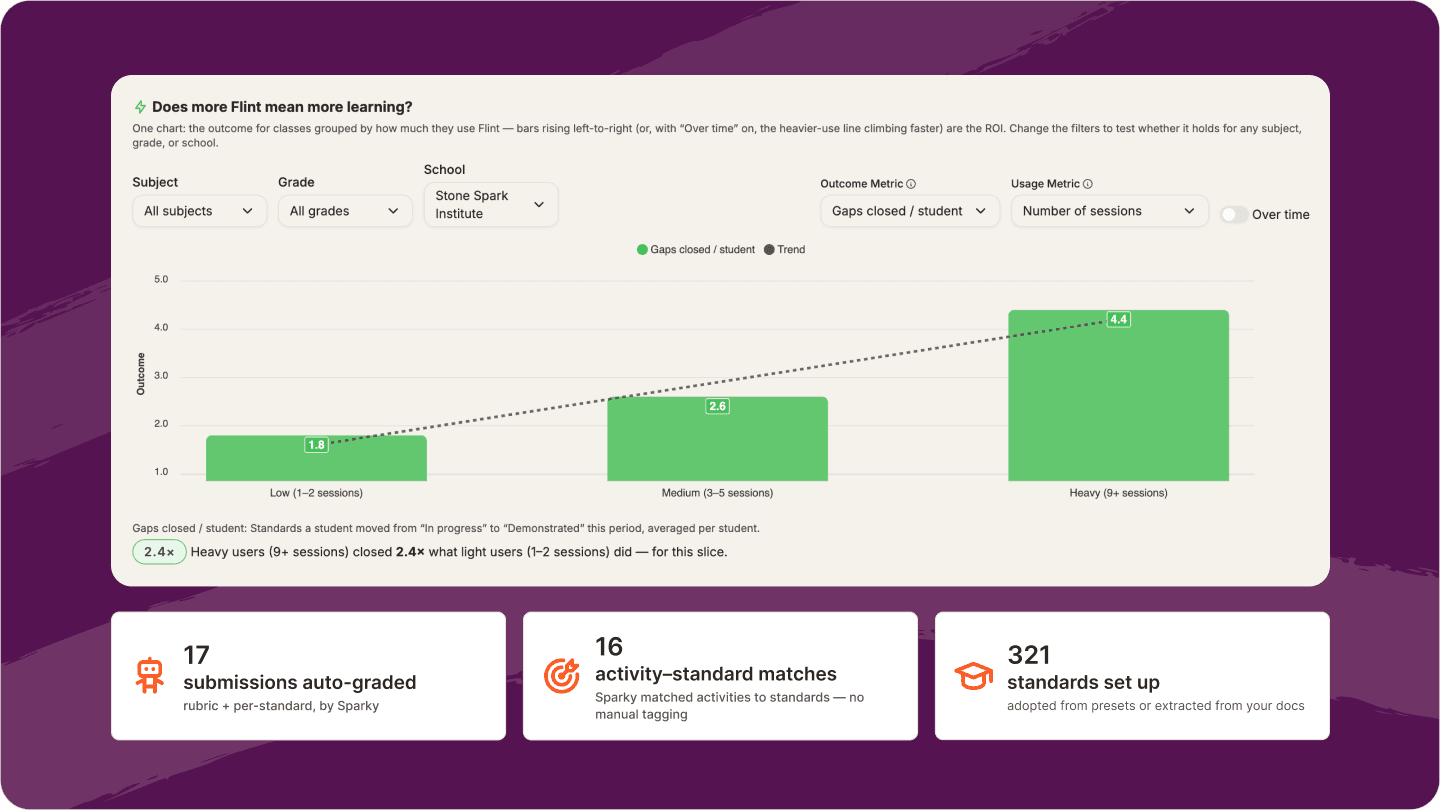
The Outcomes view compares how much pupils use Flint with how many learning objectives they move from "In progress" to "Demonstrated". Example data.
The practical difference: Zero Gravity has exam board mark schemes built in for 40 subjects. Flint doesn't. Flint teachers set the marking criteria themselves, which can follow their board's mark scheme, and Sparky marks against those. Flint also covers primary: for a trust with primary schools, KS1 and KS2 run on the same platform as secondary.
Pricing
Zero Gravity doesn't publish prices. Its page for school leaders says "pricing is agreed with your leadership team", that teachers can try the tools for free, and that pupil access comes with a whole-school rollout. The tutor was free for pupils during the 2026 exam season; pupils now get access through their school.
Flint is free for up to 80 users, counting staff and pupils, so a free pilot includes real pupil use. Paid plans start at $3,000£2,234 a year for up to 150 users and include SIS integration, school-wide analytics and training for staff.
Data, privacy and safeguarding
Both companies say they don't use pupil data to train AI models, and both describe how they meet the DfE's generative AI product safety standards. Zero Gravity holds ISO/IEC 27001:2022 and Cyber Essentials Plus.
Where pupil data goes. Zero Gravity's privacy policy, last updated 6 October 2026, says "Zero Gravity Tutor data, including file storage and backups, is hosted in the UK (AWS London region)". It also says pupils' messages and any images they upload are "transferred to Anthropic, OpenAI and/or Google in the United States for processing". Flint also stores pupil data in London, and AI conversations run through Amazon Bedrock with EU-only routing, with image generation and speech through OpenAI's EU endpoint. A few supporting services, such as web search, sit outside the UK and EU; Flint's sub-processor list names every provider.
What staff can see. Flint's class teachers and school admins can read every pupil conversation, and pupils can't delete them. Zero Gravity's security page says "Teachers can open any student's full conversation with the tutor", alongside a summary of engagement and where each pupil got stuck, with access "scoped by role" and safeguarding flags going to the staff a school names. Its school leaders page says "your teachers can open every conversation."
Safeguarding alerts. Zero Gravity's safeguarding policy sets out three levels: standard concerns are signposted and logged, high-level concerns send a notification to the DSL, and critical concerns direct the pupil to Childline or Shout and send an alert to the DSL, which schools agree to acknowledge within one working day. Flint checks every pupil message for self-harm, violence, harassment, hate, sexual content, illicit content and relationship-building, and schools can add up to 20 categories of their own. Alerts go by email to the staff a school chooses, and self-harm alerts are always sent immediately.
Younger pupils. Both serve pupils under 13 only through accounts their school sets up.
Where Zero Gravity is the better fit
- If your priority is GCSE and A-level revision, Zero Gravity's content is already organised around your boards' specifications and mark schemes, with exam-style practice for 40 subjects.
- With Zero Gravity, teachers pick a topic and level and get homework, a lesson or a worksheet mapped to the specification, without writing prompts or uploading materials.
- Zero Gravity's free mentoring and scholarships programme for pupils from low-opportunity backgrounds is something Flint doesn't offer.
Where Flint is the better fit
- Flint runs from Reception to Year 13 on one platform, with trust-wide analytics and school-level settings.
- Teachers build activities on their own schemes of work and specifications, from Year 3 reading to A-level history essays, and see coverage against the objectives they've chosen.
- Both store pupil data in London, but Flint's AI processing stays in the EU, which some DPOs and IT leads will require.
- You can try Flint before talking to anyone: it's free for up to 80 users, with published prices after that.
Flint has gaps of its own. We don't ship exam board mark schemes. Safeguarding alerts arrive by email rather than going straight into CPOMS or MyConcern. Parts of the interface still use US wording, such as "standards" where UK teachers would say "specification points", and list prices are in dollars. We're working through these with the schools in the AI Tutoring Pioneers programme.
The bottom line
If you want an exam-prep tutor for secondary pupils, mapped to AQA, Edexcel, OCR and the other boards, Zero Gravity is a strong choice built for exactly that.
If you want one AI platform across the whole school or trust, shaped by your own teachers and curriculum, with pupil data in London, AI processing in the EU and every conversation visible to staff, that's what Flint is built for. You can start free with up to 80 users, or email Alex McPherson, our UK Special Projects Lead, at alex@flintk12.com to talk through a rollout for your school or trust.
Last updated: October 2026
