ComparisonSep 26, 2026
Flint vs. ChatGPT for Teachers: general-purpose AI platform or classroom learning system?
ChatGPT for Teachers gives educators free access to GPT-5.1 through June 2028. Flint is a classroom learning system where students work with AI under teacher supervision. The student access question is more complicated than it looks.

ChatGPT for Teachers is OpenAI's free offering for K-12 educators — a full-featured workspace powered by GPT-5.1, with district-level admin controls and a growing set of education-specific tools. Flint is a classroom learning system built for students and teachers together.
On the surface, the comparison looks similar to other teacher-AI-platform vs. student-learning-system matchups. But ChatGPT for Teachers has something Claude for Teachers and other educator tools don't: a partial student story. OpenAI models reach students through Canvas LMS integration, ChatGPT's study mode adds Socratic-style prompting, and teens can now use ChatGPT consumer accounts with parental consent. The question this raises is whether those pieces add up to a classroom learning system — or whether they're features bolted onto a general-purpose platform.
The short version
- Use ChatGPT for Teachers if your primary goal is giving educators access to a powerful, free general-purpose AI for their own work — lesson planning, material creation, data analysis — with strong admin controls and a generous free period through June 2028.
- Choose Flint if your primary goal is student learning: AI tutoring that students interact with directly, under teacher supervision, with every conversation visible and every activity designed around what's being taught.
Many schools will use both. But whether students should learn with AI — and what that learning should look like — is the question that separates these products.
What each is
ChatGPT for Teachers: a premium AI workspace for educators
ChatGPT for Teachers gives verified US K-12 educators free access to OpenAI's GPT-5.1 model through June 2028 — the same capabilities that normally require a paid ChatGPT subscription. Teachers get unlimited messages, deep research, file uploads, voice mode, image generation, and web search. Teachers could also build custom GPTs and share them across their school, but OpenAI is retiring custom GPTs on every ChatGPT plan on December 11, 2026 and moving creators to plugins. A migrated plugin starts private, and OpenAI says migration doesn't give anyone else access to it.
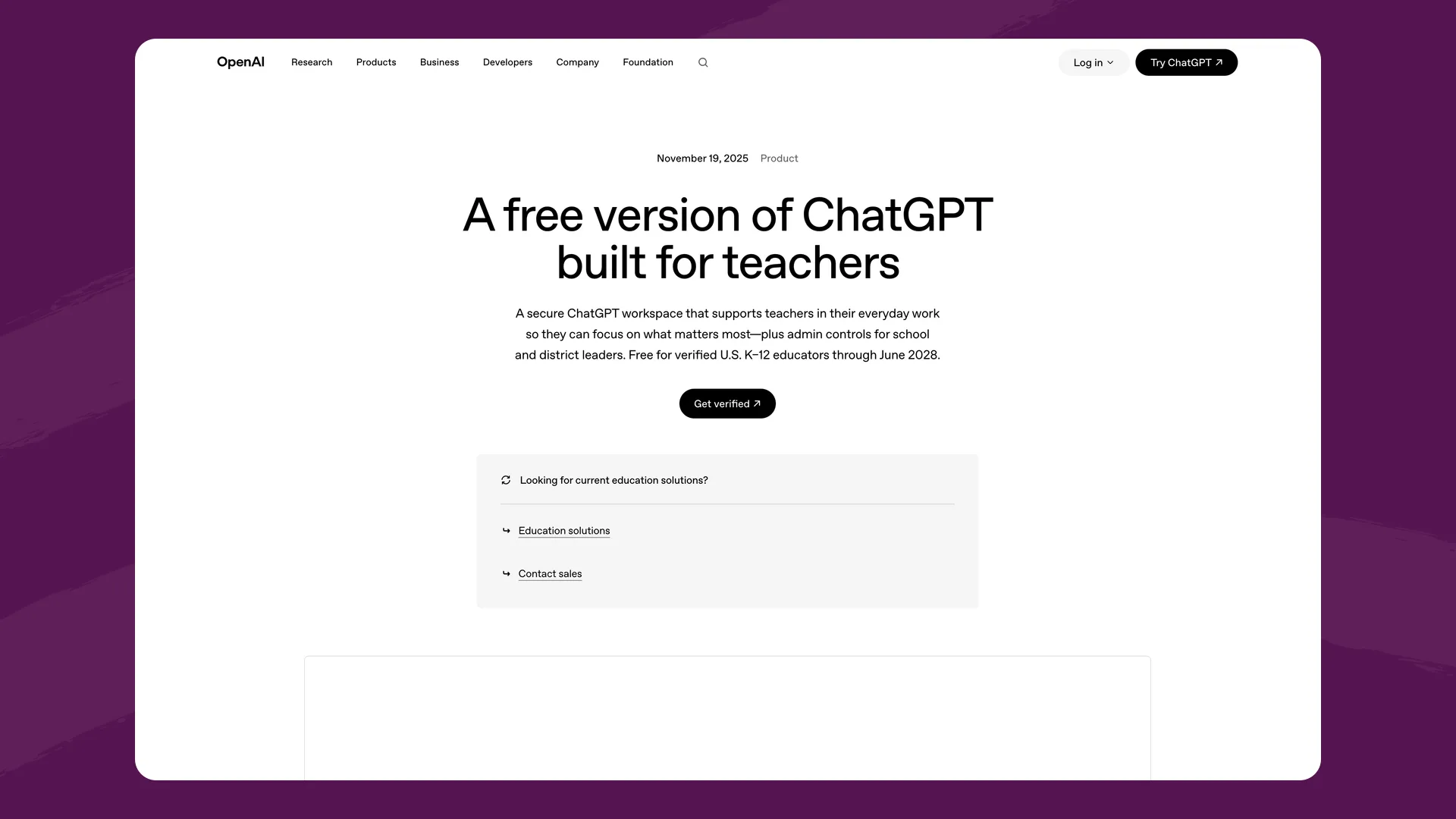
OpenAI's ChatGPT for Teachers announcement (openai.com), captured September 2026.
For districts, it includes real governance tools: SAML SSO, role-based access controls, domain claiming, and usage analytics. OpenAI has signed a 16-state National Data Privacy Agreement through the Student Data Privacy Consortium, and conversations are not used to train models by default.
ChatGPT Edu, OpenAI's institutional offering (chatgpt.com), captured September 2026.
The adoption numbers are significant. OpenAI reports 103+ partner districts across 30 states, with 340,000+ educators and staff on the platform. A five-year partnership with the American Federation of Teachers aims to train 400,000 educators on AI fluency.
What ChatGPT for Teachers does not include: student accounts. The product is designed for teachers, administrators, and staff. Students cannot log in or interact with it directly.
But OpenAI models do reach students — through other channels
This is where ChatGPT for Teachers gets more interesting than a simple adults-only offering.
Canvas LMS integration. In July 2025, Instructure and OpenAI announced a global partnership embedding OpenAI's models into Canvas — the LMS used by over 8,000 schools. Teachers can create "LLM-Enabled Assignments" where students interact with AI directly inside Canvas, with no ChatGPT account required. The teacher defines learning goals, the AI guides students through practice, and Canvas captures evidence of learning tied to rubrics and standards. Student data stays with the school, not OpenAI.
Study mode. OpenAI introduced a "study and learn" mode in ChatGPT that switches the AI from answering questions directly to asking Socratic follow-up questions, providing hints, and scaffolding understanding. It's available on free and paid ChatGPT accounts and rolling out to education workspaces.
ChatGPT for Teens. Separately from the education offering, ChatGPT now allows users aged 13–17 on consumer accounts with parental consent, with age-appropriate protections and optional parental controls.
These are three different products with three different governance models. None of them is ChatGPT for Teachers. But collectively, they mean OpenAI has a presence in the student experience that Anthropic, for example, does not. The question is what that presence looks like compared to a purpose-built classroom system.
Flint: a classroom learning system where AI activities are the product
Flint is built around AI activities that students complete: tutoring sessions, writing feedback, speaking practice, quiz review, simulations, and study sessions that teachers create by describing what they're teaching. The AI works with each student one-on-one — asking questions instead of giving answers, adjusting difficulty, and staying grounded in the materials the teacher uploads (PDFs, slides, links, rubrics, curriculum standards).
Around that core, Flint includes what schools need to run AI at scale:
- Full visibility: teachers see every message students exchange with the AI; administrators see every conversation school-wide, with automatic flagging of concerning content (self-harm, violence, harassment) for review
- Structured hierarchy: district → school → term → class → activity → conversation — not a flat list of chat transcripts
- Feedback and grading: rubric-based feedback with evidence, session summaries for students, teacher override on any AI-suggested grade
- Accessibility: text-to-speech and speech-to-text in 200+ dialects, 50+ languages, ACTFL/CEFR level controls for world language classes, automatic leveling for students with learning differences
- Teacher tools too: Flint's activity builder, differentiation tools, and analytics cover much of the planning and feedback workload — the difference is these exist to power student learning, not as standalone generators
The student access question is more complicated than it looks
ChatGPT for Teachers itself is adults-only. But OpenAI models reach students through at least three pathways, each with a different governance surface:
1. Canvas LMS (Instructure partnership). Students interact with OpenAI models inside Canvas assignments. The teacher sets learning goals, the AI guides practice, and Canvas captures evidence. This is the closest thing to a classroom AI experience in the OpenAI ecosystem — but it's Instructure's product, not OpenAI's. Canvas's IgniteAI framework is model-agnostic: it also supports Claude and Gemini. If a school uses Canvas + OpenAI, they're managing two vendors, two DPAs, and two governance surfaces. And the AI provider is interchangeable — there's nothing OpenAI-specific about the student experience.
2. Study mode (ChatGPT consumer product). Study mode toggles ChatGPT's behavior from answering directly to asking Socratic questions and providing hints. It runs on custom system instructions rather than a trained model behavior, and OpenAI says that choice may result in "some inconsistent behavior and mistakes across conversations." It doesn't ground responses in teacher-uploaded materials, adapt to ACTFL/CEFR proficiency levels, provide rubric-based feedback, or show the teacher what the student is doing. A student using study mode is having a conversation with ChatGPT that happens to be more Socratic. There's no connection to what's being taught in their classroom.
3. ChatGPT for Teens (consumer product, 13+). Teens can use ChatGPT with parental consent, with age-appropriate safety protections and optional parental controls. This is entirely separate from the school product — there's no teacher visibility, no classroom structure, no institutional governance. Schools don't control or see these accounts.
Flint's approach is different in kind, not degree. Every student conversation happens inside an activity a teacher created, grounded in materials the teacher uploaded, with every message visible to the teacher and administrators. The AI doesn't just happen to be Socratic — it's constrained by the teacher's curriculum, adapted to the student's level, and supervised in real time. There's no toggle to turn off, no separate consumer product running alongside the school deployment, no second vendor managing the student-facing layer.
Study mode is Socratic prompting, not Socratic tutoring
OpenAI's study mode is a meaningful step. Instead of handing students an answer, ChatGPT asks follow-up questions, provides hints, and tries to guide understanding. For a general-purpose chatbot, that's a significant behavioral change.
But there's a structural difference between prompting a general-purpose model to be Socratic and building a tutoring system around pedagogical goals.
Study mode doesn't know what the student is supposed to be learning. It can't reference the teacher's lesson plan, uploaded readings, or rubric. It can't adjust its approach based on whether the student is an AP Physics student or an ELL newcomer working at ACTFL Novice-Mid. It doesn't produce session summaries, rubric-aligned feedback, or evidence of learning that a teacher can review. And it operates inside the consumer ChatGPT interface — if the student turns off study mode, ChatGPT goes back to giving direct answers with no teacher awareness.
Flint's tutoring is built around the teacher's curriculum. The AI stays grounded in uploaded materials, adapts difficulty to the student's demonstrated level, asks questions calibrated to what the teacher wants students to learn, and generates rubric-based feedback with cited evidence from the conversation. For STEM subjects, Flint pairs the AI with a built-in calculator, 2D/3D graphing, and web search for current sources, reducing the hallucination risk of raw model output. For world languages, ACTFL/CEFR level controls ensure the AI's vocabulary and grammar stay appropriate for each student's proficiency.
The difference isn't whether the AI asks questions instead of giving answers. It's whether the Socratic interaction is connected to what a specific teacher is teaching in a specific classroom.
Canvas integration is a partnership, not a product
The Instructure-OpenAI partnership is real and worth understanding. LLM-Enabled Assignments in Canvas let teachers define learning goals in natural language, and students interact with AI that's guided by those goals, with evidence of learning captured in the gradebook.
Three things to consider:
It's Instructure's product running on OpenAI's models (among others). Canvas's IgniteAI framework supports multiple AI providers — including Claude and Gemini. The student-facing experience is identical regardless of which model is powering it. If your school is evaluating whether to commit to OpenAI's ecosystem for education, the Canvas integration isn't an argument for OpenAI specifically; it's an argument for Canvas.
It's a separate governance surface from ChatGPT for Teachers. A district running ChatGPT for Teachers for staff and Canvas + OpenAI for students is managing two products, two vendor relationships, two DPAs, and two admin consoles. The teacher's ChatGPT workspace and the student's Canvas AI assignment are different systems with different data flows.
It doesn't provide the full infrastructure schools need for AI-powered learning. Canvas captures evidence of learning from AI interactions, which is valuable. But it doesn't include the moderation layer (automatic flagging of concerning student messages for administrator review), the hierarchical visibility (principal → department → teacher → student), the cross-platform rostering, or the accessibility features (200+ speech dialects, ACTFL/CEFR levels, automatic leveling) that a purpose-built classroom AI system provides.
Flint is a single platform where the teacher experience and the student experience are part of the same system, under one vendor, one DPA, and one governance surface.
Feature comparison
| Flint | ChatGPT for Teachers | |
|---|---|---|
| Primary focus | Student learning (AI tutoring + activities) | Teacher productivity (general-purpose AI) |
| Student access | Core product: students interact with AI directly | Not available directly; OpenAI models reach students through Canvas LMS (separate product) |
| Student AI experience | Socratic tutoring, adaptive practice, open-ended learning in any subject | Via Canvas: LLM-Enabled Assignments with teacher-defined goals. Via ChatGPT: study mode (consumer product) |
| Teacher AI experience | Activity builder, differentiation tools, feedback/grading, analytics | Full ChatGPT workspace with GPT-5.1, deep research, file uploads, voice mode; custom GPTs until December 11, 2026 |
| Classroom structure | District → school → class → activity → conversation | Flat: individual teacher/staff accounts with admin dashboard |
| Conversation visibility | Every student message visible to teachers and admins | Teacher's own conversations only; Canvas AI interactions visible in Canvas gradebook |
| Content moderation | Automatic flagging of concerning content for admin review | N/A in ChatGPT for Teachers (no student content); Canvas has separate moderation |
| Socratic tutoring | Core architecture: grounded in teacher materials, adapted to student level | Study mode: system-prompt toggle on consumer ChatGPT, not grounded in teacher curriculum |
| SIS/LMS integration | Canvas, Schoology, Google, Microsoft, Moodle, Blackboard; Veracross, Blackbaud, PowerSchool, OneRoster | SSO, RBAC, domain claiming; LMS integration through Canvas partnership (separate product) |
| AI models | Anthropic and OpenAI models (a more capable model on paid plans) + calculator, graphing, web search, translation | GPT-5.1 + deep research, voice mode, image generation |
| STEM tools | Built-in calculator, 2D/3D graphing, web search for current sources | General-purpose (no education-specific STEM tooling) |
| Accessibility | 50+ languages, 200+ speech dialects, ACTFL/CEFR levels, automatic leveling | Standard ChatGPT interface |
| Browser support | Chrome, Safari, Firefox, Edge — any device, no install | ChatGPT.com (any browser); K-12 Educator Plugin in ChatGPT Work |
| Students under 13 | Yes, with school COPPA consent | No (ChatGPT for Teachers is 18+; ChatGPT for Teens is 13+ with parental consent, no school governance) |
| Free tier | Free for up to 80 users (teachers + students, all features) | Free for verified US K-12 educators through June 2028 |
| Data training | Never trains on user data | Never trains on ChatGPT for Teachers conversations |
Pricing
ChatGPT for Teachers is free for verified US K-12 educators through June 2028, with advance notice before any pricing changes. That's a generous runway — longer than most free education AI offerings. OpenAI hasn't published post-2028 pricing, but the offering is per-educator (students aren't part of the product), so future costs will scale with staff headcount.
Flint is free for up to 80 users — and those users include students, teachers, and administrators, so a pilot includes real classroom use from day one. Paid school plans start at $3,000£2,234/year for up to 150 users (about $1.67£1.24/user/month) and scale down from there, including SIS/LMS integration, school-wide analytics, a dedicated customer success manager, and unlimited professional development sessions.
The cost comparison is worth thinking about carefully. ChatGPT for Teachers covers educators. Flint covers the whole school community — teachers and students — under one price. If your school has 50 teachers and 500 students, ChatGPT for Teachers covers the 50 teachers; Flint covers all 550.
If your school also uses Canvas with OpenAI's models for student-facing AI, that's a separate product with separate costs and governance — it doesn't come bundled with ChatGPT for Teachers.
Privacy and safety
Both Flint and OpenAI take data privacy seriously.
ChatGPT for Teachers is FERPA-aligned with a Student Data Privacy Agreement. OpenAI holds SOC 2 Type 2 and ISO 27001 certifications. A 16-state National Data Privacy Agreement has been signed through the Student Data Privacy Consortium. Conversations are not used for model training by default. Districts get SSO, domain claiming, RBAC, and usage analytics.
Flint is GDPR-compliant and FERPA-aligned, supports students under 13 through school consent, never uses any user data to train AI models, and has signed state DPAs in Illinois, Massachusetts, Maine, New Hampshire, New York, Rhode Island, and Vermont, with custom DPAs available. See our security page for the full picture.
Where the two differ most is what kind of data exists to protect. ChatGPT for Teachers contains teacher conversations — no student data unless a teacher inputs it manually. Flint contains the full record of every student-AI interaction, which means it carries more data and must protect it at a higher standard. That's also why Flint's moderation system exists: automatic flagging of concerning student messages (self-harm, violence, harassment) for administrator review — a layer that ChatGPT for Teachers doesn't need because students aren't in the system.
For schools using Canvas + OpenAI for student-facing AI, note that the data governance is split: ChatGPT for Teachers is under OpenAI's education DPA, while student interactions in Canvas are under Instructure's data policies with OpenAI as a subprocessor. That's two governance surfaces to manage.
Where ChatGPT for Teachers is the better fit
- If teachers already use ChatGPT, formalizing access with admin controls, SSO, and a school workspace is a straightforward win. It turns shadow AI usage into governed usage, with no cost through 2028.
- If your school wants teachers to build with AI before committing to a student-facing platform, ChatGPT for Teachers is a strong starting point. Teachers can try AI on department rubric checks, IEP drafts and parent communication without writing code. Don't build the pilot around custom GPTs, though: OpenAI retires them on December 11, 2026.
- If you're an AFT-affiliated district, the five-year OpenAI-AFT partnership offers structured training and AI literacy resources specifically for union educators.
- If free matters more than anything right now. ChatGPT for Teachers is free through June 2028 with no usage caps on messages. For schools that need to get AI into teachers' hands immediately with zero budget, the long free period is a real advantage.
Where Flint is the better fit
- If students are the point. Flint's AI tutoring is open-ended, Socratic, and grounded in teacher materials — built to make students think, not to hand them answers. Research increasingly supports this model when it's built pedagogically.
- If you need to answer "what are students saying to the AI?" Message-level visibility for teachers and administrators, automatic safety flagging, and moderation workflows are a different tier of accountability than usage dashboards.
- If you want a single platform, not a patchwork. ChatGPT for Teachers for staff, Canvas + OpenAI for students, study mode on consumer accounts, ChatGPT for Teens at home — that's four products with four governance surfaces. Flint is one platform, one DPA, one admin console.
- If pricing predictability matters. Published pricing, students included, no multi-year free period that creates dependency before renewal decisions.
- If you serve diverse learners. 50+ languages, 200+ speech dialects, ACTFL/CEFR level controls for world language classes, and automatic leveling for students with learning differences.
- If you want a partner, not just a product. Every paid Flint license includes unlimited PD sessions, 1-1 teacher onboarding, and live chat support. Schools like Brophy Prep, McDonogh, and Durham Academy have used that partnership to drive school-wide adoption.
The bottom line
ChatGPT for Teachers is a powerful, free AI workspace for educators. OpenAI has also made moves toward student-facing AI — through Canvas, study mode, and teen accounts — that go further than any other frontier AI lab.
But those student-facing pieces are separate products with separate governance, and none of them provides the structured classroom learning system that schools need when AI is part of how students learn. Canvas integration is Instructure's product (model-agnostic, not OpenAI-specific). Study mode is a toggle on a consumer chatbot (not grounded in teacher curriculum). Teen accounts are unmanaged consumer products (no school visibility).
Flint is built around the premise that student-AI interaction should be designed, supervised, and connected to what's being taught — from the ground up, in a single system.
Some schools run both — ChatGPT for Teachers for staff productivity, Flint for the classroom. But if you're choosing one platform to define how AI shows up in student learning, the question is whether you need a general-purpose AI platform with education features added around the edges, or a classroom system where every interaction is designed for learning and visible to the people responsible for students.
The easiest way to compare is to try it: Flint is free for up to 80 users, or you can book a demo and we'll walk through your school's specific goals.
