ComparisonSep 10, 2026
Flint vs. Carnegie Learning: AI platform or AI-powered curriculum?
Carnegie Learning sells curriculum with adaptive AI built in; Flint is an AI platform that works with the curriculum you already have. They solve different problems — here's how to tell which one you're solving.

Most "Flint vs. X" comparisons put two AI platforms side by side. This one is different, because Carnegie Learning isn't really an AI platform — it's a curriculum company with AI inside. Understanding that distinction is the whole comparison.
Carnegie Learning grew out of Carnegie Mellon University's cognitive science research in 1998 and has spent nearly three decades building core curricula — math, literacy, and world languages — with adaptive software woven in. Flint launched in the generative AI era as a platform that adds AI tutoring, practice, and feedback to whatever curriculum a school already teaches.
So the real question isn't "which is better?" It's "which problem are you solving?" Here's an accurate guide to both.
The short version
- Choose Carnegie Learning if you're adopting a core curriculum — especially 6-12 math — and want deeply researched adaptive software (MATHia) embedded in it, with the implementation services of a major curriculum provider.
- Choose Flint if you're keeping your existing curriculum and want AI tutoring, practice, and feedback across every subject and grade — built by your teachers, grounded in their materials, and visible to your administrators.
- Notably, these aren't mutually exclusive: some schools run a Carnegie math curriculum and a school-wide AI platform, because they do different jobs.
What each product actually is
Carnegie Learning: curriculum with adaptive AI inside
Carnegie Learning's flagship is MATHia, adaptive math software for grades 6-12 (with MATHia Adventure for K-5) designed to pair with Carnegie's own math curriculum. MATHia's AI is worth understanding precisely: it's an adaptive tutoring engine built on symbolic and machine-learning AI — the product of decades of cognitive science, analyzing each step a student takes and adapting skill-by-skill. It is not a generative AI chatbot, and Carnegie is upfront about that distinction.
The Carnegie Learning homepage (carnegielearning.com), captured September 2026.
Carnegie's generative AI product is LiveHint AI, a math helper currently in beta trained on data from millions of students and over a billion math problems — but it's designed to give hints on problems from Carnegie Learning's own textbooks, in middle and high school math, in English and Spanish.
The evidence base is real and worth stating fairly: a US Department of Education-funded RAND study of roughly 18,000 students found Carnegie's blended Algebra I curriculum nearly doubled growth on standardized tests — in the second year of implementation. Its high school math solution holds an ESSA "Strong" evidence rating, though the weighted average effect size across qualifying studies is a modest +0.04, driven by second-year cohorts. Translation: it works, and it works best when a school commits to full, sustained implementation of the curriculum.
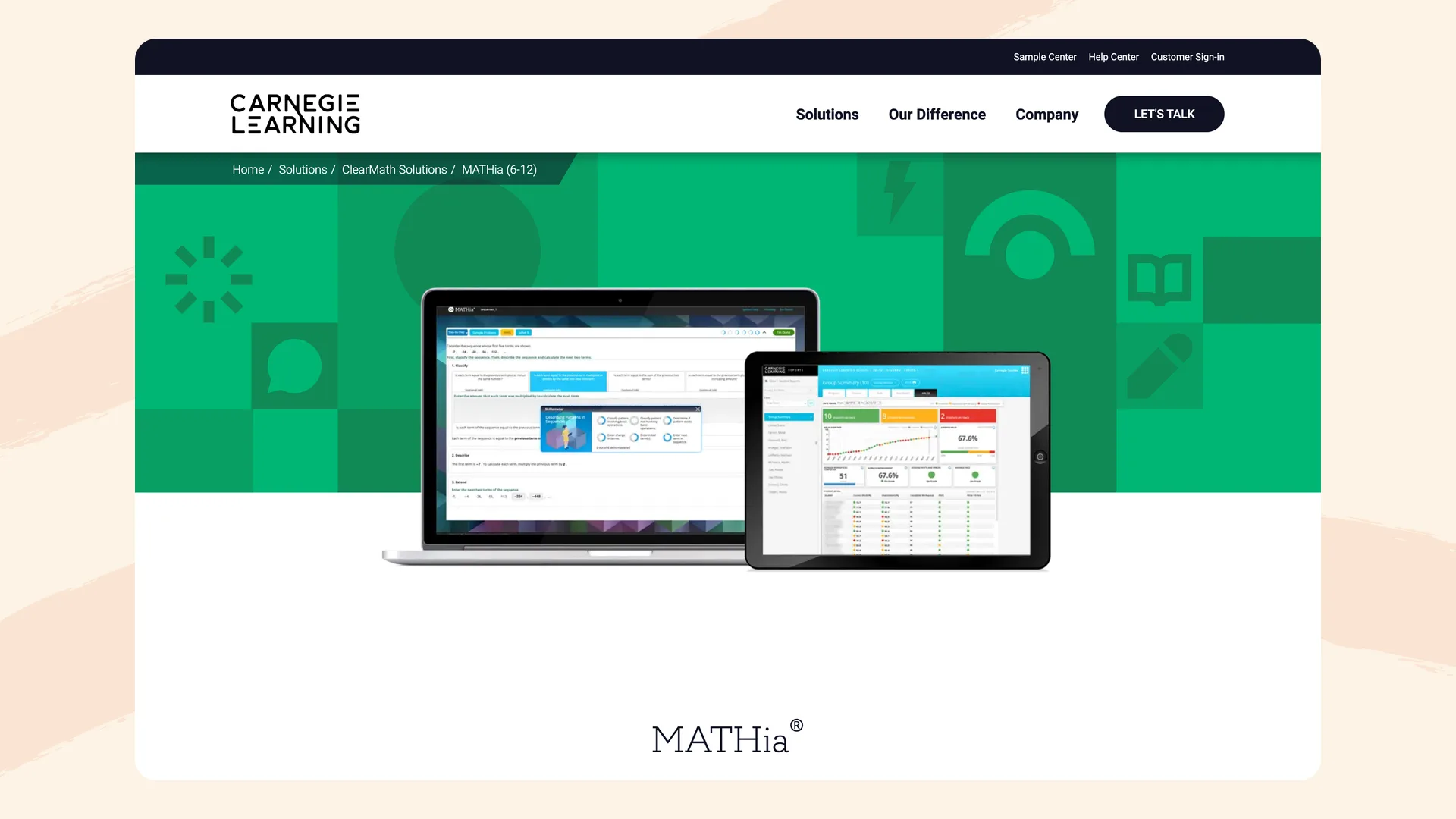
MATHia, Carnegie Learning's adaptive math software for grades 6-12 (carnegielearning.com), captured September 2026.
That's also the constraint. MATHia adapts within Carnegie's problem sets and instructional sequence. Teacher reviews on Common Sense Education note that its content can differ from what's taught in class and that its mastery-based progression can leave students stuck without teacher intervention. The AI is math-centric. In October 2026 Carnegie acquired Ethiqly, an AI writing platform it is pairing with its grades 6-12 literacy curriculum; its world language line uses separate products. And pricing is quote-based, sold as per-student curriculum adoptions through district procurement.
Flint: an AI platform for the curriculum you already have
Flint doesn't replace your curriculum — it teaches from it. Teachers create AI activities in minutes by describing what they're teaching and uploading their actual materials: textbook chapters, novels, lab manuals, problem sets, rubrics, curriculum standards. The AI then works with each student Socratically — guiding rather than answering, adjusting to the student's level, and prioritizing the teacher's sources.
What that looks like across a school:
- The math department runs practice sessions where the AI checks student work step-by-step, using a built-in calculator to verify computations and graphing equations on 2D or 3D planes.
- English teachers give AI-powered feedback on essay drafts against their own rubrics (AP, IB, or custom scales), with an AI-suggested grade the teacher can override or hide.
- World language classes hold spoken conversations with the AI in 50+ languages and 200+ dialects, at a teacher-set ACTFL or CEFR level.
- History classes run simulations — students negotiating the Cuban Missile Crisis as JFK, with the AI playing advisors.
- Administrators see every message any student sends the AI, school-wide, with concerning content automatically flagged for review.
Flint runs on Anthropic and OpenAI models (a more capable model on paid plans) with custom tooling (calculation, graphing, translation, web search), works for any grade with no minimum age, and rosters through every major SIS and LMS (Veracross, Blackbaud, PowerSchool, OneRoster; Canvas, Schoology, Google, Microsoft, Moodle, Blackboard).
Side-by-side comparison
| Flint | Carnegie Learning | |
|---|---|---|
| Category | AI learning platform | Core curriculum + embedded adaptive software |
| Curriculum | Yours — teachers upload their own materials | Carnegie's — AI adapts within its own content |
| Subjects with AI | All subjects | Math (MATHia, LiveHint AI) and, since October 2026, writing (Ethiqly); other subjects use separate products |
| AI type | Generative (Anthropic and OpenAI models, with a more capable model on paid plans) + calculator, graphing, web search | Adaptive engine (MATHia); generative hints on Carnegie textbooks (LiveHint AI) |
| Teacher customization | Full: prompts, materials, rubrics, helpfulness levels | Limited: teachers work within Carnegie's sequence |
| Evidence base | Growing research on AI tutoring broadly | RAND study, ESSA Strong rating (blended curriculum, year two) |
| Implementation | Teachers self-serve in minutes; school rollout in days | Curriculum adoption: training, pacing, multi-year commitment |
| Grades | K-12, no minimum age | Math software 6-12 core (K-5 supplemental) |
| Pricing | Published: free up to 80 users; from $3,000£2,234/yr for 150 | Quote-based, per-student curriculum licensing |
Pricing
Carnegie Learning doesn't publish prices; districts get quotes for per-student annual licenses, typically bundled with print materials and professional learning services, through formal adoption processes.
Flint is free for up to 80 users (students included), with published school plans: $3,000£2,234/year for up to 150 users, $4,000£2,979 for 250, $6,500£4,841 for 500, custom beyond that — every paid plan including SIS/LMS integration, analytics, a dedicated customer success manager, and unlimited PD. A department can pilot this semester without a procurement cycle.
Where Carnegie Learning is the better fit
- You're choosing a core math curriculum. Flint doesn't sell curriculum, full stop. If your district is adopting a 6-12 math program and wants adaptive software engineered into every unit — with one of the strongest long-term research pedigrees in edtech — Carnegie belongs on your shortlist.
- You want mastery-based skill tracking baked into instruction. MATHia's skill-by-skill adaptive model and predictive reporting are the product of decades of refinement inside a fixed instructional sequence.
- You have the implementation capacity. The research is clear that Carnegie's results come with sustained, multi-year, fully committed implementation — which their services arm is built to support.
Where Flint is the better fit
- You're keeping your curriculum. Most schools aren't shopping for new core curriculum — they want AI that strengthens what their teachers already teach. That's Flint's entire design.
- You want AI in every classroom, not one department. One platform for math practice, essay feedback, language speaking practice, science labs, and history simulations beats a math-centered tool for school-wide AI strategy.
- Your teachers want control. On Flint, teachers decide what the AI knows, how much help it gives, and how it grades. There's no fixed sequence to conform to.
- You need speed and flexibility. Rollout is measured in days, pricing is public, plans are proratable, and the free tier supports a genuine pilot.
- You're thinking about AI literacy, not just adaptive practice. Students on Flint learn to work with modern AI — question it, direct it, get feedback from it — under teacher supervision, which is itself a skill schools are now responsible for teaching.
The bottom line
Carnegie Learning answers the question "which math curriculum should we adopt?" with decades of cognitive science and real evidence behind it. Flint answers a different question: "how do we give every student personalized AI support in every subject, with the curriculum and teachers we already have?"
If the second question is yours, Flint is free for up to 80 users — or book a demo and we'll walk through what a school-wide rollout looks like.
