ComparisonSep 26, 2026
Flint vs. Brisk: Chrome extension or learning platform?
Brisk is a Chrome extension that helps teachers create materials and give feedback inside the tools they already use. Flint is a learning platform where AI tutoring, practice, and feedback are the product. Here's an honest breakdown of how they differ — and how to pick.

Brisk and Flint come up in the same conversations often enough that it's worth laying out the differences clearly. Both serve K-12 schools, both take student privacy seriously, and both involve AI in classrooms — but they approach the problem from very different directions.
Brisk started as a Chrome extension that brings AI into the tools teachers already use: Google Docs, Slides, Canvas, Schoology. The idea is to meet teachers where they are and speed up tasks like creating materials, leveling texts, and giving feedback — without asking them to learn a new platform. Flint started from a different question: what happens when students interact with AI directly, in sessions that teachers design and supervise?
Both are real products used by real schools. The right choice depends on what your school needs most. Here's an honest breakdown.
The short version
- Choose Brisk if your primary goal is helping teachers create materials and give feedback faster inside the apps they already use (Google Docs, Slides, Canvas) — and you want a Chrome extension that doesn't require a new platform.
- Choose Flint if your primary goal is student learning: AI tutoring and practice activities that teachers build, full visibility into every student-AI conversation, and a platform designed around the student experience from the ground up.
What each platform is
Brisk: a Chrome extension that brings AI to teacher workflows
Brisk's core experience is a browser extension. Teachers install it in Chrome or Edge, and it surfaces AI tools inside the apps they already use — Google Docs, Google Slides, Canvas, Schoology, and other web-based platforms. From there, teachers can generate lesson plans, quizzes, rubrics, and presentations; adjust reading levels; and give "Glow & Grow" feedback on student writing, all without leaving the page they're on.
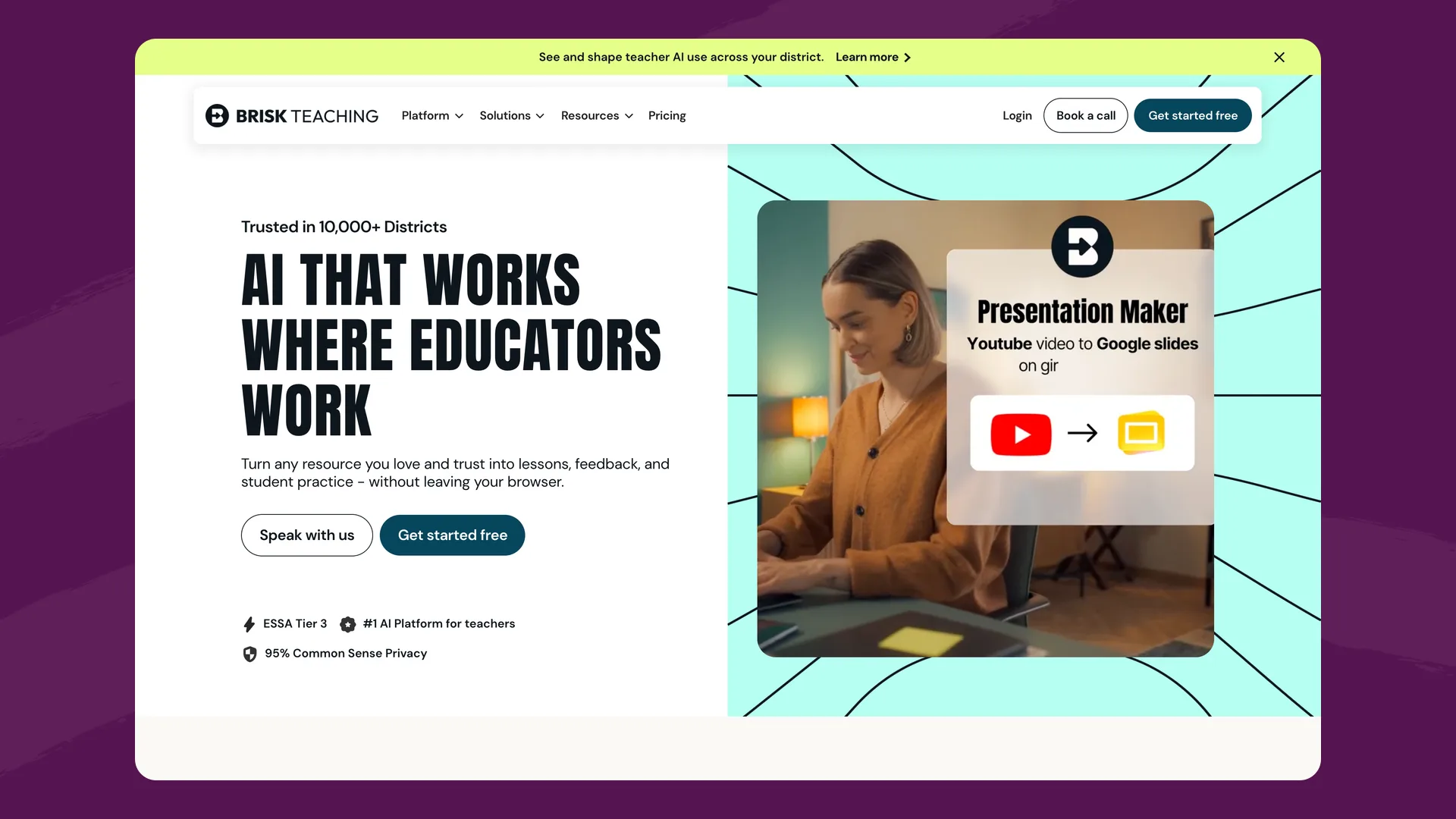
The Brisk Teaching homepage (briskteaching.com), captured September 2026.
Brisk also offers student-facing activities through Brisk Boost: 14 interactive activity types (like tutor chats, debates, exit tickets and comprehension checks) that teachers create and share via link or code. Students complete these activities in a browser — no extension required on the student side.
On the admin side, Brisk's Premium and Intelligence tiers add a district dashboard, usage analytics, tool management, and curriculum alignment features. The Intelligence tier goes furthest, ingesting a district's adopted curriculum, pacing guides, and scope and sequence so that AI outputs stay aligned to what teachers are teaching.
Brisk's plans and pricing page (briskteaching.com), captured September 2026.
This design has clear strengths: zero learning curve for teachers, works inside familiar tools, and Common Sense Media gives Brisk a 95% privacy rating. But the Chrome-only delivery model means schools on Safari, Firefox, or non-Chromium browsers can't use it — and the student experience runs through Boost activities a teacher launches. Brisk added an open-ended Boost activity, Quick Chat, in September 2026; it works from the extension only for now.
Flint: a learning platform where AI activities are the product
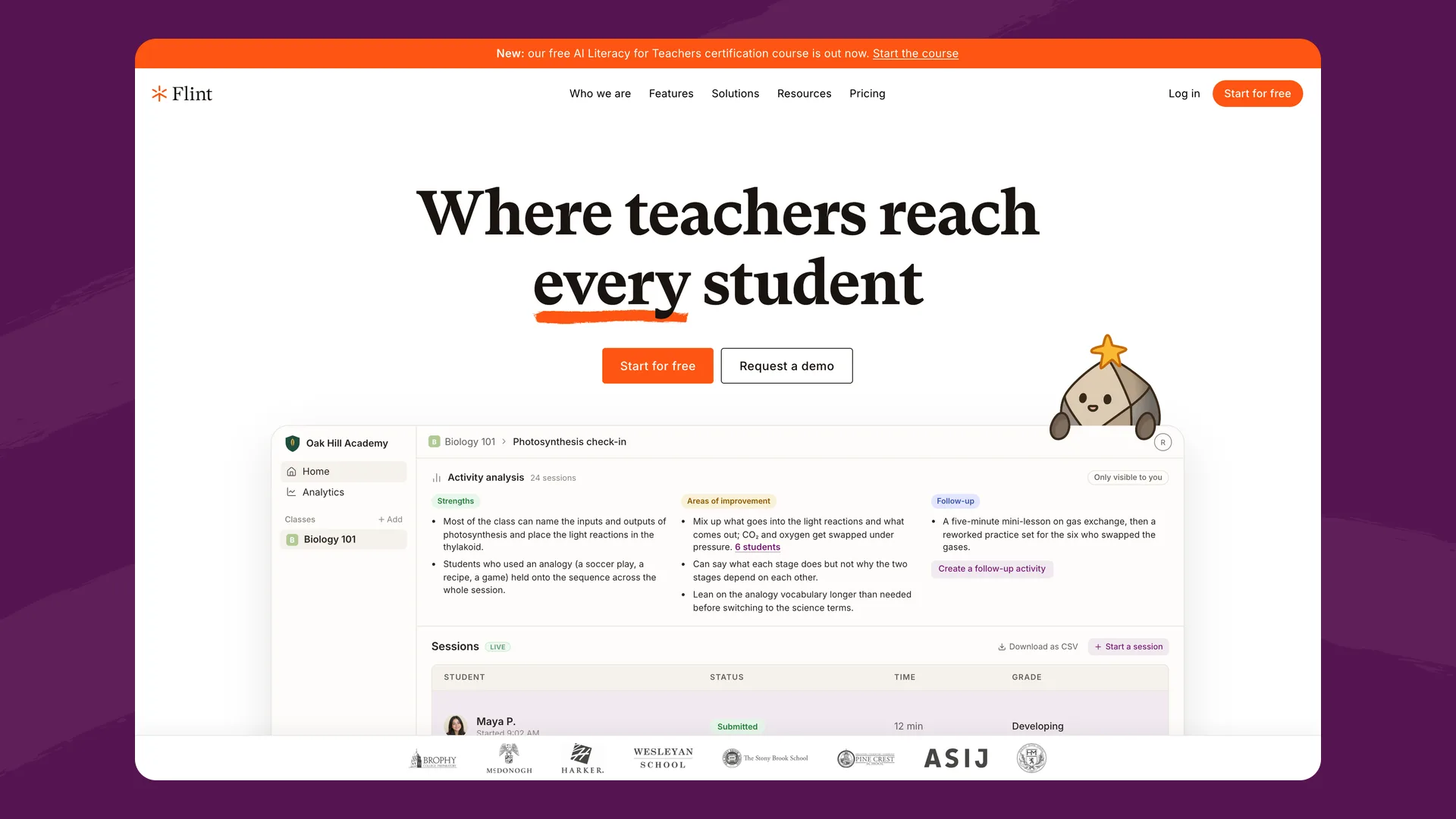
The Flint homepage (flintk12.com), captured September 2026.
Flint is built around AI activities: tutoring sessions, writing feedback, speaking practice, quiz review, simulations, and study sessions that teachers create in minutes by describing what they're teaching. The AI then works with each student individually — Socratically guiding rather than giving away answers, adjusting difficulty to the student's level, and staying grounded in the materials the teacher uploads (PDFs, slides, links, rubrics, curriculum standards).
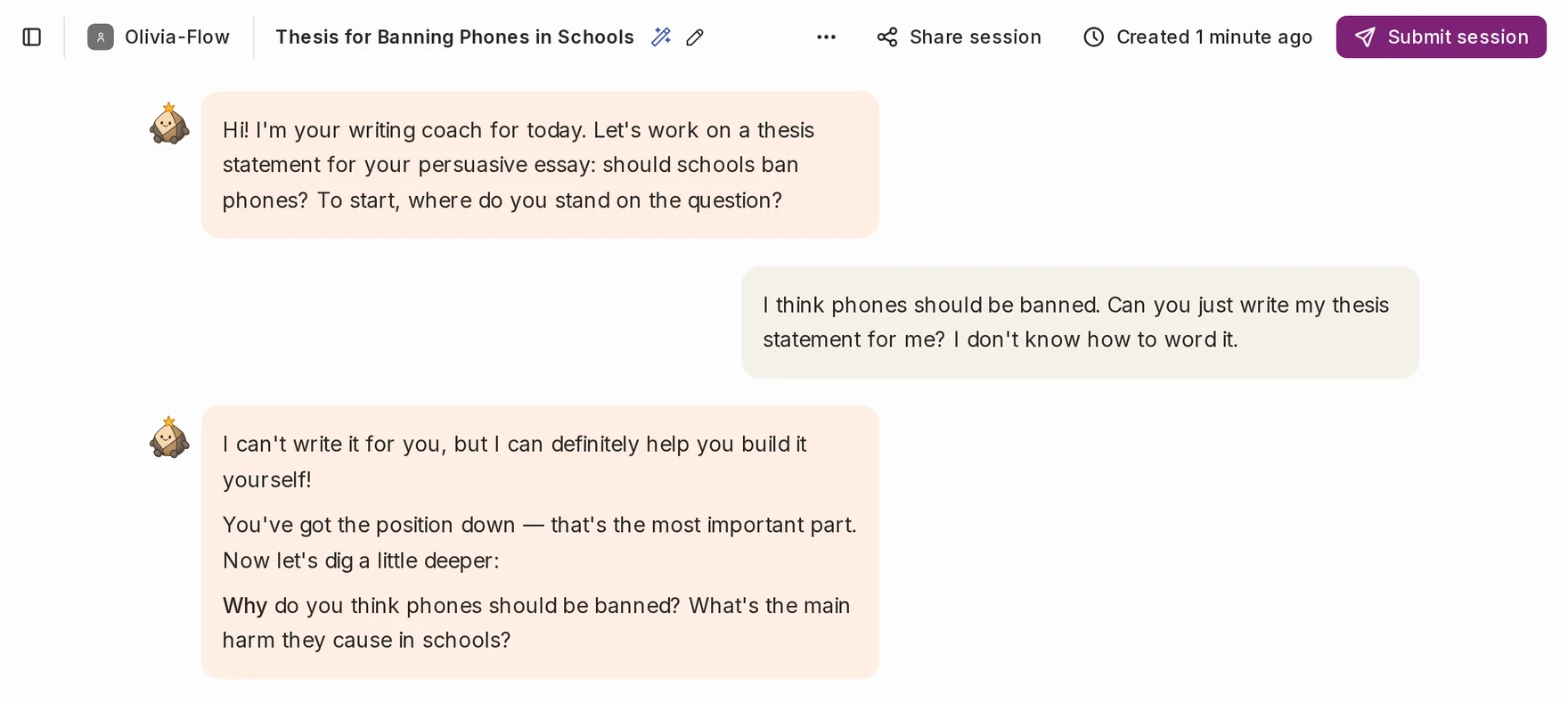
A student asks Sparky to write their thesis statement, and Sparky coaches them to write it themselves. Captured in Flint, September 2026.
Around that core, Flint includes what schools need to run AI responsibly at scale:
- Feedback and grading support: students get session summaries with strengths, areas for improvement, and hyperlinked evidence; teachers can attach custom rubrics (AP, IB, 1-4 scales, etc.) and override any AI-suggested grade.
- Full visibility: teachers see every message their students exchange with the AI; administrators see every conversation school-wide, with automatic flagging of concerning messages (self-harm, violence, harassment, and similar) for review.
- Accessibility: text-to-speech and speech-to-text in 200+ dialects, 50+ languages, and automatic leveling for students with language-based learning differences.
- Teacher tools too: Flint's activity builder, differentiation tools, and analytics cover much of the planning and feedback workload — the difference is that Flint's teacher tools exist to power student learning experiences, not as standalone document generators.
Flint works in any browser (Chrome, Safari, Firefox, Edge) with no extension required, and runs on Chromebooks, iPads, and phones.
Feature comparison
| Flint | Brisk | |
|---|---|---|
| Primary focus | Student learning (AI tutoring + activities) | Teacher productivity (AI inside existing tools) |
| Delivery model | Browser-based platform (any browser, no install) | Chrome/Edge extension + web dashboard |
| Student AI experience | Core product: adaptive tutoring, Socratic dialogue, open-ended practice in any subject | Brisk Boost: 14 activity types (tutor, debate, writing coach, exit ticket) plus open-ended Quick Chat |
| Open-ended AI interaction | Students converse freely with AI within teacher-set guardrails | Teachers: Brisk AI chat. Students: Quick Chat, an open-ended Boost activity a teacher launches (since Sept 2026) |
| Customization | Full: custom prompts, uploaded materials, standards, rubrics, school-wide context | Template-driven tools with curriculum alignment on paid tiers |
| Feedback & grading | Rubric-based feedback, session summaries with evidence, teacher override | Glow & Grow writing feedback, Inspect Writing analysis |
| Oversight | Every message visible to teachers/admins; automatic flagging | Teachers see every Boost chat; district dashboard with usage analytics and opt-in admin safety alerts (Premium+) |
| AI models | Anthropic and OpenAI models (a more capable model on paid plans) + web search, calculator, graphing, translation | Undisclosed ("standard" and "turbo" models by tier) |
| Browser support | Chrome, Safari, Firefox, Edge | Chrome and Edge only |
| Students under 13 | Yes, with school COPPA consent | Yes, with school consent |
| Free tier | Free for up to 80 users, including student access and all features | Free for teachers: 20+ tools with usage limits; student Boost activities included |
| SIS/LMS integration | Canvas, Schoology, Google, Microsoft, Moodle, Blackboard; Veracross, Blackbaud, PowerSchool, OneRoster | Canvas, Schoology, Google Classroom (Premium+) |
| Training on student data | Never | Never |
Pricing
As of this writing (September 2026), Brisk is free for individual teachers — 20+ AI tools, with usage limits; unlimited usage comes with paid plans. Premium and Intelligence tiers are custom-priced for schools and districts, adding the admin dashboard, curriculum alignment, rostering, dedicated support, and advanced features. Brisk doesn't publish per-user pricing, so you'll need to contact them for a quote.
Flint is free for up to 80 users — and users can be students, teachers, or administrators, so a free pilot includes real student use. Paid school plans start at $3,000£2,234/year for up to 150 users (about $1.67£1.24/user/month) and scale down in per-user cost from there, including SIS/LMS integration, school-wide analytics, a dedicated customer success manager, and unlimited professional development sessions.
The structural difference: Brisk's free tier is teacher-only tooling with no cost barrier, which makes bottom-up adoption easy. Flint's free tier includes students from day one, because student learning is the point of the platform.
Privacy and safety
Both platforms take student privacy seriously, and it would be misleading to claim otherwise.
Brisk earns a 95% Common Sense Media privacy rating — among the highest for any educational AI tool. It's FERPA- and COPPA-compliant, holds an ESSA Tier 3 designation, and states it does not train on student data. Brisk also offers custom data privacy agreements on paid tiers.
Flint is GDPR-compliant and FERPA-aligned, supports students under 13 through school consent (we'll review your school's technology waiver language to confirm COPPA compliance), never uses any user data to train AI models, and has signed state DPAs in Illinois, Massachusetts, Maine, New Hampshire, New York, Rhode Island, and Vermont, with custom DPAs available. See our security page for the full picture.
Where the two differ most is visibility into student conversations. Brisk provides usage analytics and a district dashboard showing who's using which tools and how often. Teachers can read every Brisk Boost chat, and admins can opt in to email alerts that link to flagged Boost conversations. Flint gives teachers and administrators access to every individual message any student sends the AI, plus automatic flagging of concerning content for admin review. For schools whose boards and parent communities ask "what exactly are students saying to the AI?", that granularity matters.
Where Brisk is the better fit
- If teachers need AI inside the tools they already use, Brisk's Chrome extension model is hard to beat. Generating a quiz in Google Docs, leveling a passage in Canvas, or giving writing feedback in Schoology — all without switching tabs — is genuinely faster than opening a separate platform.
- If free, zero-friction teacher adoption is the priority, Brisk's free tier is broad and generous. Teachers can start using 20+ tools today with no procurement, no IT ticket, and no training required.
- If your district wants curriculum-aligned AI outputs, Brisk's Intelligence tier ingests your adopted curriculum, pacing, and scope and sequence so AI-generated materials match what teachers are teaching — a meaningful differentiator for large districts focused on instructional consistency.
Where Flint is the better fit
- If students are the point. Flint's tutoring is open-ended, Socratic, and grounded in teacher materials — designed to make students think rather than complete structured exercises. Research increasingly supports this model: AI tutoring works when it's built pedagogically.
- If you need message-level oversight. Every student message visible to teachers and admins, with automatic flagging of concerning content, is a different tier of accountability than usage dashboards.
- If accuracy matters for STEM. Flint pairs Anthropic and OpenAI models (a more capable model on paid plans) with a built-in calculator for math, graphing on 2D/3D planes, web search for current sources, and teacher-uploaded materials the AI prioritizes — reducing the hallucination risk that comes with raw LLM output.
- If your school isn't all-Chrome. Flint runs on any browser and any device. Schools with iPads, mixed-OS environments, or Safari-default Macs won't hit the browser compatibility wall.
- If you serve diverse learners. 50+ languages, 200+ dialects for speech, ACTFL/CEFR level controls for world language classes, and automatic leveling for students with learning differences.
- If you want a partner, not just a product. Every paid Flint license includes unlimited PD sessions, 1-1 teacher onboarding, and live chat support — and schools like Brophy Prep, McDonogh, and Durham Academy have used that partnership to drive school-wide adoption.
The bottom line
Brisk and Flint solve different problems in the same building. Brisk answers: how do we bring AI to the tools teachers already use, so they can work faster without changing their workflow? Flint answers: how do we make AI really improve student learning, with full teacher control and oversight?
Some schools run both — Brisk for teacher productivity, Flint for the student experience. But if you're choosing one platform to define how AI shows up in your classrooms, the question is whether you're optimizing for teacher workflows or student outcomes. If it's the latter, that's the job Flint was built for.
The easiest way to compare is to try it: Flint is free for up to 80 users, or you can book a demo and we'll walk through your school's specific goals.
