Sep 29, 2026
Experts ranked small-group tutoring the best way to fix U.S. schools. Most schools can't afford it.
The New York Times asked 37 researchers to rank 30 ideas for fixing schools. Small-group tutoring came first, and it also costs the most. What the research says, why tutoring gets weaker as programs grow, and how AI tutoring can help close the gap.

Sohan Choudhury | Co-founder and CEO of Flint

On September 28, The New York Times published 30 Ideas for Fixing U.S. Schools, Ranked by Experts, by Sarah Mervosh, Francesca Paris and Claire Cain Miller. The Upshot asked 37 education researchers to rate 30 ideas for raising student achievement. Small-group tutoring got the highest effectiveness rating on the list.
The backdrop is a decade of decline. Test scores started falling before the pandemic and kept falling after it. Compared with 2015, reading scores are down in 83 percent of U.S. districts, and math declines are nearly as widespread.
Tutoring coming first didn't surprise me. The research has pointed there for years. What caught my eye was where it sits on the Times chart. It's alone in the corner for ideas that work well and cost a lot.
For most superintendents, that corner is the whole problem. They already believe tutoring works. What they can't figure out is how to pay for it for every student who needs it.
A disclosure: Flint makes AI tutoring software for schools, so I have a stake in how this question gets answered. I'll start by showing what AI tutoring looks like in Flint, so you know exactly what I'm arguing for. Then I'll get to the research, and I've tried to be straight about what it does and doesn't show.
What AI tutoring looks like in a lesson
Flint is a platform where teachers build AI activities from their own materials, and each student works through them one-on-one with Sparky, Flint's AI tutor. When a student is stuck on something that's easier to see than to read about, Sparky can build them an interactive right in the chat. Here's an example from a 10th grade biology class working on osmosis, a topic a lot of students get backwards. You get to sit in the student's seat.
Try it · Example session
Sparky built this lab for one student, in the middle of her lesson
Maya, a 10th grader, was stuck on osmosis. You're in her seat now: answer Sparky, run the lab, and see what her teacher sees. Then rewind to see how it got built.
Sparky has a question for you first
Make a prediction below and the lab starts.
How salty is each side?
They match, so water stops flowing one way.
Cell size: 100% of normal
 Sparky· your AI tutor
Rewind: how it got here
Sparky wrote a brief, and Flint built the lab from it
Sparky doesn't code the lab itself. It turns what it learned from the conversation into a brief: the concept, the misconception to test, the controls, and the challenges. Flint builds a working interactive from that brief and drops it into Maya's chat.
Interactive brief
Osmosis lab: cells in salt water
- Concept
- Osmosis. Water crosses the cell membrane toward the side with more dissolved salt. The salt itself mostly can't cross.
- Why this student
- She believes the salt moves into the cell. Ask her to predict first, then let her watch what the water does instead.
- Controls
- Salt outside the cell, 0% to 3%, starting at 2.5%. A switch between a red blood cell and a plant cell.
- Show
- Water and salt as moving dots, arrows for which way water flows, and how salty each side is, side by side.
- Challenges
- Find the balance point. Burst a red blood cell. Put a plant cell in pure water.
- Grade level
- 10th grade biology
- Read Maya's conversation: she thinks the salt moves into the cell
- Checked the teacher's rules: no answers, let students test their ideas
- Wrote the brief above
- Built the lab and tested it at 0%, 0.9% and 3% salt
- Sent it to Maya's chat
The lab is the eye-catching part. The steps behind it are what make it tutoring: a teacher's plan, an AI that asked for a prediction and held back the answer, help built for one student's specific mistake, and a teacher who can see exactly who still needs help. The rest of this post is about why that matters, and why it's so hard to get with human tutors alone.
What the experts ranked
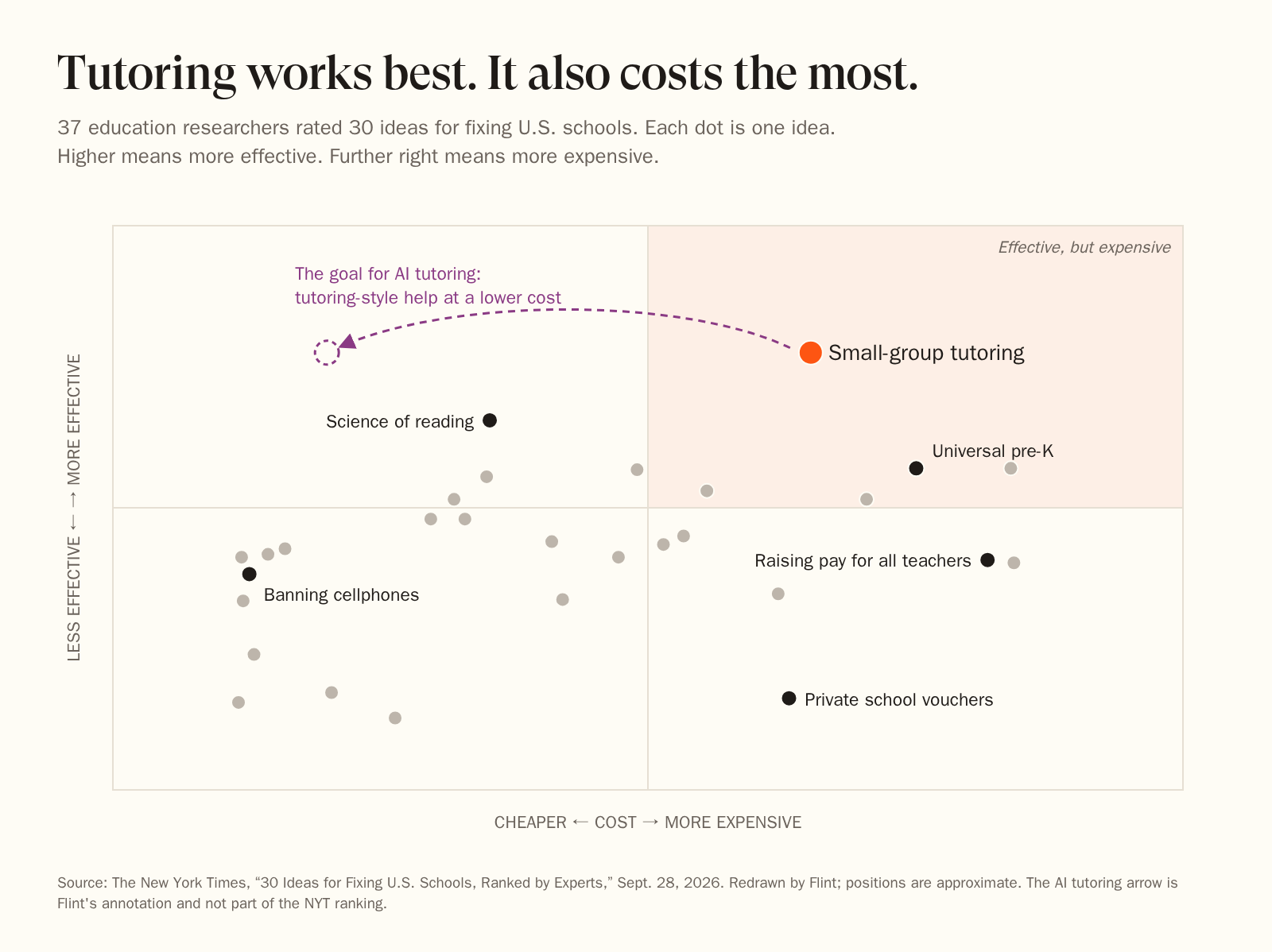
The higher an idea sits, the more effective the experts rated it. The further right, the more it costs. Tutoring is at the top. The science of reading comes close for a lot less money. Private school vouchers cost a lot and landed near the bottom.
The researchers were asked to judge each idea assuming it was done well. Stanford's National Student Support Accelerator, which researches tutoring, pointed out in its reaction that the article stresses implementation, which can decide whether even proven ideas succeed in practice. Most of the debate about tutoring now is about that "done well" part.
Why tutoring works
Researchers usually report tutoring results in "standard deviations," which mean little to most people. Percentiles are easier to picture. Imagine a student sitting right in the middle of their class, at the 50th percentile. The question is how far up tutoring moves that student.
- Across 96 rigorous studies, tutoring moved that average student to about the 64th percentile. In plain terms, they passed 14 out of every 100 classmates. The peer-reviewed version, published in 2024, found a slightly smaller jump, to about the 61st percentile. Tutoring worked best when the tutors were teachers or trained aides, when students were younger, and when sessions happened at least three times a week during school.
- In Chicago, intensive math tutoring from Saga Education during the school day moved ninth and tenth graders from the 50th percentile to somewhere between the 57th and 66th. Their grades went up in math and in their other classes too, and the gains lasted into later years. Many researchers had assumed it was too late to move scores that much for teenagers who were already behind.
The National Student Support Accelerator's definition of high-impact tutoring sums up what these programs have in common:
- Tutoring three or more times a week, for at least ten weeks
- The same well-trained tutor each time, who gets to know the student
- Groups of four students or fewer, and one-on-one where possible
- Material that follows the school's curriculum
- Time built into the school day
The Chicago researchers think the reason is personalization. A tutor works at the student's actual level, catches a mistake the moment it happens, and makes the student do the thinking. A teacher with 28 students can't do that for everyone at once, however good she is.
Why tutoring is hard to scale
Those same features are what make tutoring expensive.
In the Chicago study, Saga's tutoring cost about $3,500 per student per year (details). Picture a district of 10,000 students that wants to tutor the quarter who are furthest behind. That's around $8.75 million a year. Saga later cut its cost to about $1,800 per student by using bigger groups, having students spend half their time on a learning program, and getting an AmeriCorps subsidy. That's real progress, and it still leaves most districts short.
Money is only part of it. Tutoring needs a trained adult for every few students, several times a week, inside a school schedule that's already full. Many districts that expanded tutoring after the pandemic paid for it with federal relief money. That money is gone, and districts like Tucson Unified have had to cut reading specialists it paid for.
When programs do grow, the results shrink. A 2024 review of 265 studies by Matthew Kraft and colleagues found:
- In programs with fewer than 100 students, tutoring moved an average student to about the 71st percentile.
- In U.S. programs with 1,000 or more students, measured on standardized tests, it moved them to about the 56th.
That's still a meaningful gain for a program that big, and the authors say so. But it's a lot smaller than the number that usually gets quoted, and it's the one a district should plan around.
How AI tutoring can help close the gap
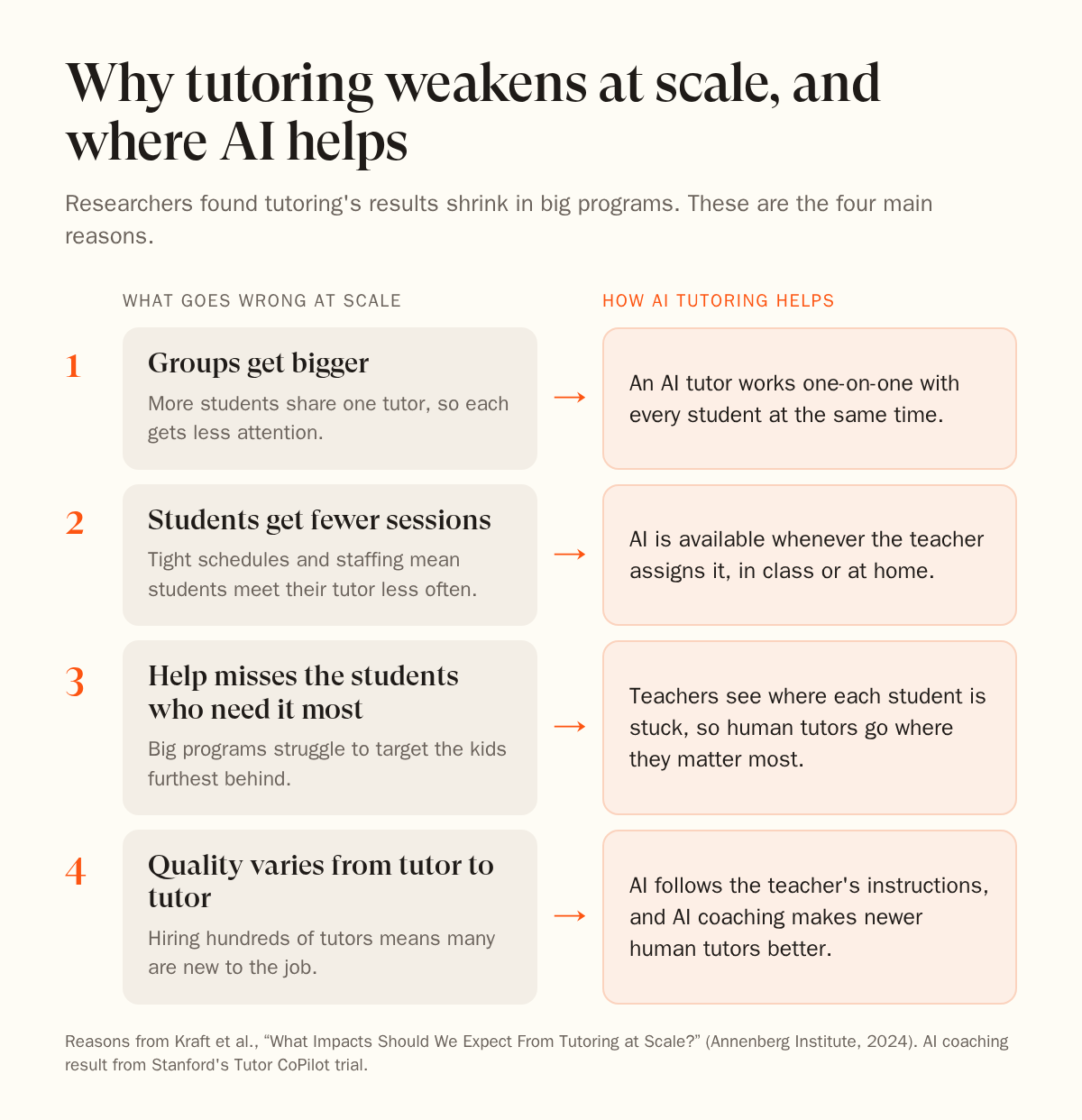
Kraft's team pointed to four reasons tutoring weakens as it grows. Each one is a place where AI can help.
Groups get bigger. When money runs short, each tutor ends up with more students, and each student gets less attention. An AI tutor doesn't have that limit. Every student in the class can work one-on-one at the same time.
Students get fewer sessions. The research is clear that three or more sessions a week matters, and that's the first thing to slip when schedules and staffing get tight. AI tutoring is there whenever the teacher assigns it, during class, during an intervention block, or at home.
Help misses the students who need it most. Big programs struggle to reach the kids furthest behind. If AI handles everyday practice for the whole class, schools can save their human tutors for those students. And when teachers can see where each student got stuck, they know who needs that human time.
Quality varies from tutor to tutor. Hiring hundreds of tutors fast means many are new to the job. An AI tutor follows the same teacher-written instructions for every student. AI can also coach the human tutors. In Stanford's Tutor CoPilot study, an AI assistant suggested teaching moves to tutors while they worked. Students of the less experienced tutors gained the most: up to 9 more out of every 100 mastered the topic. It cost about $20 per tutor for a whole year.
Then there's cost. AI tutoring costs far less per student than a human tutor, which changes the question a district is answering. Instead of choosing which few hundred students get tutoring, it can give every student some version of it, and put its human tutors where they count most.
The early results are encouraging:
- In a Harvard physics course, students using an AI tutor learned more than twice as much, in less time, as students in a well-run class covering the same lesson (study). The instructors wrote detailed instructions so the AI would teach the way they do. These were college students, so it doesn't prove the same thing works in high school.
- In Nigeria, a six-week after-school AI tutoring program moved students from the 50th percentile to about the 62nd. The World Bank researchers compared that to 1.5 to 2 years of normal schooling.
The catch: how the AI is built matters
AI tutoring doesn't work automatically. In a study of nearly 1,000 high school math students, students who used plain ChatGPT did better on practice problems. When it was taken away, they scored 17% lower on the test than students who never had it. They had used it as a crutch. A second version that gave hints instead of answers mostly fixed that problem.
The research is also still thin. NPR reported on September 28 on a Stanford review of more than 800 papers that found little solid evidence yet on AI in schools. The studies that do exist suggest carefully designed tools do better than general chatbots.
That's the same lesson as the Times ranking. Tutoring works when it's done well, and so does AI tutoring. An AI tutor should follow the same rules that make human tutoring work: stick to the curriculum, make students do the thinking, get used several times a week, and let the teacher see how each student is doing.
What I'd do as a district leader this year
- Keep human tutoring for the students furthest behind. A smaller program that reaches the right kids beats a thin one spread across everyone.
- Hold AI tools to the same standards as human tutoring. The AI should follow your curriculum, hold back answers until the student has done the work, and show teachers where each student is stuck.
- Use AI to give tutoring-style practice to every other student. For most students in most districts, the realistic alternative to an AI tutor is no tutor at all.
- If you already run a tutoring program, look at tools that coach your tutors. The biggest gains in the Tutor CoPilot study went to the newest ones.
- Judge results with tests you already give, not a vendor's dashboard. Tutoring studies show smaller gains on independent tests than on tests the researchers wrote themselves, and there's no reason to expect AI to be different.
Where Flint fits
Maya's osmosis session at the top of this post maps onto the design choices the research rewards:
- The teacher writes each activity's instructions, including whether Sparky should hold back answers and which materials it should draw on.
- Sparky responds to what each student actually writes. Maya's wrong answer got a guiding question, and a student who answered correctly would have gone straight to the harder follow-up.
- When reading about an idea isn't enough, Sparky can build an interactive in the chat, like the osmosis lab, so the student can test the idea for themselves.
- Teachers see every message their students exchange with Sparky, along with a summary of how each student did.
Flint works best alongside human tutoring, for the students who wouldn't otherwise get any. It gives them something much closer to tutoring than a worksheet, and it shows their teacher where each of them is stuck.
Frequently asked questions
What did the New York Times experts rank as the best way to improve U.S. schools?
Small-group tutoring. In the Times Upshot analysis published September 28, 2026, 37 education researchers rated 30 ideas for improving student achievement, and small-group tutoring got the highest effectiveness rating. The experts rated each idea assuming it was done well, and the chart puts tutoring on the more expensive side.
What is high-impact tutoring?
Stanford's National Student Support Accelerator defines it as tutoring three or more times a week for at least ten weeks, with the same well-trained tutor, in groups of four students or fewer, following the school's curriculum, during the school day.
How much does high-impact tutoring cost per student?
In the Chicago trials of Saga Education's math tutoring, researchers put the cost at about $3,500 per student per year. Saga later brought that down to about $1,800 per student with bigger groups, time on a learning platform, and an AmeriCorps subsidy.
Does tutoring still work when schools scale it up?
Yes, but the results get smaller. Kraft and colleagues' 2024 review of 265 studies found that in U.S. programs serving 1,000 or more students, tutoring moved an average student from the 50th percentile to about the 56th. In programs with fewer than 100 students, it moved them to about the 71st.
How can AI tutoring help close the gap?
AI tutoring can give every student one-on-one, tutoring-style help as often as the teacher assigns it, at a much lower cost per student than a human tutor. That lets schools save human tutors for the students furthest behind. It also shows teachers where each student is stuck, and it can coach human tutors while they work.
Does AI tutoring work?
Early studies are promising when the AI tutor is carefully designed, including a Harvard physics study and a World Bank study in Nigeria. Design matters: in a high school math study, students using plain ChatGPT scored 17% lower on the test once it was taken away, while a version that gave hints instead of answers mostly avoided that.
Tutoring topped the ranking because it gives a student someone working at their level, several times a week, who makes them do the thinking. Budgets decide how many students get that. The work now is getting it to every student without losing the parts that made it work.