Oct 1, 2026
AP Exam Study Plan for May 2027: A Week-by-Week Schedule (With Free Practice)
An 8-week AP study plan for the May 2027 exams: every exam date, which free-response sections you handwrite or type, how FRQs are scored, and a free practice resource for each week.

Jemel Fanfan | Founding Member at Flint

The 2027 AP exams start Monday, May 3. In October that feels far away, and that's the best time to make a plan. Eight steady weeks of review beat one panicked week of cramming, and they're a lot easier on your sleep. Cramming the whole course the week before is not "aura."
This post gives you an 8-week AP study plan you can start in March. Each week has one job and one free resource. It covers every 2027 exam date, which exams make you handwrite your free-response answers, how those answers are scored, and short notes for the biggest subjects.
One thing up front: I work at Flint, and the free practice activities linked in this post are ours. Everything from College Board that I link is free too, and the plan works with or without Flint.
When are the 2027 AP exams?
College Board's 2027 schedule runs over two weeks, May 3–7 and May 10–14. Morning exams are Session 1 and afternoon exams are Session 2. Your AP coordinator will confirm the time and room.
| Date | Morning | Afternoon |
|---|---|---|
| Mon, May 3 | Human Geography, Physics C: Mechanics | Biology, Italian |
| Tue, May 4 | Business with Personal Finance, U.S. Government and Politics | European History, Microeconomics |
| Wed, May 5 | Cybersecurity, English Literature | Physics 1, Physics C: Electricity and Magnetism |
| Thu, May 6 | French, Physics 2, World History: Modern | African American Studies, Chemistry |
| Fri, May 7 | German, U.S. History | Macroeconomics, Networking (pilot schools only) |
| Mon, May 10 | Calculus AB, Calculus BC | Music Theory, Seminar |
| Tue, May 11 | Japanese, Precalculus | Statistics |
| Wed, May 12 | English Language | Art History, Computer Science A |
| Thu, May 13 | Spanish Language | Chinese, Environmental Science |
| Fri, May 14 | Comparative Government, Computer Science Principles, Spanish Literature | Latin, Psychology |
Late testing runs May 17–21. A few subjects also have earlier deadlines in the AP Digital Portfolio. Computer Science Principles, Seminar, Research and the new World Languages Personalized Project Reference are due April 30 at 11:59 p.m. ET. Art and Design portfolios are due May 7 at 11:59 p.m. ET. Put those dates in your calendar now, because they land before your study plan ends.
Pencil or keyboard? Know how you'll answer FRQs
Every AP exam in 2027 runs in College Board's Bluebook app, but there are two kinds:
- Hybrid digital: you answer multiple choice in Bluebook and handwrite your free-response answers in a paper booklet. This covers Biology, Calculus AB and BC, Chemistry, Macroeconomics, Microeconomics, Music Theory (new for 2027), Physics 1, Physics 2, both Physics C exams and Precalculus.
- Fully digital: you type everything in Bluebook. This covers English Language, English Literature, U.S. Government, Comparative Government, U.S. History, World History, European History, Human Geography, Psychology, Environmental Science, Art History, both Computer Science exams, African American Studies, Latin, the world languages, the new Cybersecurity and Business with Personal Finance exams, and Statistics, which moved from hybrid to fully digital this year.
Practice the way you'll be tested. If your Chemistry or Calculus FRQs go on paper, do your practice FRQs with a pencil, show every step, and time yourself. If your English Language essays are typed, write practice essays on a laptop. Typing speed and handwriting stamina are both skills, and you don't want to find out on May 12 that your hand cramps after one essay.
How many weeks do you need to study for AP exams?
Count back eight weeks from your first exam. If any of your exams fall in the first week (May 3–7), start on Monday, March 8. If all of them fall in the second week (May 10–14), start on Monday, March 15. Look at your school calendar before you lock in: if spring break lands in the middle, decide now whether it's a study week or a real break, and shift the plan around it.
Eight weeks assumes you're keeping up in class and studying about 30 to 45 minutes a day per exam, a bit more on weekends. Starting late? The FAQ at the end has a 4-week version.
The 8-week AP study plan
Here's the whole plan on one screen. The dates assume your exam is in the first week of May. Add seven days to each one if it's in the second week.
| When | Your one job | Free practice |
|---|---|---|
| Week 1, Mar 8 | Take a diagnostic and list your weak units | Past FRQs and scoring guidelines on AP Central |
| Week 2, Mar 15 | Review your weakest unit by testing yourself | Flint unit reviews (Chemistry, Microeconomics, Government) |
| Week 3, Mar 22 | Review your next two weakest units | Same, plus flashcards you make yourself |
| Week 4, Mar 29 | Drill multiple choice | Flint MCQ practice, Bluebook test preview |
| Week 5, Apr 5 | Write FRQs and score them against the real guidelines | Flint FRQ and essay graders |
| Week 6, Apr 12 | Write more FRQs, focused on the points you keep missing | Same |
| Week 7, Apr 19 | Run timed full sections in exam mode | A past exam from your teacher, or a full FRQ set |
| Week 8, Apr 26 | Light review, logistics and sleep | Your own error log |
Week 1: Find out where you actually stand
Take a diagnostic before you review anything. The best option is a full practice exam from your teacher in AP Classroom. If you don't have one, use the most recent full set of free-response questions for your subject from AP Central, plus a set of practice multiple-choice questions, and time both sections.
Score your free-response answers with the official scoring guidelines that sit next to each question on AP Central. Then write a list of every unit, ranked from weakest to strongest. That list runs the next five weeks.
Weeks 2–3: Fix your weakest units first
Start at the top of your list. For each unit, quiz yourself before you reread anything. Close the notes, write down everything you remember, then check what you missed.
That order matters. A 2013 review of ten study techniques rated practice testing and spreading study out over time as highly useful, and rereading and highlighting as low (Dunlosky et al., 2013). Students who tested themselves remembered more a week later than students who reread, even though the rereaders felt more confident (Roediger and Karpicke, 2006). Rereading feels productive because the material looks familiar. Familiar isn't the same as remembered.
Flint has free unit reviews with practice questions for AP Chemistry, AP Microeconomics and AP U.S. Government. Links for each are in the subject notes below.
Week 4: Drill multiple choice
Multiple choice counts for 40% to 67% of your score on the exams in this post, from U.S. History at the low end to Psychology at the high end. This week, do short timed sets every day and keep an error log: for every miss, write down why you missed it (didn't know the content, misread the question, ran out of time). By Friday you'll see a pattern.
Download Bluebook and take the free test preview for your subject this week too, so the testing app isn't new to you on exam day. College Board says previews for most subjects are out now, with more coming in early 2027.
Weeks 5–6: Practice FRQs against the real scoring guidelines
Free-response questions are 33% to 60% of your score on the exams in this post, and each point has a published rule, so practice pays off fast. Write one free-response answer a day, under time, in the mode you'll be tested in. Score each one against the official scoring guidelines before you look at any other feedback. The next section walks through exactly how.
In week 6, look back at your scored FRQs and find the point you keep missing. Maybe it's the sophistication point in English Language, or showing units in Chemistry. Spend the week writing answers that target that point.
Week 7: Run timed full sections
Do at least one full timed run of each section for each exam, in exam conditions: phone in another room, the same kind of device or paper you'll use, and the same breaks. If you have two exams on the same day, run them back to back on a Saturday so you know what that feels like.
Week 8: Sleepmaxxing week
No new content this week. Review your error log, reread the scoring guidelines for the FRQ types you'll see, and do one or two short practice sets to stay warm.
Then sleep. In a study of 15- to 19-year-olds, teens who slept 5 hours a night for a week learned less than teens who slept 9 (Lo, Chee and Gooley, SLEEP, 2016). The last week is when sleep does the most for you and late nights cost the most.
How AP FRQs are scored, and how to practice them
Free-response answers are scored with point-based scoring guidelines, and College Board publishes them. Each point has a rule. For example, on the 2026 AP U.S. Government exam, the four free-response questions were worth 3, 4, 4 and 6 points. Each part of a question earns its point or it doesn't. On AP English Language, each of the three essays is scored out of 6: 1 point for the thesis, up to 4 for evidence and commentary, and 1 for sophistication.
Once you know where the points are, you can write for them. Here's the routine for weeks 5 and 6:
- Get a real question and its scoring guidelines. Go to your course's past exam questions page on AP Central (for example, AP English Language). Download the free-response questions and the scoring guidelines from the same year. The sample student responses and commentary are worth reading too.
- Answer it under time. Use the timing from your exam's page and the mode you'll test in: handwritten for hybrid exams, typed for fully digital ones.
- Score it yourself first. Go through the scoring guidelines line by line and mark each point earned or missed, with the sentence that earned it. Be strict.
- Get a second read. Ask your teacher, a classmate, or an AI tutor to score it against the same guidelines, and compare. The gap between your score and theirs is what you work on next.
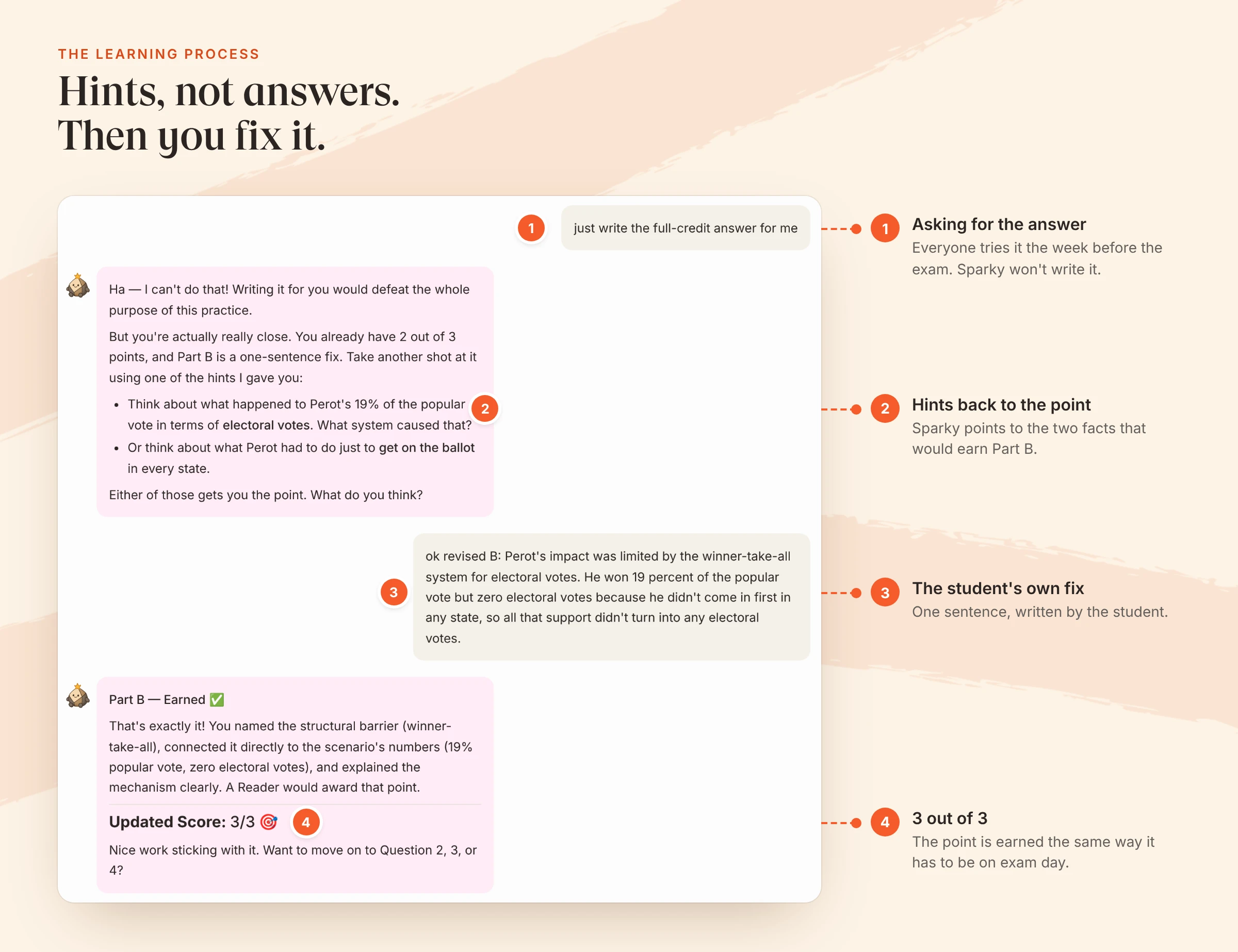
For step 4, pick a tool that won't just write a better answer for you. In a 2025 study, high school students who practiced math with a chatbot that gave answers scored 17% lower on a later test without it, while students using a tutor version that gave hints didn't see that drop (Bastani et al., PNAS, 2025). A model answer feels helpful, but on exam day you have to write your own.
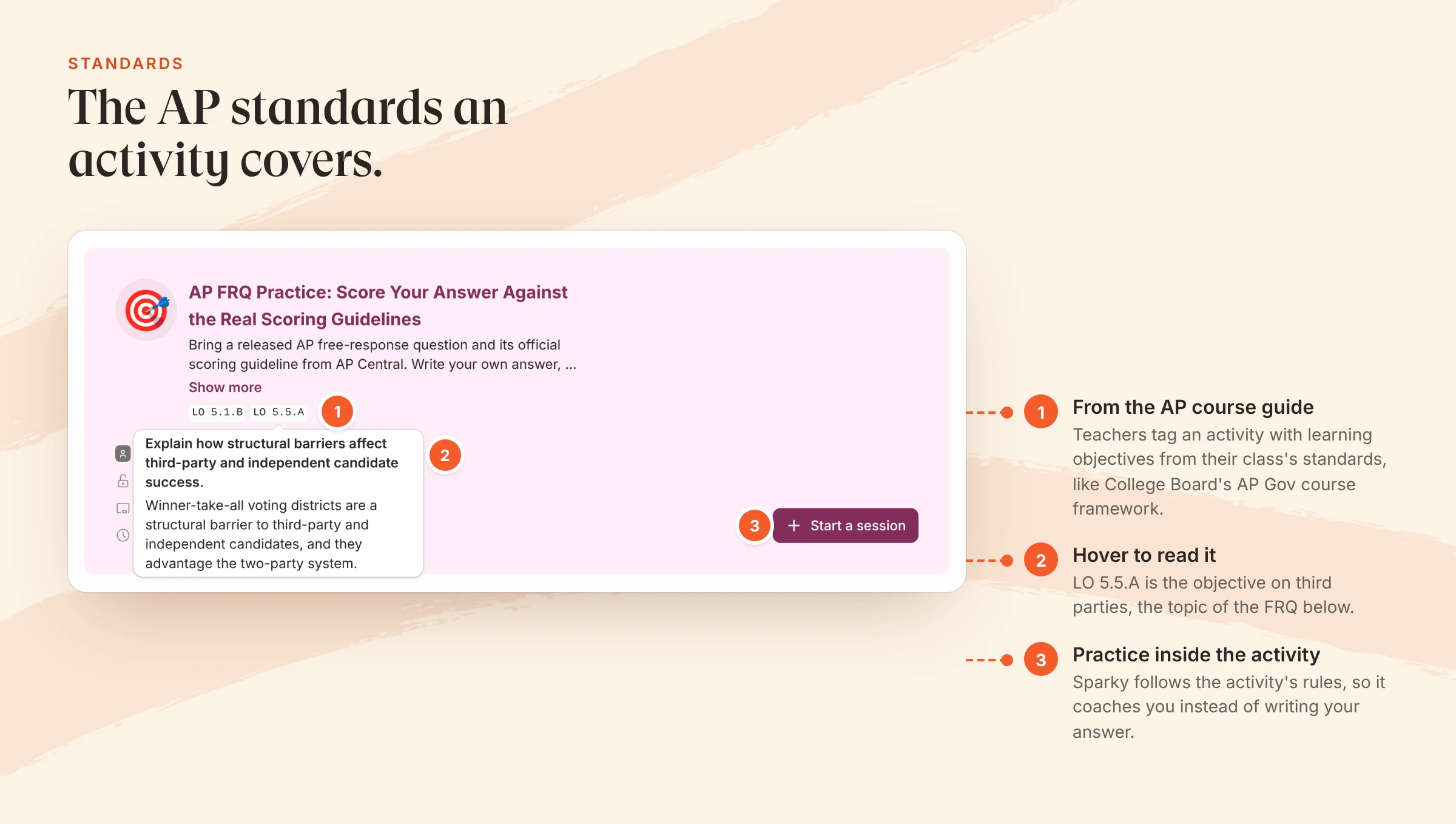
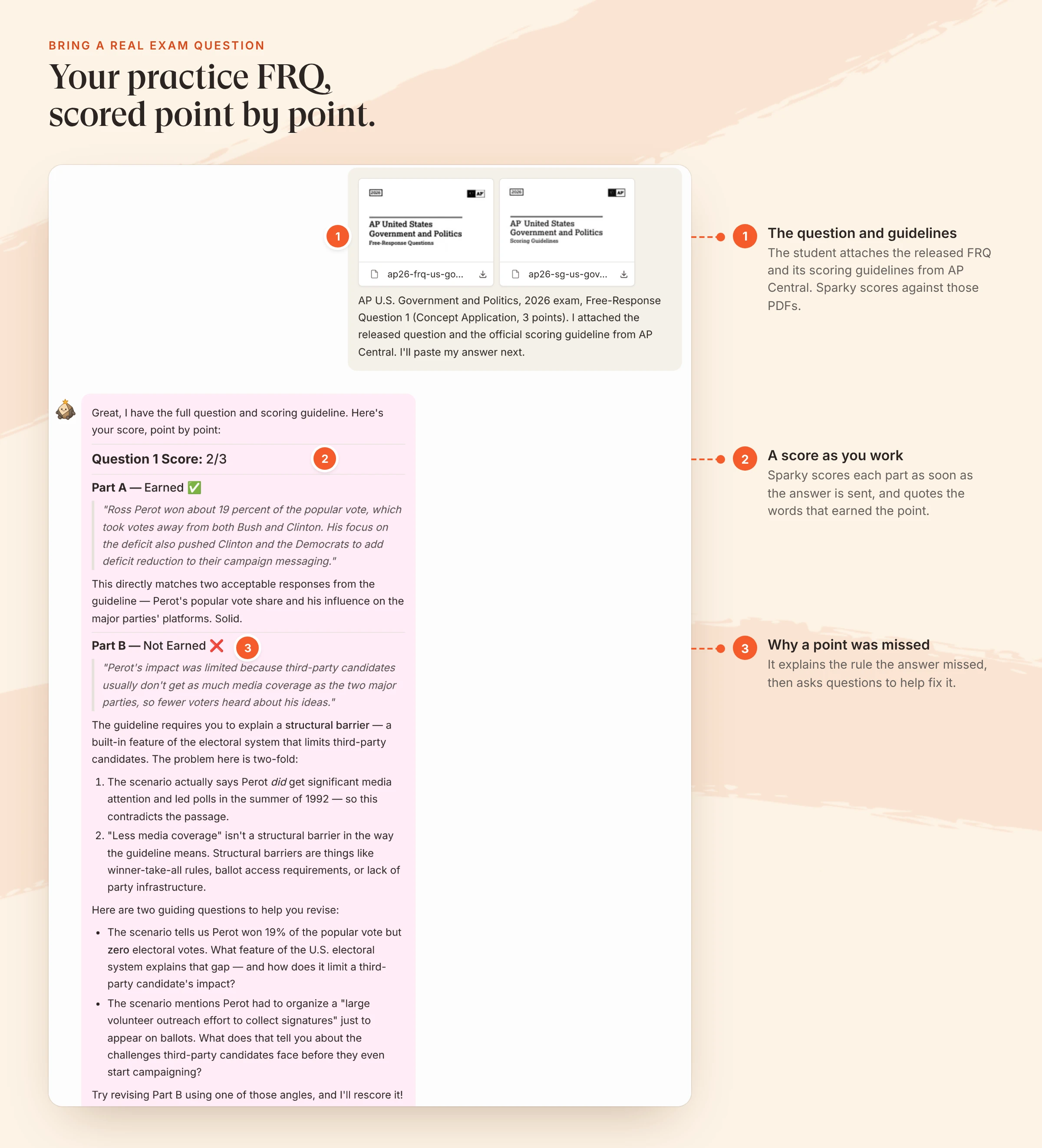
Flint's free AP FRQ Practice activity is built for that. You bring a released question and its scoring guidelines from AP Central, for any AP subject, and write your own answer. Sparky, Flint's AI tutor, scores it point by point against the guidelines, quotes the words that earned or missed each point, and asks you questions to help you fix the parts you missed.
If your teacher assigns it in a Flint class, the activity can also show which AP learning objectives it covers, taken from College Board's course framework:
Here's a practice answer to Question 1 from the 2026 AP U.S. Government exam, on third parties, that earns 2 of 3 points:
Asking it to just write the full-credit answer doesn't work. It sends you back to the hints, and the fix has to come from you:
When you submit the session, Flint adds a session analysis: what you did well, what cost you points, and one thing to practice next. If a teacher assigned the activity, they see it too.
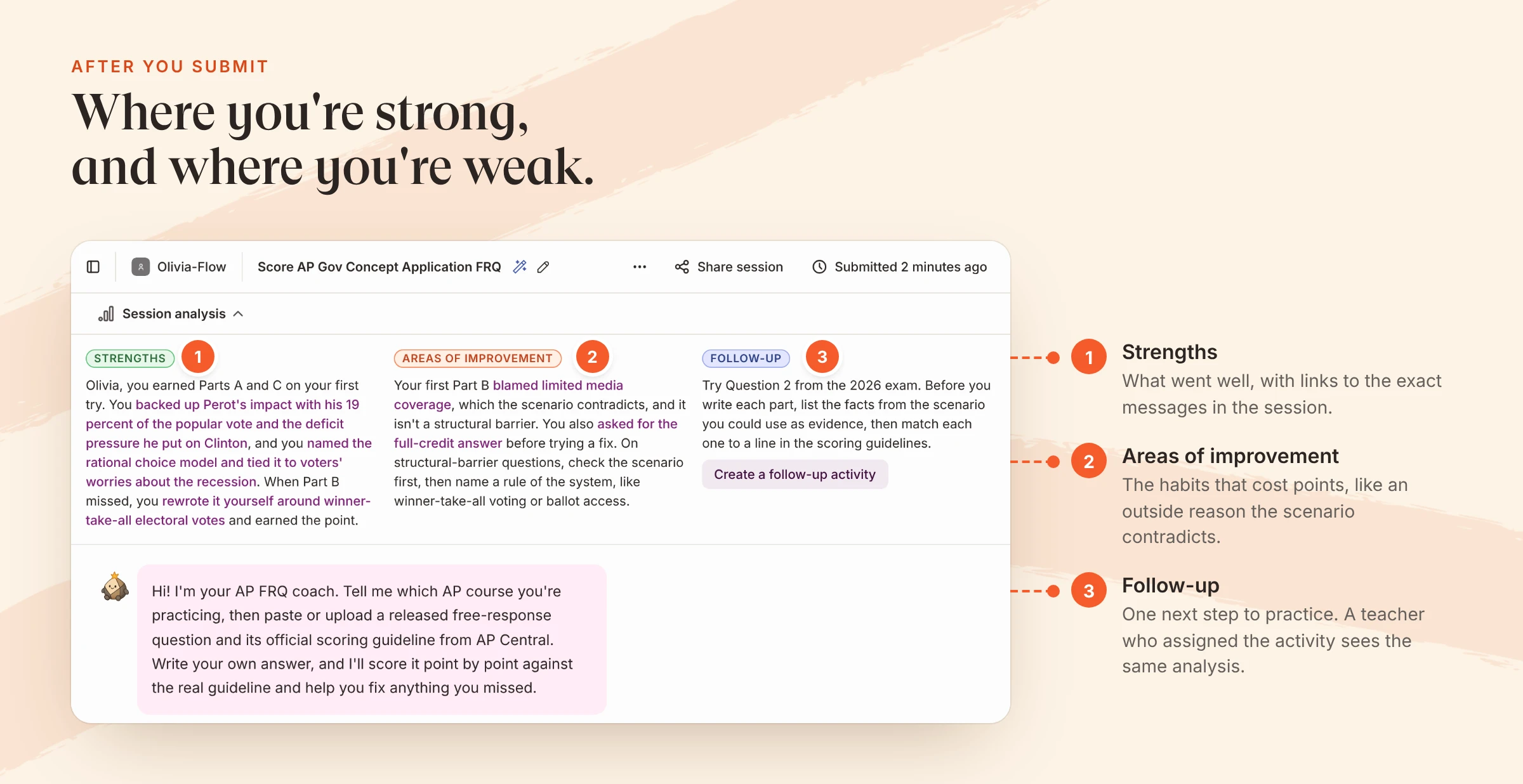
The student is an example. The FRQ, scoring guidelines and learning objectives are College Board's, from AP Central. We added the standard codes in the first image and the analysis cards in the last one, in the same layout Flint uses, and cut one student message from the second image for length.
Subject notes: Lang, Chem, Gov and Micro
These four subjects have free Flint activities. Each one opens in your browser, and you'll need a free account to start one.
AP English Language (Wed, May 12, morning, typed)
The exam has 45 multiple-choice questions (45% of your score) and three essays (55%): synthesis, rhetorical analysis and argument. Since every essay is typed, write your practice essays on a keyboard.
- AP English Language FRQ Practice & Grader
- AP English Language MCQ Practice and Grader
- Essay feedback for rhetorical analysis, synthesis and argument
More detail on each in our AP English Language post.
AP Chemistry (Thu, May 6, afternoon, handwritten)
Sixty multiple-choice questions in 90 minutes, then seven free-response questions in 1 hour 45 minutes, written by hand in a paper booklet. Practice FRQs on paper, show units and setups, and use the equation sheet College Board gives you so you know where everything is on it.
- Unit reviews with multiple choice, one FRQ and a study guide: Unit 1, Unit 2, Unit 3, Unit 4, Unit 5, Unit 6, Unit 7, Unit 8, Unit 9
- AP Chem MCQ Practice
You can upload a photo of your handwritten work for Sparky to analyze, so you can practice on paper and still get feedback. More in our AP Chemistry post.
AP U.S. Government and Politics (Tue, May 4, morning, typed)
Fifty-five multiple-choice questions in 1 hour 20 minutes, then four free-response questions in 1 hour 40 minutes: concept application, quantitative analysis, a Supreme Court comparison and an argument essay. You need to know the required cases and foundational documents cold.
- AP U.S. Government Essay Practice & Grader
- AP Government Supreme Court Cases Quiz
- AP Government Legislative Acts Quiz
- AP Gov Unit 2 Review
More in our AP Government post.
AP Microeconomics (Tue, May 4, afternoon, handwritten)
Sixty multiple-choice questions in 1 hour 10 minutes, then three free-response questions in 1 hour, handwritten. A four-function calculator is allowed on both sections. Micro FRQs are full of graphs, so draw and label them by hand while you practice.
- AP Microeconomics FRQ Practice
- Unit reviews: Unit 1, supply and demand graphs, Unit 3, game theory and imperfect competition, Unit 5, Unit 6
More in our AP Microeconomics post.
Subject notes: Calc, APUSH, Bio and Psych
Flint doesn't have subject activities for these yet. The scoring routine above still works, and so does the AP FRQ Practice activity, since it scores against whatever released question and guidelines you bring.
AP Calculus AB and BC (Mon, May 10, morning, handwritten)
Six free-response questions in 1 hour 30 minutes, handwritten. Part A is two questions with a graphing calculator; Part B is four without one (College Board). Practice both parts, and practice writing out your justifications, since the scoring guidelines award points for them. You can't take both AB and BC in the same year. If a unit isn't clicking, our guide on how to study for a math test shows how to find the exact step where your work goes wrong.
AP U.S. History (Fri, May 7, morning, typed)
Fifty-five multiple-choice questions in 55 minutes, three short-answer questions in 40 minutes, then the document-based question and the long essay in 1 hour 40 minutes (College Board). It's all typed, so practice the long essays on a keyboard.
AP Biology (Mon, May 3, afternoon, handwritten)
Sixty multiple-choice questions in 90 minutes, then six free-response questions in 90 minutes: two long and four short (College Board). Expect to graph and analyze data, so practice plotting by hand. Biology is on the very first day, so it's the earliest start on this plan.
AP Psychology (Fri, May 14, afternoon, typed)
Seventy-five multiple-choice questions in 90 minutes (67% of your score), then two free-response questions in 1 hour 10 minutes (College Board). One catch: the past questions on AP Central are from 2024 and earlier, before the free-response questions changed. For the current format, use the sample questions and the student responses with scoring commentary that College Board links from the same page.
Taking more than one AP exam?
Plan around your earliest exam, and study each subject a little every day instead of giving each one a whole week. If you're taking U.S. Government and Microeconomics, both on Tuesday, May 4, a weekday could look like 30 minutes of Government cases, then 30 minutes of Micro graphs. If you also take English Language on May 12, add one typed essay every other day.
Keep both same-day exams in your week 7 timed run. Government runs 3 hours in the morning and Micro 2 hours 10 minutes in the afternoon, so a Saturday rehearsal with a real lunch break in between will tell you how much energy you have left for the second one.
The last 48 hours: lock in, no cap
This part is mostly logistics. Learning a brand-new unit the night before is delulu. Here's what to do instead, based on College Board's what to bring list:
- Know your College Board username and password. You sign in to Bluebook on exam day, and College Board says a password saved on your device won't work.
- Charge your device and pack the charger if you're bringing your own. Make sure Bluebook is installed and updated.
- Pack pencils. For hybrid exams, bring two sharpened No. 2 pencils with erasers, or pens with black or dark blue ink, for the free-response booklet. Mechanical pencils aren't allowed. For fully digital exams, bring pencils for scratch paper.
- Bring up to two approved calculators if your exam allows them, and a watch that isn't a smartwatch. Your phone stays out of the room.
- Do one light review. Read your error log and the scoring guidelines for the question types you'll see. Then stop.
- Sleep. This is the last chance for that week of sleepmaxxing to pay off. Eat breakfast, get there early, and take the W.
Is 4 weeks enough to study for an AP exam?
It can be, if you've kept up in class. Squeeze the 8-week plan:
- Week 1: diagnostic on day one, then your weakest unit.
- Week 2: your next weak units, plus a daily multiple-choice set.
- Week 3: one free-response answer a day, scored against the real guidelines.
- Week 4: one timed run-through early in the week, then light review and sleep.
Two weeks or less? Skip straight to free-response practice with the scoring guidelines, since that's where you can pick up points fastest.
Where can I find free AP practice tests?
College Board posts past free-response questions, scoring guidelines and sample student answers for free on AP Central; start from your course's exam page. Bluebook has free test previews for digital AP exams. Your teacher can unlock progress checks and released questions for you in AP Classroom. Flint's free activities for English Language, Chemistry, U.S. Government and Microeconomics are linked in the subject notes above.
Can AI grade my AP essay?
AI can score a practice answer against College Board's published scoring guidelines and show you which points you earned or missed, which is useful feedback between drafts. Treat that as practice, not a predicted score: only College Board's AP readers give real scores. And choose a tool that asks you questions instead of rewriting your answer, for the reasons in the study above.
Do I handwrite or type my AP exam in 2027?
Both, depending on the subject. Every exam runs in Bluebook, but hybrid exams like Biology, Calculus, Chemistry and Microeconomics have handwritten free-response answers on paper. Fully digital exams like English Language, U.S. Government, U.S. History, Psychology and Statistics are typed from start to finish. The full list is in the pencil-or-keyboard section above.
Start this week, not in May
Put your start date in your calendar today, bookmark AP Central for your subjects, and save this page. When March comes, the plan's already done.
If you want the free Flint activities, you can make a free account at app.flintk12.com with Google, Microsoft or email if you're 13 or older. Teachers looking for more can see everything Flint does for test prep.