Oct 1, 2026
How to Study for a Math Test (When You're Stuck, Not Just Behind)
Six steps for studying for a math test when the material hasn't clicked yet: find the exact step where your work breaks, practice on new numbers, mix problem types, and a night-before checklist.

Jemel Fanfan | Founding Member at Flint

Feeling cooked about your next math test? Start here. This guide is for when you've gone to class and done the homework, and the material still hasn't clicked. What helps then is finding the exact step where your math goes wrong, and the only way to find it is to work problems.
Below are six steps, a spot-the-mistake challenge to try first, how to use an AI tutor without it doing the work for you, and a night-before checklist you can screenshot.
Quick heads-up: I work at Flint, and the AI tutor and free practice activity in this post are ours. Every step also works with a pencil and your old homework.
Try this first: spot the mistake
Here's a student's solution with exactly one wrong line. Find it before you read on.
Solve 3(x − 4) = 2x + 5
- 3(x − 4) = 2x + 5
- 3x − 12 = 2x + 5
- 3x − 2x = 5 − 12
- x = −7
Picked a line?
It's line 3. Moving −12 to the right side turns it into +12, so the line should read 3x − 2x = 5 + 12, which gives x = 17. You can check it by plugging 17 back in: 3(17 − 4) = 39 and 2(17) + 5 = 39. So the answer is 17, not −7. (Sorry, no 6-7 joke this time.)
Lines 1, 2 and 4 are fine. The student knew how to solve the equation, and one flipped sign still cost them the whole problem. Most points lost on math tests look like this: one bad step inside a method you mostly know. The rest of this guide is about finding your line 3.
Why rereading your notes doesn't work for math
Rereading feels productive, but it lowkey does very little for math. When you read a worked example, every step looks obvious because someone already chose it for you. On the test you have to choose each step yourself, starting from a blank page, and the only way to practice that is to do problems.
When researchers reviewed ten common study techniques, they rated practice testing and spreading your practice over several days as the most useful, and rereading and highlighting as low (Dunlosky et al., 2013).
Flashcards are good for formulas, like slope or the quadratic formula. They won't help you decide which formula a problem needs, or what to do after you've written it down.
Step 1: Find out what you actually don't get
Pull out your old homework and quizzes for the units on the test. Pick two or three problems from each section and redo them cold, with no notes and no peeking at your old answers. Then check them and sort them into three piles:
- Right, and you didn't hesitate. Stop studying these.
- Right, but you guessed at a step. Practice these.
- Wrong, or you couldn't start. This is your study list.
The third pile is usually shorter than people expect. It tends to be a few specific skills, like distributing a negative or solving when the variable shows up on both sides.
Step 2: Work problems out loud
Take a problem from your list and say each step as you write it, out loud or as a note next to the line: "I'm distributing the 3." "I'm moving the 12 to the other side, so its sign flips."
It feels a little silly. Do it anyway. When you have to say why a step is allowed, you notice the step you can't explain, and that's usually the one you'd get wrong on the test. Explaining a problem to a friend works the same way.
Step 3: Find the exact step where you went wrong
For every problem you missed, compare your work with a correct solution line by line. Find the first line where yours is different, then work out which rule that line broke. Write the rule next to it in your own words, like "negative times negative is positive."
This is the hardest step to do alone. An answer key shows the right work, but it can't tell you where yours went off. A teacher, a friend who gets it or a tutor can help here, and so can an AI tutor that works like a tutor.
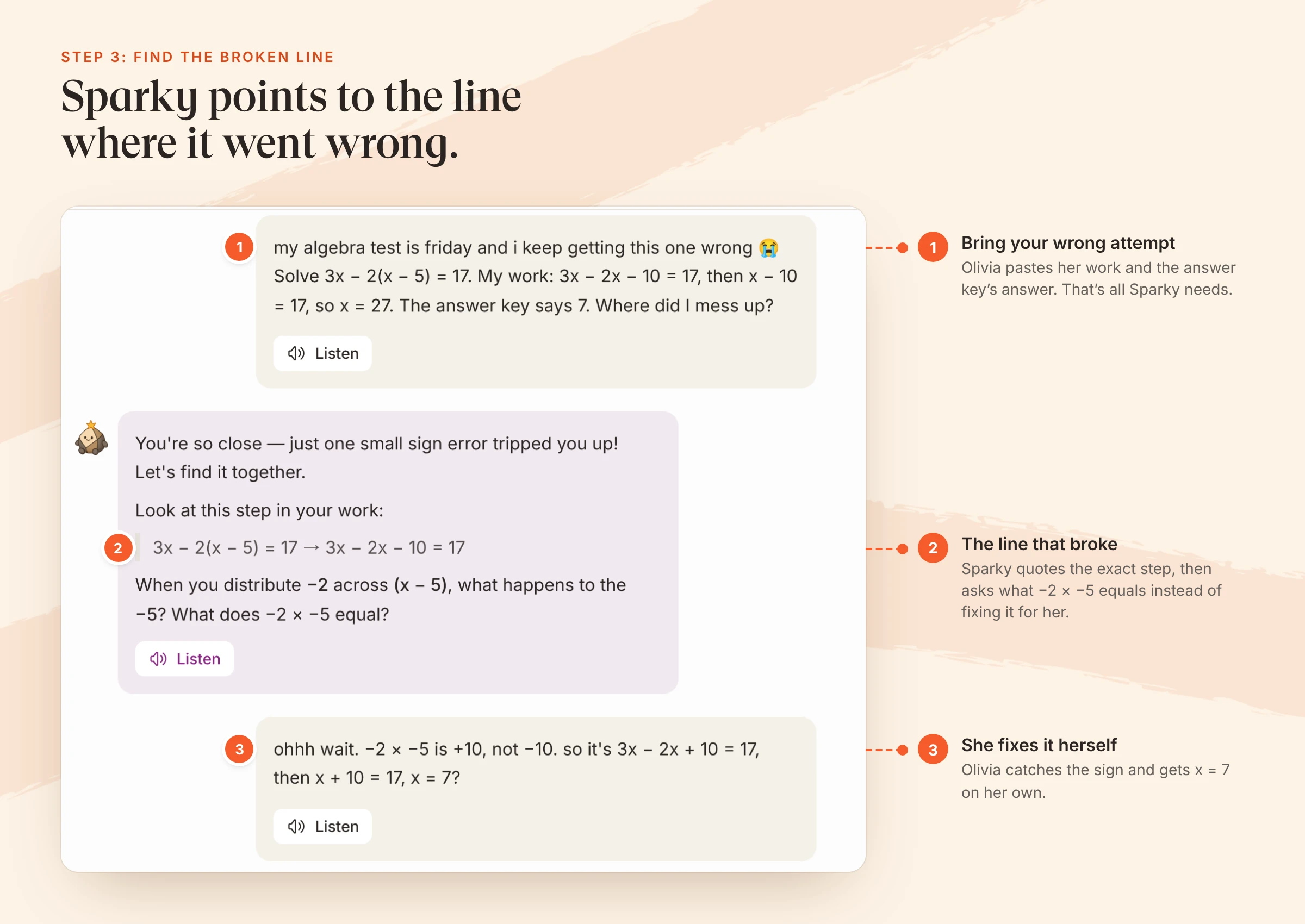
Here's that step with Sparky, Flint's AI tutor. Olivia is an example student. She pasted her wrong work, and Sparky quoted the line where she distributed −2 and got −10 instead of +10. Then it asked her what −2 × −5 equals and let her fix it herself.
Step 4: Practice on new numbers
After you fix a mistake, don't redo the same problem. You'll remember the answer, and remembering an answer is a different skill from solving. Do a problem with the same setup and different numbers instead. If your textbook pairs odd and even problems, do the other one in the pair, or change two numbers yourself.
If you get the new one right, the fix stuck. If you don't, go back to Step 3.
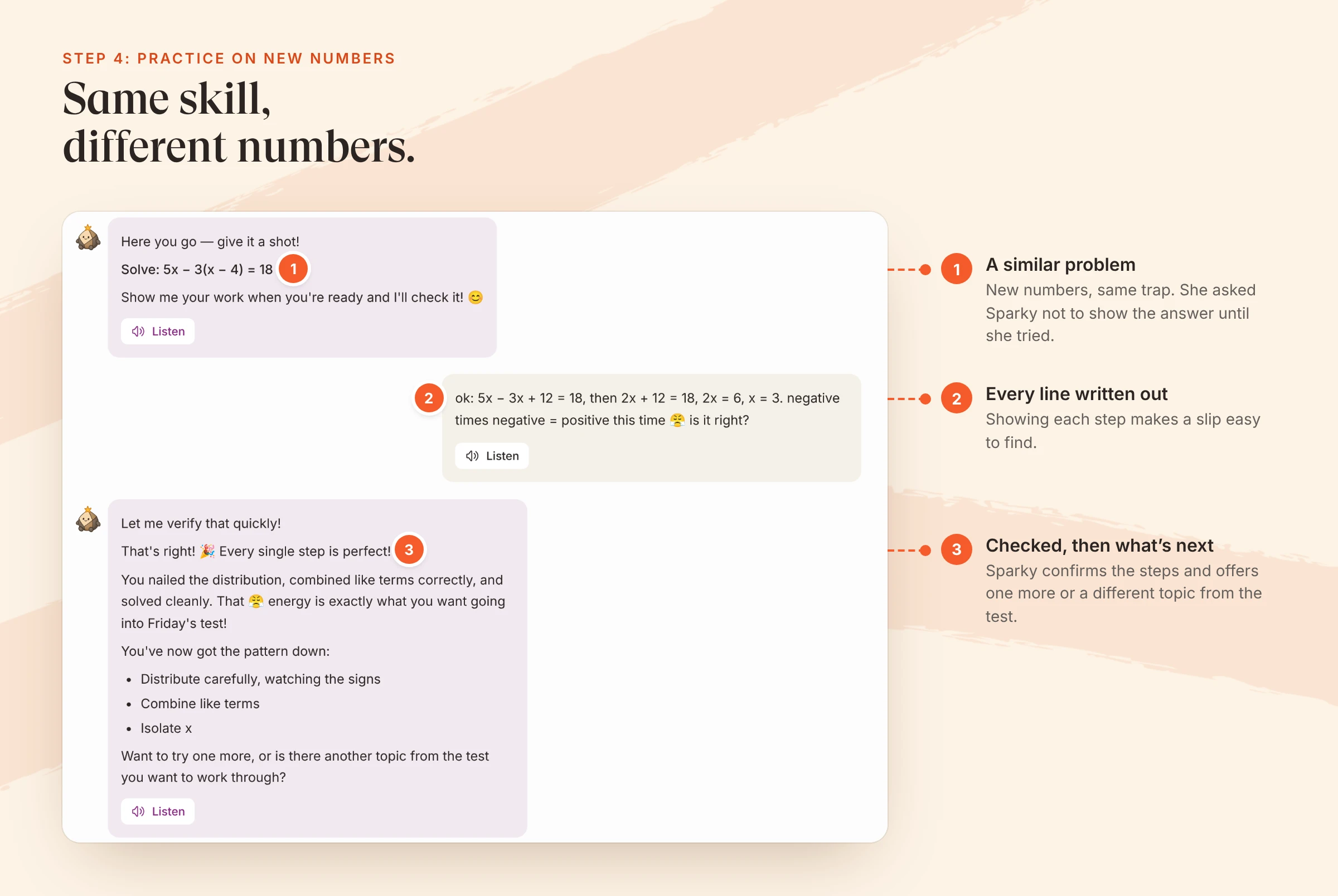
Olivia asked Sparky for a similar problem and told it not to show the answer until she'd tried. She got 5x − 3(x − 4) = 18, wrote out every line, and got it right.
Step 5: Mix problem types
Homework usually comes sorted: 20 problems from one section, all solved the same way. Your test won't be sorted. A big part of a math test is figuring out which method a problem needs, and sorted homework never makes you practice that.
So build your own mixed quiz. Take two problems from each section on the test, shuffle them, and cover up the section headings. In a study of 126 seventh graders, students who practiced with mixed problem types scored 74% on a surprise test 30 days later, compared with 42% for students who practiced one type at a time (Rohrer, Dedrick and Stershic, 2015).
Step 6: Time yourself once
A day or two before the test, take your mixed quiz under test conditions: timer on, phone in another room, and only the calculator you're allowed to use. Give yourself a bit less time than the real test.
You're checking two things: whether you finish, and which problems eat your time. If one type takes three times longer than the rest, practice it one last time. On the real test, skip it at first and come back to it.
How to use an AI tutor without it doing the work for you
If your AI hands you the full solution every time, it's giving "copy the back of the book," and that has a cost. In a study of high school math students, the ones who practiced with an AI that gave answers did 17% worse once the AI was taken away, while students who used a version built to tutor didn't show that drop (Bastani et al., PNAS 2025). A Harvard physics study found students learned more than twice as much, in less time, from an AI tutor built on good teaching practices (Kestin et al., 2025).
How you ask matters. Copy and paste these:
- "Here's my attempt. Find the first wrong step, but don't fix it for me."
- "Give me a similar problem with different numbers."
- "Don't show the answer until I've tried."
- "I'm stuck on this step. Give me a hint, not the next line."
- "Ask me what I'd do next instead of telling me."
Sparky works this way for students in a teacher's Flint class and inside Flint's tutoring activities, like the free Math 101 Tutor linked below. It asks what you've tried, uses worked examples with different numbers, points to where your reasoning went wrong, and won't solve assigned problems for you (Flint help center). It's set up to check math with a calculator instead of doing it in its head, and you can upload a photo of your handwritten work so you can practice on paper. Teachers can read more about how the Flint AI tutor works in class, and calculus students can see an example study session on parametric and polar curves.
The night before: don't crash out
Screenshot this list.
- Take your mixed quiz one more time, cold, and check every answer.
- For anything you missed, find the broken line and do one new-numbers version.
- Write the three rules you keep forgetting on one card. Read it twice, then put it away.
- Pack a pencil, an eraser, and the calculator you're allowed to use, with fresh batteries or a full charge.
- Pick a time to stop studying, and stop then. Starting a new topic at midnight mostly costs you sleep.
- Sleep. Tired brains make the same sign slips you just spent an hour fixing.
- In the morning, read your card once and leave it in your bag.
How do I study for a math test in one night?
Skip rereading. Spend the first half hour redoing two or three problems from each section without notes to see which skills you can't do yet. Spend the next hour on those skills: find the exact step that goes wrong, then work new versions with different numbers until you get two right in a row. Finish with a short mixed set and go to sleep. One night won't cover everything, so spend it on the skills that show up most on the test.
What if I don't understand anything?
Go back to the first problem in the unit that you can do, even if it's from the first day, and work forward one problem at a time until you reach the first one you can't. That problem is your starting point. Take it and your attempt to your teacher, a classmate or a tutor, and ask "what's the first thing I did wrong?" That's a much easier question to answer than "how do I do this chapter?", so you'll get a more useful answer.
Is it OK to use AI for math homework?
Check your teacher's rules first, because they differ between classes and schools. When AI is allowed, use it to check your reasoning and get hints while you do the work yourself. Asking for a full solution feels like a shortcut, but it skips the practice you'll need on the test, which is what the PNAS study above found.
How do I study for a math final?
Use the same steps over about two weeks. Redo a few problems from every unit to build your study list, spend most days on the units that broke, and build your mixed quizzes from the whole course instead of one chapter. Take one full timed practice test about three days before the final so you still have time to fix what it shows. Taking AP Calculus or AP Precalculus in May? Our AP exam study plan has a week-by-week schedule.
Start with one problem tonight
Pick the problem from your last quiz you're least sure about and work it out loud. If you want help finding the broken line, try Flint's free Math 101 Tutor, or SAT Math Practice if you're prepping for the SAT. You can look at both without signing in. To use one, make a free account at app.flintk12.com with Google, Microsoft or email if you're 13 or older, click "Use activity" to save your own copy, then click "Back" on the settings page that opens and "Start a session." Paste in your attempt and ask for the first wrong step.