Oct 1, 2026
How to Review an SAT Practice Test (and Actually Fix Your Mistakes)
A step-by-step way to review a Bluebook practice test: sort every miss, keep an error log (free printable PDF), re-work questions before reading the explanation, and get unstuck without being handed the answer.

Jemel Fanfan | Founding Member at Flint

You just finished a Bluebook practice test and the score came back 150 points under your goal. You're not cooked. The list of questions you missed is worth more than the number at the top, and it's the part most people skim and close.
This post is a step-by-step way to review an SAT practice test so the same mistakes don't follow you to test day. It uses the free tools College Board already gives you, a printable error log, and, for the questions you still can't crack, an AI tutor that asks you questions instead of handing you the answer.
I work at Flint, so the tutor activities linked near the end are ours. Everything else here is free from College Board, and the method works without Flint.
When is your next SAT?
Here are the remaining dates for this school year, from College Board's dates and deadlines page and score release schedule, checked October 1, 2026:
| Test date | Register by | Late registration | Scores out |
|---|---|---|---|
| Nov 7, 2026 | Oct 23 | Oct 27 | Nov 20 |
| Dec 5, 2026 | Nov 20 | Nov 24 | Dec 18 |
| Mar 6, 2027 | Feb 19 | Feb 23 | |
| May 1, 2027 | Apr 16 | Apr 20 | |
| Jun 5, 2027 | May 21 | May 25 |
Five weeks to November 7 is enough for two or three full practice tests if you review each one with the steps below. If December 5 is your date, you have room for one more.
Scores matter again at a lot of colleges. College Board's BigFuture list of schools that require the SAT or ACT includes Harvard, MIT, Stanford, Penn, Cornell, Dartmouth, Brown, Georgia Tech, Purdue and UT Austin. Check each college's own admissions page, since College Board says the list changes often.
Your worst practice test is your best study guide
Two findings from memory research make a rough score easier to look at.
In a 2001 study, the wrong answers people were most confident about were the ones they were most likely to fix after seeing the correct answer (Butterfield and Metcalfe). The miss that made you say "wait, what?" is the one you're most likely to remember next time.
In a 2009 study, people who tried to answer a question before seeing the answer remembered it better later than people who just read the question and answer together, even when their attempt was wrong (Kornell, Hays and Bjork). Every question you got wrong on the practice test already counts as an attempt. Review is where you collect on it.
So taking test after test without reviewing wastes most of what each one gives you. One test reviewed properly does more for you than three you only score.
Step 1: Pull up every miss in My Practice
When you finish a full-length practice test in Bluebook, your results go to My Practice. College Board's guide to Bluebook practice tests says Score Details lists every question on the test, the answer you gave and the correct answer, with a Review button that shows the question and its explanation.
Don't open any explanations yet. For now, write down the question number and section for three kinds of questions:
- Every question you got wrong.
- Every question you got right by guessing. A lucky guess is a miss you haven't paid for yet.
- Every question you flagged during the test, even if you got it right.
Step 2: Sort each miss into one of four piles
Every miss has a reason, and the reason decides the fix. Put each one in one of these piles:
| Pile | What it looks like | The fix |
|---|---|---|
| Content gap | You didn't know the rule. You've never seen how to find the vertex of a parabola, or you don't know when a semicolon works. | Learn the rule, then practice it |
| Slip | You knew how, but made a small error: dropped a negative sign, multiplied wrong, clicked B when you meant C. | A habit, like rewriting each line of work or checking units |
| Timing | You rushed it or guessed because time was running out. | Pacing practice, and knowing which questions to skip and come back to |
| Misread | You solved a different question. It asked for 2x and you gave x, or it asked which choice weakens the claim and you picked the one that supports it. | Underline what the question asks for before you solve |
Next to each miss, also mark how sure you were when you answered: sure, unsure or a guess. The "sure" misses go straight to the top of your list, for the reason in the study above.
Step 3: Build your error log
An error log turns a pile of misses into a plan. You can use a notebook or a spreadsheet, or download our printable SAT error log (PDF). It has these columns:
- Section and module (for example, Math, Module 2)
- Question number
- Topic
- How sure you were
- Why you missed it (content gap, slip, timing or misread)
- What went wrong, in your own words
- Your rule for next time, such as "Percent change multiplies, it doesn't add"
- A box to tick once you've re-worked it before reading the explanation
- A retest date, one week out
When you're done, count each pile. Ten slips and two content gaps means you need checking habits more than new content. Ten content gaps in one Math domain means that domain is your next week of study.
Step 4: Re-work it first (nodding along is mid)
Before you open the explanation, cover the answer and solve the question again from scratch, with no time limit. Show every step. For Reading and Writing, write down why each wrong choice is wrong.
Reading an explanation feels like learning because everything makes sense while you read it. Re-working the question first gives you the attempt the Kornell study describes, so the explanation sticks better when you do read it.
Then open the explanation in Score Details and compare. If your re-work got it right, the miss was probably a slip, timing or a misread, and your rule for next time is a habit. If you still got it wrong, it's a content gap. Move to step 5.
Step 5: Get unstuck on the ones you still don't get
Some questions still won't make sense after the explanation. College Board gives you three free places to go next, all listed on its practice test page:
- Official SAT Prep on Khan Academy, which you can open from My Practice, with lessons, videos and practice questions.
- Schoolhouse.world, which runs free four-week tutoring groups led by peer tutors who recently did well on the SAT.
- Your teacher, or a friend who's strong in that section.
An AI tutor can help too, as long as you use it the right way. In a 2025 study published in PNAS, nearly a thousand high school math students practiced with either a plain chatbot or a tutor version built to give hints. Once the AI was taken away, the plain-chatbot group did 17% worse than students who never had it. The hint-giving version mostly avoided that drop. On test day, you're the only one in the room who can do the math.
So tell the tutor what you want before you show it the question:
| Ask this | Not this |
|---|---|
| "I got this wrong. Don't tell me the answer yet. Ask me how I set it up." | "What's the answer?" |
| "Here's my work. Which step went wrong?" | "Explain this question." |
| "Give me a similar one with different numbers." | "Solve the rest of these for me." |
The last one matters most. If you can solve a fresh version of the question by yourself, the fix stuck.
Flint has two free SAT activities that work this way. In SAT Math Practice, Sparky, Flint's AI tutor, works through problems step by step without giving away the answer, and it uses a built-in calculator to check the math. SAT Reading and Writing Tutor walks you through passage-based questions and the reasoning behind each choice. Both open in your browser, and you'll need a free account to start one. You can paste a question in, or upload a screenshot of your work for Sparky to look at.
Here's what that looks like in SAT Math Practice, with a percent question that trips up a lot of people:
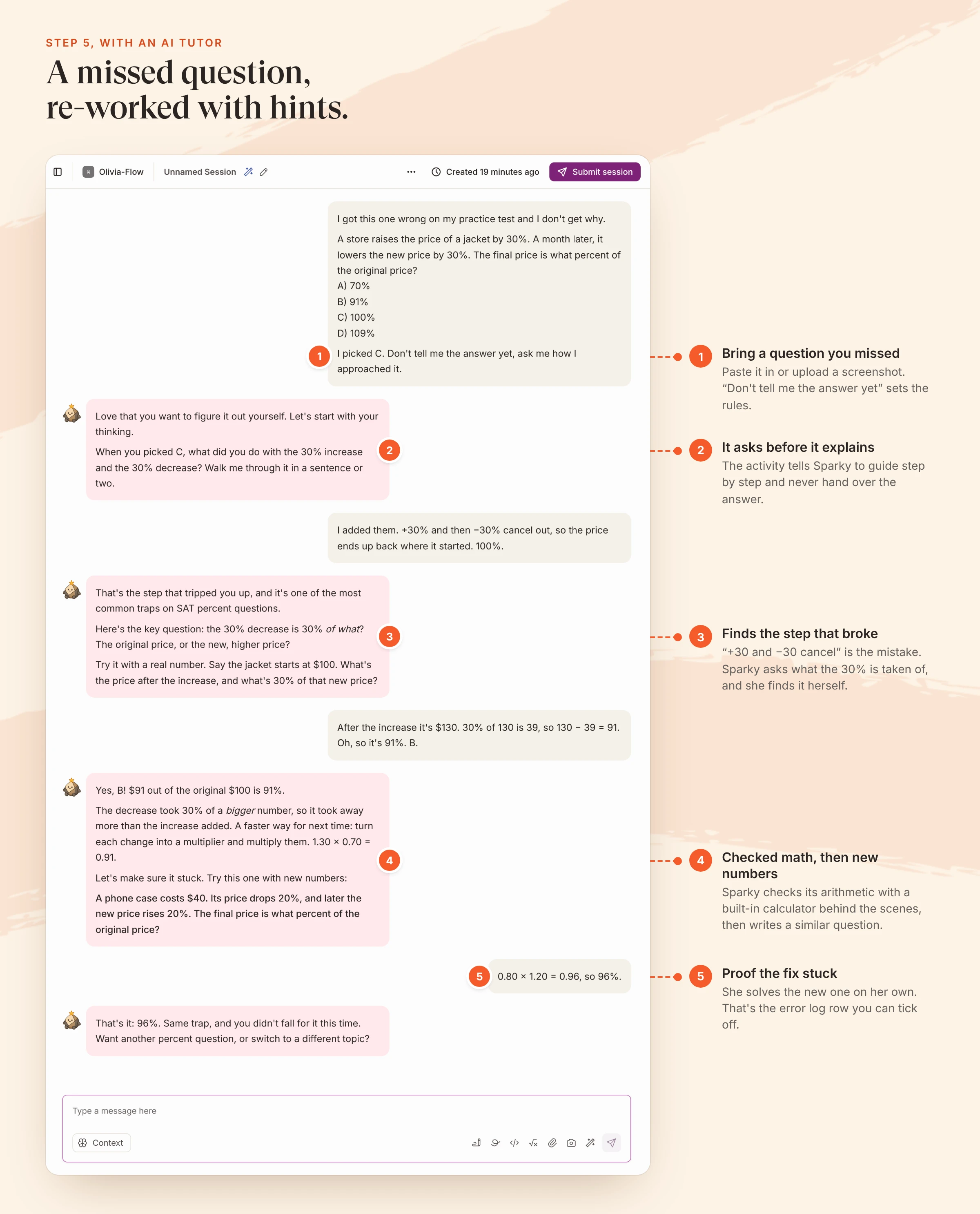
The question is one we wrote, in the style of an SAT percent question. The screen is the SAT Math Practice activity. We wrote the conversation after the student's question to show how the activity coaches, using the same layout Flint uses.
Step 6: Drill the pattern, not just the question
Fixing one question doesn't fix the pattern behind it. Once you know why you missed something, practice that exact skill:
- Tailored Practice: College Board says My Practice can build a custom question set from your practice test results. Look for the Get Tailored Practice button on your dashboard or in Score Details.
- The Student Question Bank: you can filter thousands of official SAT Suite questions by section, domain, skill and difficulty, so you can do 10 questions on exactly the skill you missed.
- A Flint activity: ask Sparky in SAT Math Practice or the Reading and Writing Tutor for five more questions on one skill, like percent change or transitions, and work through them with hints when you need them.
If your teacher uses Flint, they can also build SAT Math and Reading and Writing practice sets for your class with the SAT practice generator.
Step 7: Retest the pattern a week later
A week after your review, go back to your error log. For every row, try a new question on the same skill, from the Question Bank or a tutor, without looking at your notes. If you get it right, tick the retest box. If you don't, the row stays open for another week.
The gap is the point. A 2013 review of ten common study techniques found two that worked across ages and subjects: quizzing yourself, and spreading practice out over days instead of packing it into one night (Dunlosky et al.). A retest a week later does both.
How long should review take?
College Board hasn't published a rule for this, so here's my suggestion: plan to spend about as long reviewing as you spent testing. The SAT itself runs 2 hours and 14 minutes, so set aside around two hours, split over a day or two. Slips and misreads take a minute or two each to log. Content gaps take 10 minutes or more, since you re-work the question, learn the rule and try a similar one.
If review takes much longer than the test, you're probably reading every explanation in detail, including for questions you got right with confidence. Skip those.
Just took the PSAT? Don't crash out over it
The PSAT/NMSQT runs in schools October 1–30 this year, so a lot of juniors are taking it right now. College Board's score release schedule puts fall scores out to students on October 22, November 5 or November 12, depending on when your school sends in answers. Your school or counselor can give you your score report, and College Board says US students who added a phone number during testing can also see scores in the BigFuture School app.
The PSAT score report shows your total and section scores, plus a Knowledge and Skills section showing how you did in each of the eight content areas, four in Reading and Writing and four in Math. Use that graphic the way you'd use the piles in step 2:
- Pick the one or two content areas where you did worst.
- Take a full-length practice test in Bluebook. College Board has full-length practice tests for the PSAT/NMSQT as well as the SAT.
- Review it with steps 1 to 7, paying extra attention to questions from those weak content areas.
Both tests are part of College Board's SAT Suite, so the skills you fix now carry over to the SAT.
How many SAT practice tests should I take?
College Board doesn't set a number. Take as many as you can review properly. One test you sort, log and re-work teaches you more than three you only score. Leave a full review and about a week of drilling between tests, so each new one shows whether last week's fixes held.
How long should it take to review an SAT practice test?
About as long as the test, roughly two hours, split over a day or two. Slips and misreads go fast. Content gaps take longer because you re-work the question, find the rule, and try a similar question before you call it fixed.
Can AI help me study for the SAT?
Yes, if it makes you do the thinking. Ask it to question you about how you set up a problem, to point to the step that went wrong, and to give you a similar question with new numbers. Skip asking for the answer. In the 2025 PNAS study above, practicing with a plain chatbot left students worse off once it was gone, while a hint-giving tutor didn't.
What is an SAT error log?
It's a list of every question you missed, guessed on or flagged on a practice test, with why you missed it, what went wrong, the rule you'll use next time, and a date to retest that skill. Counting the reasons shows you what to study. Our printable error log has all of these columns.
Lock in
Take your next practice test this week, print the error log, and give the review the same two hours you gave the test. The score on the next one will tell you whether it worked.
If you want a tutor for step 5, the SAT Math Practice and SAT Reading and Writing Tutor activities are free at app.flintk12.com, where you can sign up with Google, Microsoft or email if you're 13 or older. Teachers can see more of what Flint does for test prep, and if you're also taking APs this spring, here's our AP exam study plan for May 2027.