Oct 2, 2026
Report Card Comments for English Learners (Fall 2026): Examples by WIDA Level, Plus How to Translate Them for Families
Example report card comments for English learners at WIDA levels 1 to 5, for kindergarten through 8th grade, plus a checklist for comments that hold up in translation and where AI translation is and isn't enough.

Jemel Fanfan | Founding Member at Flint

First-quarter report cards go home in October and November in many districts. If you teach ESL or ELD, your comments have two jobs that pull against each other. They have to describe language growth honestly, and they have to make sense to a family that may read them in Spanish, Arabic or another home language, often through a translation nobody at school has checked.
Most of those students are in the early grades. In fall 2021, the latest year the National Center for Education Statistics has reported, English learners were 10.6% of US public school students (5.3 million), 14.7% of kindergartners and 9.0% of 8th graders. Spanish was the home language of 76.4% of them.
This post has example comments for WIDA levels 1 to 5 across grades K-8, a checklist for writing comments that hold up in translation, and where AI translation is fine and where you still need the district's interpreter. Copy any comment and change the details to fit your student.
What should a report card comment for an English learner say?
Say what the student can do in English now, give one example from class, and name one next step. Keep it to three or four short sentences, so it still reads clearly after translation. If there's room, add one thing the family can do at home, in any language.
A pattern that works at every level:
[Student] can [skill in English]. For example, [what you saw in class]. Next, we will work on [one goal]. At home, you can help by [one thing, in your home language or English].
The home-language line is worth the space. The National Academies' 2017 report on English learners found that children "who become proficient in both a home or primary language … and English … are likely to reap benefits in cognitive, social, and emotional development" (summary). The committee's report brief also warns that children who don't keep up their home language "may lose their ability to communicate with parents and family members." A comment that says "keep reading together in Spanish" tells a family their language is helping.
Report card comments for English learners, by WIDA level
The comments below follow WIDA's six proficiency levels, which the 2020 ELD Standards Framework names Entering, Emerging, Developing, Expanding, Bridging and Reaching. Newer WIDA materials often use the numbers alone. Level 6 is open-ended, so the examples cover levels 1 to 5, with one comment per language domain and a next step in each table.
You know your students' WIDA ACCESS scores well. Most families don't, so describe the skill and leave the level out of the comment unless your district asks for it. WIDA makes a similar point in its proficiency level FAQ: a level "does not categorize a multilingual learner" but describes a snapshot of their performance. This fall there's one more reason. WIDA set new cut scores in July 2026 that take effect in spring 2027, and it advises using 2026 proficiency level scores "with caution" because they still reflect the cut scores set in 2016 (WIDA, April 2026).
Level 1, Entering
| Domain | Comment |
|---|---|
| Listening | [Student] follows one-step directions when I show what to do, such as "Get your folder." |
| Speaking | [Student] answers yes-or-no questions in English and is starting to name things in our classroom. |
| Reading | [Student] matches pictures to words and is learning the sounds of English letters. |
| Writing | [Student] labels drawings with words from our word wall. |
| Next step | Next, [Student] will learn short phrases to ask for help, such as "Can you help me?" |
A newcomer who doesn't say much yet still has plenty to report. Write about what they understand and the routines they follow, such as finding their seat, lining up, or getting their lunch.
Level 2, Emerging
| Domain | Comment |
|---|---|
| Listening | [Student] follows two-step directions in English when I use pictures or gestures. |
| Speaking | [Student] shares ideas in small groups using sentence starters such as "I think ___ because ___." |
| Reading | [Student] retells a picture book in order using the pictures. |
| Writing | [Student] writes short sentences with help from a word bank. |
| Next step | Next, we will practice past-tense verbs, such as "I went" instead of "I go," when [Student] talks about something that already happened. |
Level 3, Developing
| Domain | Comment |
|---|---|
| Listening | [Student] understands the main idea of a short read-aloud and answers who, what and where questions about it. |
| Speaking | [Student] explains the steps of a process in a few connected sentences, such as how a seed grows into a plant. |
| Reading | [Student] reads grade-level texts when we preview new words first, and finds key details. |
| Writing | [Student] writes a paragraph with a topic sentence when using a graphic organizer. |
| Next step | Next, [Student] will use words like "first," "then" and "because" to connect ideas in writing. |
Level 4, Expanding
| Domain | Comment |
|---|---|
| Listening | [Student] follows whole-class discussions and asks questions when something is not clear. |
| Speaking | [Student] explains how they solved a math problem using words like "equal," "total" and "divide." |
| Reading | [Student] reads grade-level texts with little help. Expressions that don't mean what the words say, such as "raining cats and dogs," are still new. |
| Writing | [Student] writes stories and reports with several paragraphs. |
| Next step | Next, [Student] will choose more exact words and use different kinds of sentences in writing. |
Level 5, Bridging
| Domain | Comment |
|---|---|
| Listening | [Student] understands grade-level lessons in every subject. |
| Speaking | [Student] gave a clear, well-organized presentation to the class about [topic]. |
| Reading | [Student] reads grade-level texts on their own and compares information from two sources. |
| Writing | [Student] writes opinion pieces that give reasons and support each reason with evidence from a text. |
| Next step | Next, [Student] will use more formal language in writing, such as "In conclusion" instead of "So." |
Kindergarten and first grade
Young students learn English through play and routines, so report on those. These work across levels 1 to 3:
| Domain | Comment |
|---|---|
| Listening | [Student] joins in when we sing songs and say rhymes in English. |
| Speaking | [Student] uses English to ask a friend to share, such as "Can I have the blue?" |
| Reading | [Student] knows [number] letter sounds and points to words as we read together. |
| Writing | [Student] writes the first sound of words to label drawings. |
| Next step | Next, [Student] will practice speaking in full sentences during morning meeting. |
Grades 6 to 8
Middle schoolers read their own report cards, and some also end up translating school letters for their families. Make sure the family gets its own translated copy, so the student isn't the one explaining their grades. Content teachers grade the subject, so your comment can tell families how English is affecting it.
| Subject | Comment |
|---|---|
| Science | [Student] uses science words like "evidence" and "conclusion" correctly in lab reports. Next, we will work on explaining results in complete sentences. |
| Social studies | [Student] finds the main idea in primary sources when we read them in small groups. Next, [Student] will practice summarizing a source in their own words. |
| Math | [Student] solves multi-step problems and is learning to explain each step in writing. |
| English language arts | [Student] compares two characters and supports each point with a quote from the book. |
| Next step | Next, [Student] will speak up more in whole-class discussions. A sentence starter on their desk is helping. |
How do you write report card comments that translate well?
Plan for the translation from the first sentence. Short sentences, plain words and concrete facts come through intact, while idioms, school jargon and vague praise often come out garbled or empty. Charlie Davis, a school nurse in Croton-Harmon, New York, gave Education Week the short version: "No euphemism. No slang. Be to the point. Be brief."
Districts with their own translators say the same. Anne Arundel County Public Schools in Maryland asks elementary teachers to send narrative comments to a bilingual facilitator at least 10 days ahead, to limit each child to "no more than two" unique sentences, and to "keep the information simple" (2015 guidelines).
Before you submit, check each comment against this list:
- One idea per sentence, and most sentences under 15 words.
- No idioms. "On the right track," "a bit of a chatterbox" and "needs to buckle down" can come out word for word.
- No school terms without an explanation. WIDA, ACCESS, ELD, Tier 2, CER and decoding mean nothing to most families in any language.
- Use the student's name, not "he" or "she," when a sentence could point to two people.
- Name the grading period with dates. A US "quarter" doesn't match the school terms in every country.
- Write dates and times out in full. NAEYC notes that some languages, such as French and French Creole, don't use "a.m." and "p.m."
- Watch words about feelings. Belle Li, a Purdue researcher, told Education Week that if you write you're "worried" about slow reading progress, a translation tool "might choose a word that better describes a dire situation." It might also address parents with the informal tú instead of usted.
- Give a fact instead of a judgment: "reads 42 words a minute, up from 25 in September" says more than "reading is improving."
The grading-period point came up when we ran a comment through a translator for this post (more on that below). "In the next quarter" became en el próximo trimestre, and the tool asked how the school's grading periods work.
| Instead of | Try |
|---|---|
| [Student] is on the right track with reading. | [Student] reads short books on their own. In September, [Student] needed help with every page. |
| [Student] needs to work on CER in science. | In science, [Student] will practice writing an answer, the evidence for it, and why the evidence supports it. |
| [Student] is a pleasure to have in class. | [Student] helps classmates and joins every group activity. |
| [Student] struggles with decoding. | [Student] is still learning to sound out new words. |
Can you use AI to translate report card comments?
For a first draft of a routine comment, yes, if it's a tool your school has approved and someone who reads the language checks the result. For anything with real consequences, use your district's interpreters or translation service.
Plenty of teachers are already using AI for this kind of writing. In an NPR/Ipsos poll of 545 K-12 teachers (April 27 to May 5, 2026), 41% of the teachers who use AI said they use it for communicating with parents or writing reports. Schools are still deciding how far to trust it for translation. Alyson Klein reported in Education Week on September 21 that a bilingual speaker "should review materials translated by AI before they are sent to parents, experts and educators say," and that IEPs and academic placement information "should never be translated by AI alone." Li put the risk this way: "AI translation is so fluent it makes it harder to notice a miscommunication."
The federal rules changed in 2025, too. A 2015 fact sheet from the Education and Justice departments said schools must communicate with parents who have limited English "in a language they can understand," naming report cards and parent-teacher conferences, and may not rely on students, siblings or untrained staff to interpret. The letter it accompanied also cautioned against web-based machine translation unless "an individual qualified to do so" reviewed it. The Education Department rescinded that letter in August 2025, K-12 Dive reported, and a July 2025 Justice Department memo encouraged "responsible use of artificial intelligence and machine translation." The laws behind the 2015 guidance, including Title VI of the Civil Rights Act, haven't changed. Colorado's education department, for one, says "the legal requirements described in the guidance remain firmly in place." Ask your district what its own language-access policy says before you decide what goes through AI.
Here's where I'd draw the line:
| Situation | AI translation, then a bilingual check | District interpreter or translation service |
|---|---|---|
| Routine progress comment | Yes | |
| Classroom newsletter or reminder | Yes | |
| A grade that puts promotion or a course at risk | Yes | |
| Discipline | Yes | |
| Special education, IEP or 504 | Yes | |
| Parent-teacher conference | Yes, with a live interpreter | |
| A language nobody on staff reads | Yes |
Accuracy also depends on the language. Li told Education Week that tools do better between "high resource" languages such as Spanish, Chinese and French than "lower resource" ones such as Swahili, Lao or Yoruba. A 2024 Pediatrics study of hospital discharge instructions found ChatGPT and Google Translate close to professional translators in Spanish and Portuguese. In Haitian Creole, 33.3% of ChatGPT's translations and 23.3% of Google Translate's had potentially serious errors, against 8.3% for professionals. A June 2026 study of school psychology reports translated into Spanish found that "no translation method produced a perfect translation," the human translator included.
Whatever tool you use, keep student names, ID numbers, IEP details and anything about health or family situations out of chatbots your district hasn't approved. Use a placeholder such as [Student] and add the name after you paste the comment into your gradebook.
A 3-step workflow: draft, simplify, translate
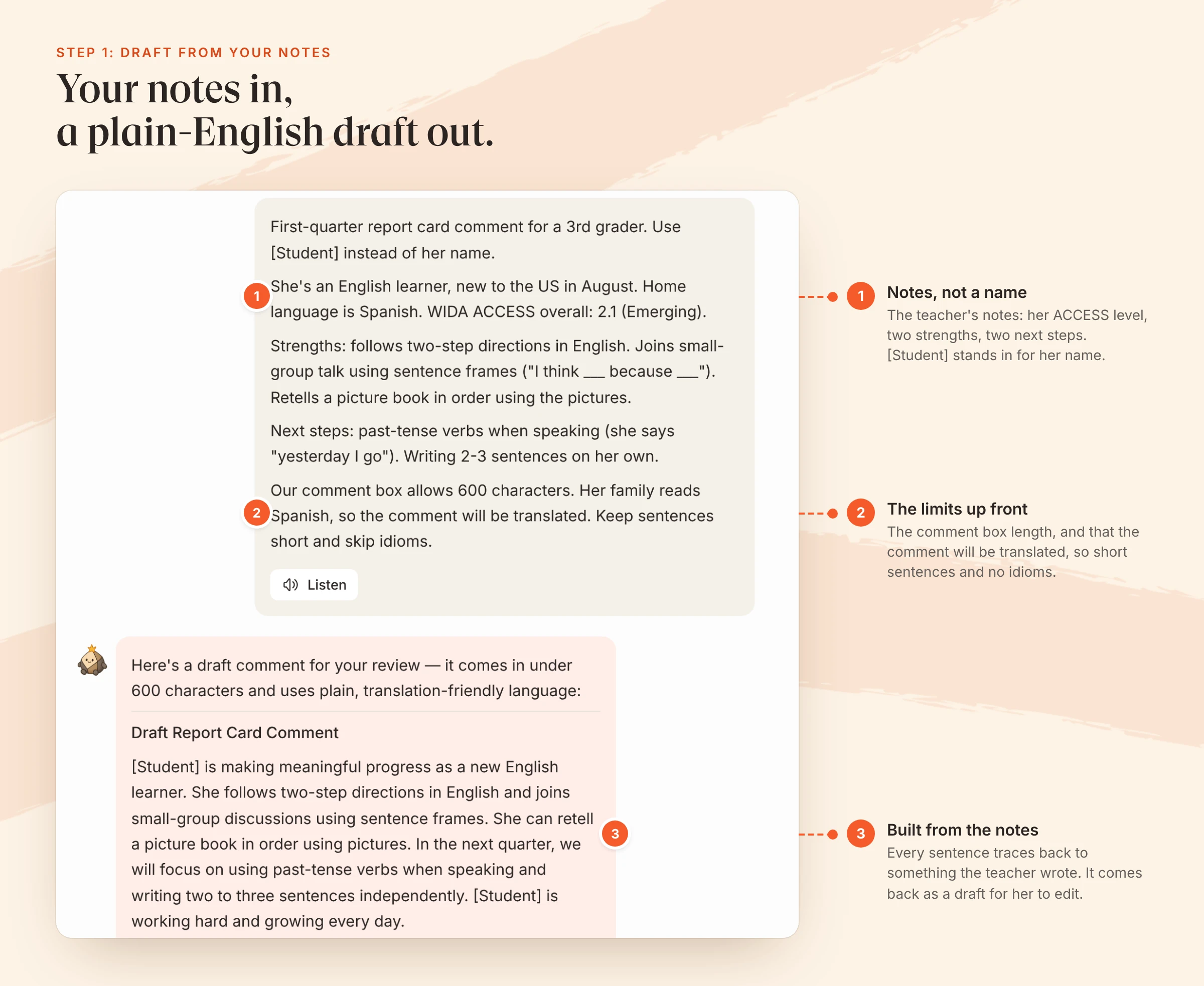
I work at Flint, so weigh this section with that in mind. Flint is an AI learning platform for schools, and its teacher tools include a Report Card Commenter and a Text Translator. Here's one comment going through both, for a 3rd-grade English learner at WIDA level 2. The student and the notes are made up for this post.
Step 1: Draft from your notes
Start from what you've written down: the student's level, two strengths, one or two next steps, and the limits of your comment box. The Report Card Commenter asks for strengths and next steps first, and it's set up to work from your notes without inventing details. It returns a draft for you to review before anything goes on the report card.
Step 2: Simplify
Read the draft against the checklist above. This one was already short and free of idioms, at 394 characters for a 600-character box. I'd still change "independently" to "on her own," since plainer words are easier to translate. You might also swap "in the next quarter" for the dates of your next grading period.
Step 3: Translate and check
Paste the final English comment into the Text Translator and name the language. It's built to keep meaning, tone and register, and to flag wording it can't translate confidently instead of guessing.
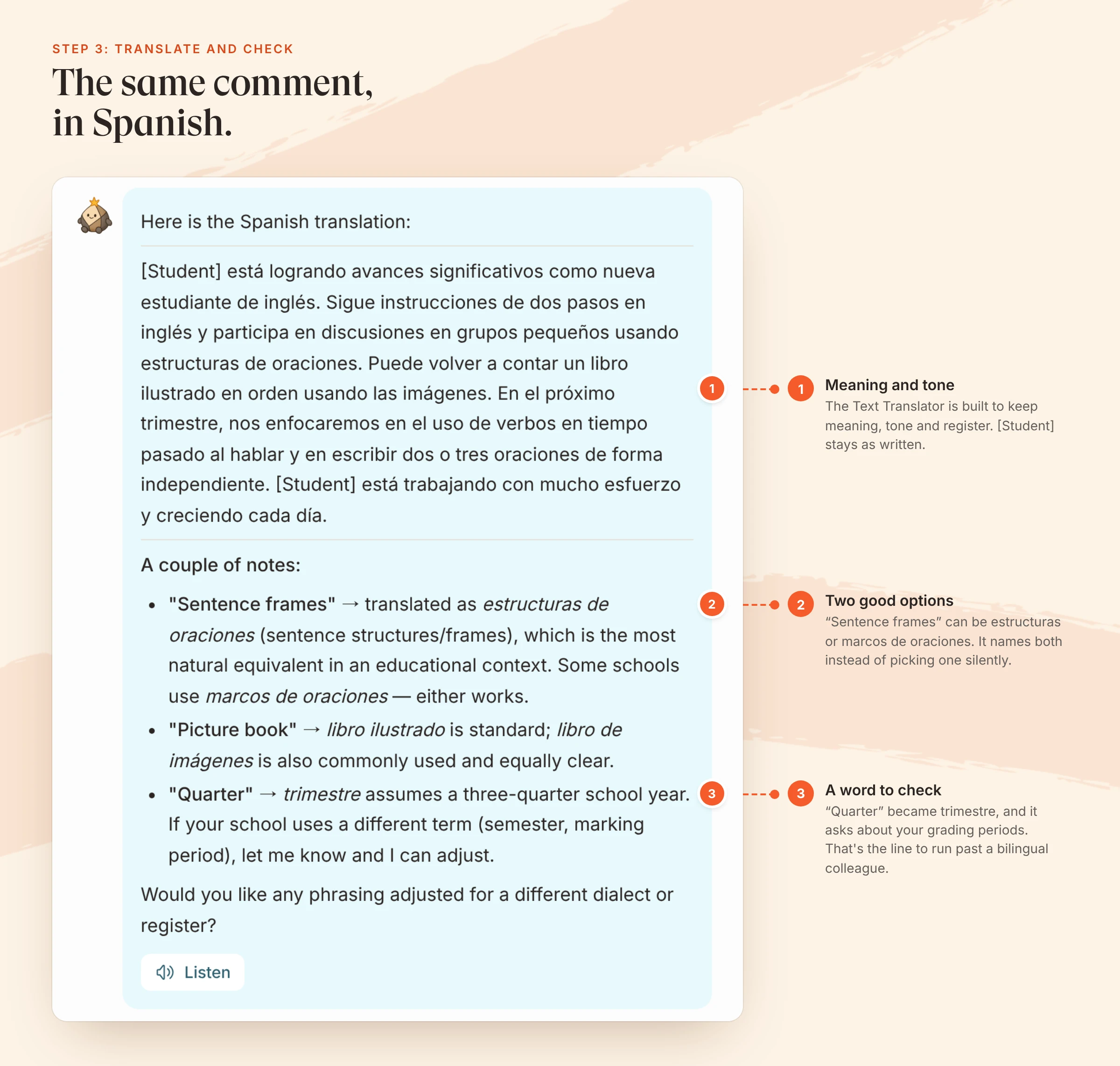
Its notes are where a bilingual colleague should look first. Here it offered two Spanish terms for "sentence frames" and asked about grading periods. A colleague who reads Spanish can settle both in a minute.
If you also want to send a short note home inviting the family to a conference, the AI Email Writer drafts one from your notes. That message can go through the same translate-and-check step.
If you share students with classroom teachers
Most ELD teachers write comments for students who also get comments from a homeroom or content teacher. A few minutes of planning keeps families from getting two messages that don't match:
- Agree on who reports what. The classroom teacher covers the subject and the grade, and you cover English growth across the four domains.
- Share your next step with the classroom teacher, so both comments point to the same goal.
- Decide who adds the at-home suggestion, so families get one, not three.
- Send both comments through translation at the same time, so the family gets them together.
FAQ
What do you write in a report card comment for an ESL student?
Write what the student can do in English now, one example from class, and one next step. Use short sentences and plain words so the comment still makes sense after translation, and leave out idioms and school terms like WIDA levels or ELD unless you explain them.
Should report card comments include WIDA levels?
Usually not. Most families don't know what a WIDA level or an ACCESS score means, and the number translates without the meaning. Describe the skill instead, such as "retells a picture book in order," and follow your district's rules if it reports WIDA ACCESS scores separately.
Can I use Google Translate for report card comments?
For a routine comment, a school-approved translation tool can give you a first draft, but have someone who reads the language check it before it goes home. Don't paste student names or private details into a tool your district hasn't approved. For grades at risk, discipline or special education, use your district's interpreters.
Do schools have to translate report cards for parents?
Federal guidance from 2015 said yes: schools had to share report card information with parents who have limited English in a language they understand, through competent translators or interpreters. The Education Department rescinded that guidance in August 2025, but the civil rights law behind it, Title VI, still applies, and state and district rules may too. Ask your district's English learner or family engagement office what applies to you.
What are good ESL report card comments for kindergarten?
Report on what young students do through play and routines. For example: "[Student] joins in when we sing songs in English," "[Student] uses English to ask a friend to share," or "[Student] writes the first sound of words to label drawings." Then add one next step, such as speaking in full sentences during morning meeting.