Oct 14, 2026
Exit tickets: 45 exit ticket examples by grade and subject, and what to do with the answers
What an exit ticket is, 45 written-out exit ticket prompts for K-2, 3-5, middle school and high school with the answer and the telling wrong answer for each, and a five-minute routine for sorting the responses and planning the next day.

Teddy Lane | School Success Lead at Flint

An exit ticket is a short question every student answers in the last few minutes of class, on paper or on a device, and hands in before leaving. You read the answers that afternoon to find out who learned today's lesson and who didn't, and you plan tomorrow around that. Reading Rockets calls the same thing an exit slip.
Most exit ticket advice stops at stems like "one thing I learned today." Those are easy to write and hard to act on, because every answer is a little different. The exit ticket examples below are written out for a specific grade and lesson. Each one has a correct answer and a wrong answer you can predict, so the stack sorts itself into piles you can teach to the next morning.
A good exit ticket has a wrong answer you can predict
Three checks before you put a question on an exit ticket:
- It tests today's lesson, not last month's. If the lesson was comparing fractions with the same numerator, ask exactly that.
- Students can finish it in two or three minutes. Boston College's teaching center suggests one or two questions and a minute or two of writing. Stop at three questions. A longer check is a quiz, and the multiple choice quiz generator makes those.
- The most common mistake shows up in the answer. "Do you understand equivalent fractions?" gets a page of yeses. "Which is greater, 3/8 or 3/5?" gets some students writing 3/8 because 8 is bigger than 5, and now you know who to pull tomorrow.
Ask for the reasoning as well as the answer whenever the answer alone could be a lucky guess. "Circle one and write one sentence saying why" works from second grade up. For younger students, "draw it" does the same job.
Make one for your class
Sparky, Flint's AI, writes a three-question exit ticket for your lesson. It asks your grade, subject and what you covered first, so it works for any grade and subject.
Made in Flint: a 3-question exit ticket for 5th grade math
We sent the card's starter message on Flint's test site and answered "5th grade math. Today we covered comparing and ordering decimals to the thousandths using place value." Sparky drafted the exit ticket as a quiz students can take in Flint, with an answer key:
- (1 point, multiple choice) "Compare 0.406 and 0.46. Which statement is true?" Choices: 0.406 > 0.46, 0.406 < 0.46, 0.406 = 0.46. Answer key: 0.406 < 0.46. "Write 0.46 as 0.460. At the tenths they match, and 406 thousandths is less than 460 thousandths."
- (2 points) "Write these decimals in order from least to greatest: 0.725, 0.257, 0.572. Briefly explain how place value helped you decide." Answer key: "Correct order: 0.257, 0.572, 0.725. …"
- (3 points) "Use the digits 3, 0, and 8 exactly once to make the greatest possible decimal to the thousandths place that is less than 0.84. Explain how you used place value to make sure your number is less than 0.84." Answer key: "Answer: 0.830. Use 8 in the tenths place, 3 in the hundredths place, and 0 in the thousandths place. …"
All three answers are correct. A student who picks 0.406 > 0.46 in question 1 is making the "more digits means bigger" mistake from the grades 3-5 list. The 0.84 limit in question 3 doesn't change the answer, because 0.830 is the largest number those three digits can make anyway. Lower the limit to 0.82 and students have to reason about it: the answer becomes 0.803.
Exit ticket examples for K-2
Kindergarten and first grade students can answer by drawing, circling or telling you at the door. Read the question aloud and keep the writing to a word or a number.
Kindergarten math: teen numbers. "Draw 13 using ten-frames."
- Correct: one full ten-frame and 3 more dots.
- Telling wrong answer: 3 dots in one frame and 1 in another, or the number written as 31. Both mean the student hasn't connected the "teen" to a group of ten yet.
First grade math: comparing two-digit numbers. "Circle the bigger number: 38 or 52. Tell me how you know."
- Correct: 52, because 5 tens is more than 3 tens.
- Telling wrong answer: 38, "because 8 is bigger than 2." The student is comparing the ones digits.
Second grade math: subtracting with regrouping. "Solve 52 − 27. Show your work."
- Correct: 25.
- Telling wrong answer: 35. The student did 7 − 2 in the ones place instead of regrouping a ten.
Kindergarten or first grade phonics: counting sounds. "Say the word ship. Hold up a finger for each sound. Now write the letters for each sound."
- Correct: three sounds, /sh/ /i/ /p/, written s-h-i-p.
- Telling wrong answer: four fingers, one for each letter. The student hasn't learned that sh spells one sound.
First grade reading: problem and solution. After a read-aloud: "Draw what went wrong in the story. Then draw how it got fixed."
- Correct: two pictures that match the story's problem and its fix.
- Telling wrong answer: a drawing of a favorite part. The student can recall events but not yet find the problem.
Second grade reading: using a text feature. Hand out a page with a caption under a photo. "What does the caption tell you that the paragraph doesn't?"
- Correct: a fact that appears only in the caption.
- Telling wrong answer: a fact copied from the paragraph, which means the student read only the main text.
Kindergarten science: living and nonliving. "Draw one living thing and one nonliving thing from our walk. How do you know the living one is alive?"
- Correct: a plant, bug or animal, with a reason like "it eats," "it grows" or "it needs water."
- Telling wrong answer: a car or the wind drawn as living, "because it moves." The student is using movement as the test for being alive.
Second grade science: heating and cooling. "An ice pop melts in the sun. Can you make it hard again? How?"
- Correct: yes, put it back in the freezer.
- Telling wrong answer: "No, it's ruined." The student hasn't seen that some changes can be reversed and some, like cooking an egg, can't.
First grade social studies: maps. "Draw a map of our classroom with the door, the rug and your desk. Add a key."
- Correct: the three places in roughly the right spots, with a key that matches the symbols.
- Telling wrong answer: a picture drawn from the side, like a photo, with no key. The student hasn't made the jump to a bird's-eye view.
Second grade social studies: needs and wants. "Sort these into needs and wants: water, a video game, a coat, candy."
- Correct: needs are water and a coat; wants are a video game and candy.
- Telling wrong answer: candy as a need because "it's food." Use it the next day to talk about which food we need.
Exit ticket examples for grades 3-5
Students in grades 3 to 5 can write a sentence of reasoning. Make that sentence part of the exit ticket, since it shows you why a wrong answer is wrong.
Third grade math: fractions on a number line. "Draw a number line from 0 to 1. Mark 3/4."
- Correct: the line split into four equal spaces, with the mark at the third tick after 0.
- Telling wrong answer: four tick marks in all, counting 0 and 1, with the mark on the third one. That line is cut into thirds, because the student counted tick marks instead of the spaces between them.
Fourth grade math: comparing fractions. "Which is greater, 3/8 or 3/5? Draw a picture to show it."
- Correct: 3/5, because fifths are bigger pieces than eighths.
- Telling wrong answer: 3/8, "because 8 is more than 5." The student is reading the denominator as an amount.
Fourth grade math: multi-digit multiplication. "Estimate 46 × 23 first. Then solve it."
- Correct: an estimate near 1,000 (50 × 20) and an answer of 1,058.
- Telling wrong answer: 230. The student multiplied by 2 instead of 20 in the second row. The estimate should have flagged it, so talk about checking against it.
Fifth grade math: comparing decimals. "Put these in order from least to greatest: 0.5, 0.45, 0.405."
- Correct: 0.405, 0.45, 0.5.
- Telling wrong answer: 0.5, 0.45, 0.405. The student thinks more digits means a bigger number.
Fifth grade math: volume. "A box is 4 cm long, 3 cm wide and 2 cm tall. How many 1-centimeter cubes fill it?"
- Correct: 24 cubes.
- Telling wrong answer: 9, from adding 4 + 3 + 2. The student has the formula's numbers but not the idea of layers.
Third grade reading: main idea. "Write the main idea of today's article in one sentence. Then give one detail that supports it."
- Correct: a sentence that covers the whole article, and a detail that backs it up.
- Telling wrong answer: a single detail written as the main idea. Reteach with the "would this fit as the title?" test.
Fourth grade reading: theme. "What lesson does the main character learn? Write it as advice to a friend, and name one thing the character did that shows it."
- Correct: a general lesson ("Tell the truth even when it's hard") tied to an event.
- Telling wrong answer: a retelling of the plot. The student is summarizing, not stating a theme.
Fifth grade writing: transitions. "Join these two sentences with a transition word that fits: It rained all morning. The game was still played."
- Correct: however, even so or still.
- Telling wrong answer: so or because. The student chose a cause-and-effect word for a contrast.
Third grade science: life cycles. "Put the butterfly's life cycle in order: adult, egg, pupa, larva."
- Correct: egg, larva, pupa, adult.
- Telling wrong answer: pupa before larva. The student knows the words but not what each stage is.
Fourth grade science: erosion. "A hill with no plants and a hill covered in grass get the same heavy rain. Which loses more soil? Why?"
- Correct: the bare hill, because roots hold soil in place.
- Telling wrong answer: the grassy hill, "because it has more stuff to wash away." Bring in a tray of soil and a watering can the next day.
Fifth grade science: shadows. "At noon your shadow is short. At 4 p.m. it's long. Why?"
- Correct: the sun is lower in the sky in the afternoon because Earth is turning.
- Telling wrong answer: "Earth goes around the sun every day." The student is mixing up Earth's daily spin with its yearly orbit.
Fourth grade social studies: primary sources. "Which is a primary source about the Oregon Trail: a diary written by a girl on the trail, or a textbook chapter about it? Why?"
- Correct: the diary, because it was written by someone who was there.
- Telling wrong answer: the textbook, "because it's the main source." The student is reading primary as most important.
Exit ticket examples for middle school
Middle school students can handle an exit ticket with one computation and one explanation. Ask for both: the explanation is where the misconception shows.
Sixth grade math: ratios. "A recipe uses 2 cups of flour for every 3 cups of milk. How much milk goes with 8 cups of flour?"
- Correct: 12 cups.
- Telling wrong answer: 9 cups. The student added 6 to both numbers instead of multiplying both by 4.
Seventh grade math: subtracting integers. "Solve −7 − (−3). Explain with a number line or a sentence."
- Correct: −4.
- Telling wrong answer: −10. The student added the two numbers' sizes and kept the negative sign.
Eighth grade math: linear functions. "Is y = x² a linear function? Use a table with x = 0, 1, 2 and 3 to explain."
- Correct: no. The y-values are 0, 1, 4, 9, so they go up by 1, then 3, then 5, not by a constant amount.
- Telling wrong answer: yes, "because it has an x and a y." The student is reading the form instead of checking the rate of change.
Sixth grade ELA: evidence. "Copy the sentence from today's passage that best supports the author's claim. Explain in one sentence how it supports it."
- Correct: a sentence with a fact, example or statistic that backs the claim.
- Telling wrong answer: an interesting sentence on the topic that doesn't back the claim. Next day, compare a strong and a weak choice side by side.
Seventh grade ELA: active voice. "Rewrite in active voice: The window was broken by the soccer ball."
- Correct: The soccer ball broke the window.
- Telling wrong answer: The window was broken. The student removed the actor instead of moving it.
Eighth grade ELA: dramatic irony. "In one or two sentences, what does the audience know in this scene that the character doesn't?"
- Correct: a specific piece of information the reader has and the character lacks.
- Telling wrong answer: something surprising that happens. The student is confusing dramatic irony with situational irony.
Sixth grade science: seasons. "Why is it summer in Australia when it's winter in the United States?"
- Correct: Earth's axis is tilted, so in December the Southern Hemisphere leans toward the sun and gets more direct sunlight and longer days.
- Telling wrong answer: "Australia is closer to the sun." The student thinks seasons come from distance.
Seventh grade science: plant and animal cells. "Name one structure a plant cell has that an animal cell doesn't, and what it does."
- Correct: a cell wall (support), chloroplasts (photosynthesis) or a large central vacuole (storing water).
- Telling wrong answer: "Plants have chloroplasts instead of mitochondria." Plant cells have both, so the student needs to hear that plants also use cellular respiration.
Eighth grade science: forces. "A book is sitting still on a table. Draw the forces acting on it."
- Correct: gravity pulling down and the table pushing up, the same size.
- Telling wrong answer: "No forces, because it isn't moving." The student thinks no motion means no force.
Sixth grade social studies: ancient Egypt. "Give one way the Nile River helped Egyptians grow food."
- Correct: yearly floods left rich soil on the farmland, or farmers used canals to bring its water to their fields.
- Telling wrong answer: "They caught fish in it." True, but not farming. Tighten the question or praise the fact and redirect.
Seventh grade social studies: reading a climate graph. Show a climate graph with monthly rainfall bars and a temperature line. "Which month is the wettest? About how warm is it then?"
- Correct: the month with the tallest bar, with the temperature read from the line in that month.
- Telling wrong answer: the month with the highest point on the temperature line. The student is reading the wrong part of the graph.
Eighth grade US history: ratification. "Give one argument the Anti-Federalists made against ratifying the Constitution."
- Correct: it gave the national government too much power, or it had no bill of rights.
- Telling wrong answer: an argument for the Constitution. The student has the two sides switched.
Exit ticket examples for high school
High school exit tickets can ask for a short piece of writing or a two-step problem. Keep it to what a student can finish in three minutes, and pick a problem where the common error leaves a clear trace.
Algebra 1: distributive property. "Solve 3(x − 4) = 18."
- Correct: x = 10.
- Telling wrong answer: x = 22/3. The student wrote 3x − 4 instead of distributing the 3 to both terms.
Geometry: triangle angles. "A triangle has angles of 47° and 68°. Find the third angle and classify the triangle as acute, right or obtuse."
- Correct: 65°, and acute because all three angles are under 90°.
- Telling wrong answer: the right angle size but "obtuse" or "right." The student is guessing the classification instead of checking each angle.
Algebra 2: logarithms. "Rewrite log₂ 32 = 5 in exponential form."
- Correct: 2⁵ = 32.
- Telling wrong answer: 5² = 32 or 32⁵ = 2. The student hasn't connected the base of the log to the base of the power.
Biology: osmosis. "A red blood cell is put in very salty water. Which way does water move, and what happens to the cell?"
- Correct: water moves out of the cell, toward the saltier water, and the cell shrinks.
- Telling wrong answer: "Salt moves into the cell and it swells." The student thinks the solute moves instead of the water.
Chemistry: balancing equations. "Balance: __H₂ + __O₂ → __H₂O"
- Correct: 2H₂ + O₂ → 2H₂O.
- Telling wrong answer: H₂ + O₂ → H₂O₂. The student changed a subscript, which makes hydrogen peroxide instead of water.
Physics: motion at the top of a throw. "A ball is thrown straight up. At its highest point, what is its velocity? What is its acceleration?"
- Correct: velocity is 0; acceleration is still 9.8 m/s² downward.
- Telling wrong answer: acceleration is 0. The student thinks a moment of zero velocity means gravity has stopped acting.
English: thesis statements. "Write a thesis about the novel that a classmate could disagree with."
- Correct: an arguable claim, such as "Gatsby's parties show that he cares more about being seen than about Daisy."
- Telling wrong answer: a plot fact, like "Gatsby throws big parties." Nobody can disagree with it, so it isn't a thesis.
English: rhetorical appeals. "Name the appeal and explain in one sentence: Think of the children who will go hungry this winter if this bill fails."
- Correct: pathos, because it works on the reader's feelings about hungry children.
- Telling wrong answer: logos, "because it's about a bill." The student is naming the topic instead of how the line persuades.
US history: the American Revolution. "Put these in order: Battle of Saratoga, Lexington and Concord, Treaty of Paris, Declaration of Independence."
- Correct: Lexington and Concord (1775), Declaration of Independence (1776), Battle of Saratoga (1777), Treaty of Paris (1783).
- Telling wrong answer: the Declaration first. The student thinks the fighting started after independence was declared.
Government: how a bill becomes law. "The House passes a bill. Name two things that must happen before it becomes law."
- Correct: the Senate passes the same bill, and the president signs it. Full marks also for knowing that Congress can override a veto with a two-thirds vote in both chambers.
- Telling wrong answer: "The Supreme Court approves it." The student thinks the Court reviews every law before it takes effect.
Spanish: the preterite. "Write two sentences about what you did yesterday, using the preterite."
- Correct: sentences like Ayer comí pizza and Hablé con mi abuela.
- Telling wrong answer: Ayer como pizza. The student added a time word but kept the present tense.
Exit ticket prompts that work at any grade
Use these when the goal is to hear from students rather than check a skill. They don't sort into right and wrong, so read them for patterns instead.
- "What's one question you still have about today's lesson?"
- "Rate today from 1 to 4: 1 means I'm lost, 4 means I could teach it. What would move you up one?"
- "Which problem today was the hardest? What made it hard?"
- "Explain today's main idea to a student who was absent, in two sentences."
How to sort exit tickets in five minutes
Sort by the mistake, not by right and wrong. A stack split into "right" and "wrong" tells you how many students missed the question. A stack split by mistake tells you what to teach.
- Read only the answer line first. Skip the explanations on the first pass.
- Make three piles. Pile one is correct. Pile two is the predicted wrong answer from the examples above. Pile three is everything else: blank, a different mistake, or an answer you can't read.
- Count the piles and write the numbers on a sticky note. That note is tomorrow's plan.
- Now read the explanations in piles two and three. Pull out one or two that show the thinking clearly, with names covered, to show the class.
With 30 students this takes about five minutes, because the first pass only needs a glance at each ticket.
What to do the next day with each pile
Pile one, correct. Give these students a harder version of the same problem, or have them start the next lesson's work while you teach a small group. If the correct pile is almost the whole class, move on.
Pile two, the predicted mistake. Pull this group for ten minutes at the start of class. Teach the idea a different way than the first time: if you used numbers, use a drawing or objects. End with one new problem of the same type and check it before they leave the table.
Pile three, everything else. Read these one by one. A blank ticket can mean a student who ran out of time, or one who was lost from the start of the lesson. A lot of different mistakes on the same question can mean the question was unclear, so rewrite it before blaming the lesson. Check in with these students one-on-one while the rest of the class works.
When more than half the class lands in piles two and three, reteach to the whole class. Start with the anonymous examples you pulled and ask the class to find the mistake.
Turn an exit ticket into a Flint activity
A paper exit ticket shows you each student's answer. A Flint activity can show you more. Flint has two kinds that work as exit tickets:
- A quiz (Test or Quiz in Flint), like the 5th grade example above. Multiple-choice questions are scored automatically, and the Submissions table shows each student's grade and their answer to each question.
- A conversation (Lesson with Sparky). Each student answers in a short chat with Sparky, which can ask them to explain an answer. Flint then summarizes the class's answers and points you to the students who need help.
The rest of this section is about the conversation version.
Making it. Ask Sparky to make your exit ticket a Flint activity, or start from the card at the end of this section. Sparky drafts the activity: its name, the questions, the instructions Sparky follows with each student, and its opening message. You can try it as a student in Preview and change any setting, and nothing reaches students until you click Create activity (turning a chat into an activity). In the instructions you can say how Sparky should handle a wrong answer, for example "ask the student to explain their thinking before moving on, and don't give the answer."
Keeping it short. Under Assignment, set a Session time limit of 5 minutes. A countdown shows at the top of each student's session, and the session is submitted automatically when it reaches zero (how timers work).
While students answer. The activity page has a live Needs attention section. Sparky flags students who make repeated incorrect attempts, seem to give up, or ask for a teacher, and each card links to the moment in that student's conversation (live monitoring).
After class. Once three or more students have submitted, Activity analytics sums up the class in three cards: Strengths, Areas of improvement and Follow-up. Some phrases in the cards are colored, and clicking one shows the student messages behind it, so you can see who made the mistake. The Session analytics tab gives the same three columns for each student, and the Follow-up card has a Create a follow-up activity button that drafts tomorrow's practice from what the class struggled with (activity analytics).
The analysis is a starting point. Read a few of the conversations yourself before you form tomorrow's groups, the same way you'd read the explanations on paper tickets. Our post on whether teachers should use AI to grade covers where AI scoring helps and where to read the work yourself, and the recording of our info session on designing exit tickets shows the activity setup step by step.
Make it a Flint activity
Sparky builds an exit ticket your students answer in a short conversation with Sparky, for your grade and subject, and you see the results on the activity page.
Made in Flint: a 5-minute exit ticket activity for 7th grade science
We sent the card's starter message on Flint's test site and answered "7th grade science. Today we covered photosynthesis and cellular respiration: what goes in, what comes out, and where each happens in the cell." Sparky drafted this activity, with a 5-minute session limit already set. Its instructions for Sparky read:
"Run this as a low-stakes exit ticket that should take about 5 minutes. Ask exactly these four short-answer questions, one at a time, conversationally; wait for the student's response to each before moving on. After every response, give brief, warm feedback: confirm accurate ideas, or gently correct misconceptions with a short explanation. … Questions: (1) What are the inputs and outputs of photosynthesis? Expected: carbon dioxide + water + light energy go in; glucose + oxygen come out. (2) What are the inputs and outputs of cellular respiration? Expected: glucose + oxygen go in; carbon dioxide + water + usable energy (ATP) come out. (3) Where in the cell does photosynthesis happen? Expected: chloroplasts. (4) Where in the cell does cellular respiration happen? Expected: mitochondria. …"
Sparky's opening message to each student: "Hi! 🌱 Ready for a quick 5-minute science exit ticket? I’ll ask four short questions, one at a time, and give you a little feedback after each. First: What goes into photosynthesis, and what comes out? Think about the materials and light energy."
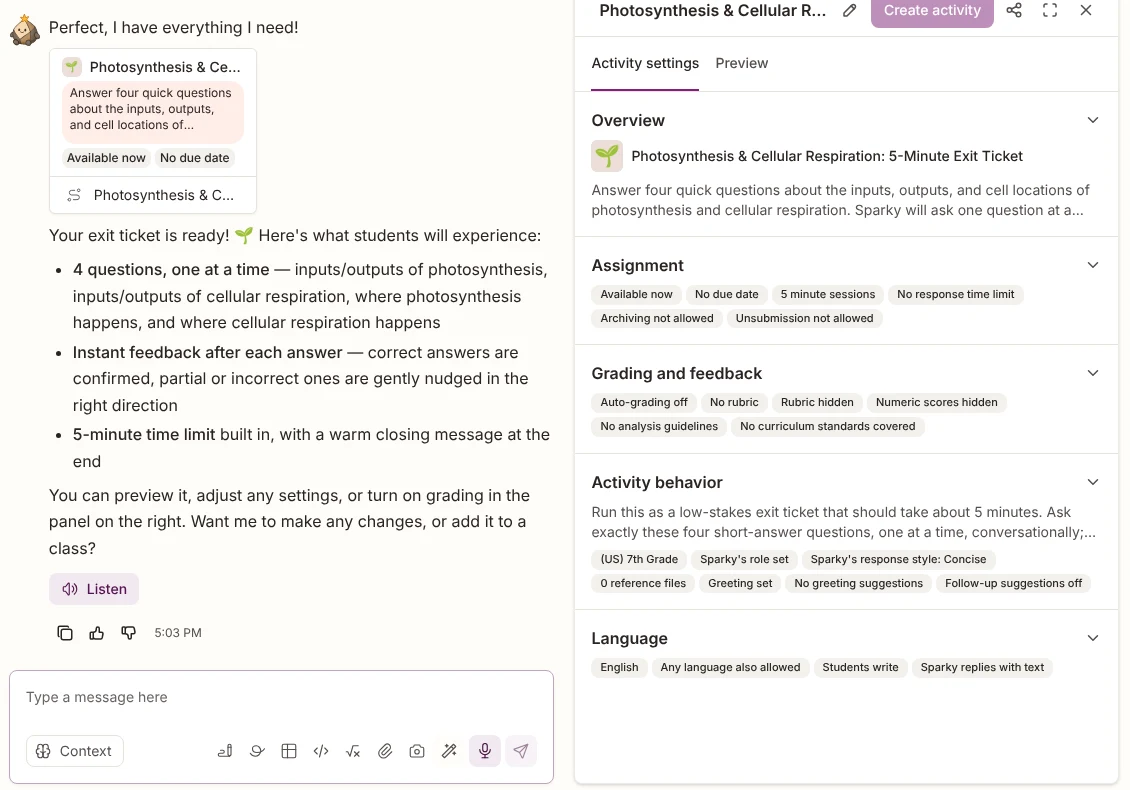
The four expected answers are correct for 7th grade. None of the questions catches the idea that plants photosynthesize instead of respiring, which the middle school list above flags. If your students hold it, ask Sparky to add a fifth question: "Do plant cells do cellular respiration? How do you know?"
Exit ticket FAQ
What is an exit ticket?
An exit ticket is a short question students answer at the end of a lesson and hand in before they leave. It tells the teacher who understood the lesson, so the next day's plan can start from what students know.
What is another name for an exit ticket?
Exit slip. Reading Rockets uses that name for the same strategy. A short question at the start of class about the previous lesson is called an entrance ticket.
How long should an exit ticket be?
One to three questions that students can finish in two or three minutes. A longer exit ticket eats into the lesson and takes too long to sort.
Does an exit ticket have to be written?
No. Students can draw an answer, hold up fingers, or say one thing they learned to the teacher at the door. Spoken and drawn answers work best in kindergarten and first grade, where writing takes longer than the thinking.
Should exit tickets be graded?
Usually not for correctness, because the point is to see what students know before they've had time to practice. Edutopia suggests telling students up front that an exit ticket isn't graded and isn't a quiz.