Sep 28, 2026
How Schools Are Talking to Parents About AI, and Why Bans Won't Settle It
From New York's pause to parent coffees and published tool lists, here's how U.S. and UK schools are talking to families about AI, what the evidence on social media bans suggests, and a letter template you can adapt.

Jemel Fanfan | Founding Member at Flint

September 2026 was the month parent worry about AI turned into policy. On September 2, New York City announced a one-year pause on student-facing AI from 2-K through 8th grade, covering nearly 600,000 students. The same week, Los Angeles Unified blocked AI tools on district devices for an estimated 378,000 students. On September 16, Florida's State Board of Education approved rules requiring schools to tell parents about each AI tool and get their permission before students use it.
I understand why. Parents are worried, the evidence on AI and learning is still thin, and a pause gives everyone time. Leaders in New York and Los Angeles are responding to real pressure from families, and they're trying to protect children.
But we've run a version of this experiment before, with phones and social media. The evidence is still coming in, but it points one way. Bans change what happens inside the building. They don't change what children do once they leave it, and they don't teach anything.
This is the third of three posts for school leaders on AI and families. The first covered parents' top ten concerns, and the second covered what parents want from a classroom AI platform. This one looks at what schools are actually doing, from the U.S. to the UK.
What happened when Australia banned social media for children?
Accounts disappeared, but most of the use didn't. Australia's minimum age for social media took effect on December 10, 2025. Within weeks, platforms had restricted 4.7 million accounts belonging to under-16s.
Three months in, the eSafety Commissioner's own evaluation of more than 4,000 families found the share of under-16s with a social media account fell from 52.4% to 42.1%. The share who used social media platforms, with or without an account, only fell from 85.9% to 81.5%.
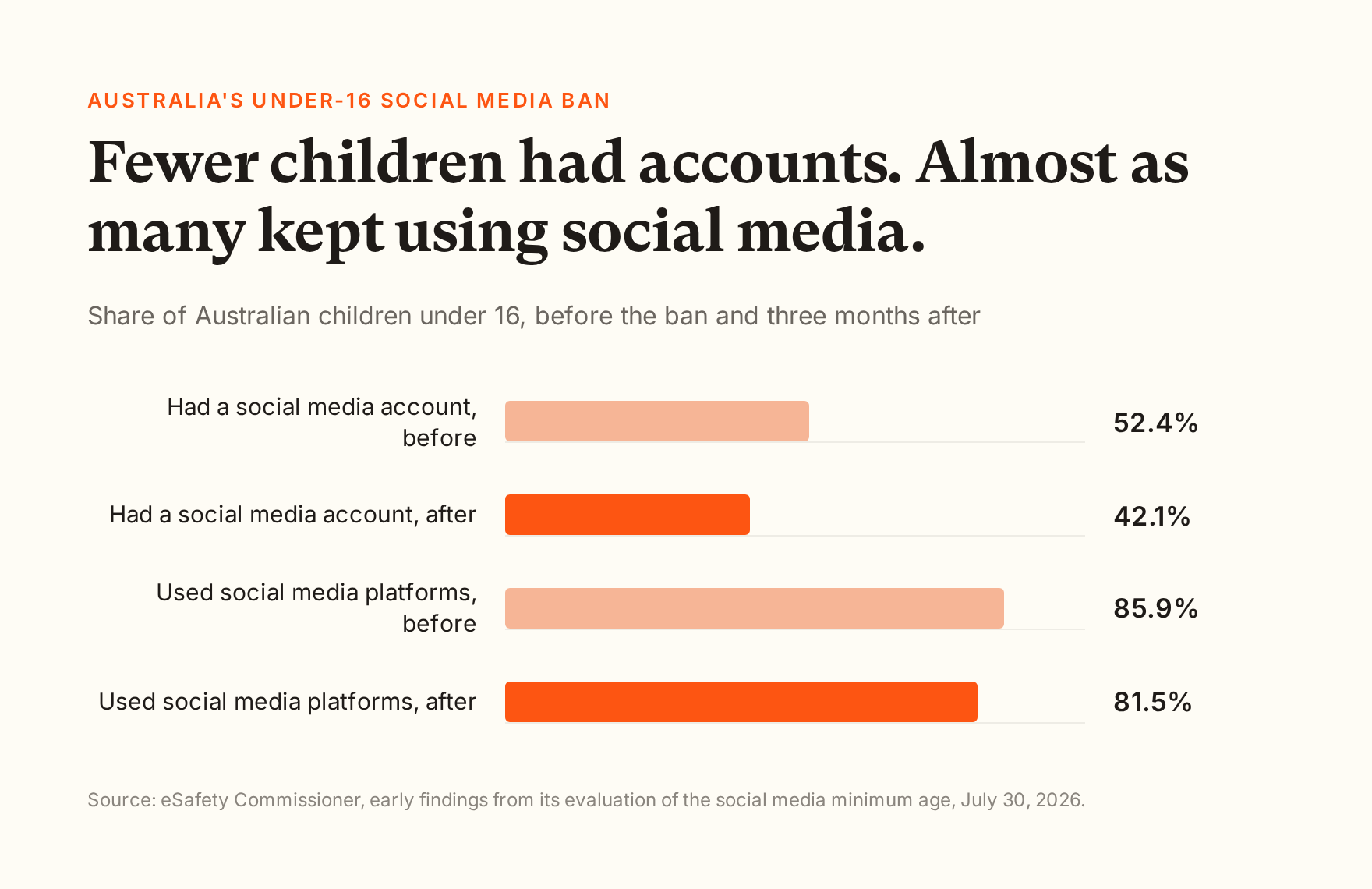
eSafety found that "most under-16s who had social media accounts before commencement were able to either retain them or create new ones." A study in The BMJ in June found "little evidence" of "immediate substantive reductions" in reported social media use.
The ban did some good. Fewer children said they felt they were missing out, down from 43.3% to 36.3%, and parents reported feeling less pressure. Australia's eSafety Commissioner, Julie Inman Grant, has a fair point when she says, "Speed limits for instance are not a failure because some people speed."
One finding should worry school leaders, though. Parents' awareness of what their children were doing online fell, especially for girls and children aged 10 to 12. When the activity went underground, the adults lost sight of it.
Do phone bans in school work?
They cut phone use at school, but on their own they haven't changed wellbeing or grades. The largest study so far in England, from the University of Birmingham, followed 1,227 pupils in 30 schools. Pupils at schools with restrictive phone policies used their phones about 40 minutes less during the school day. Across the whole day and on weekends, there was no difference. There was also no difference in mental wellbeing, sleep, physical activity, English and maths grades, or classroom behavior.
The authors concluded that their findings "do not provide evidence to support the use of school policies that prohibit phone use during the school day in their current form." The lead author, Dr. Victoria Goodyear, put it simply: "we need to do more than focus on schools alone."
The U.S. evidence is more mixed, and it's worth being honest about it. A national study of lockable phone pouches found they "substantially reduce phone use," that student wellbeing dipped in the first year and improved in later years, and that "average effects on test scores are consistently close to zero." In Florida, test scores rose in the second year of a statewide phone ban, after suspensions spiked in the first month. A phone ban can help students focus in class. What none of these studies show is a ban teaching children how to use a phone well.
Why is AI harder to ban than a phone?
A phone is an object you can put in a pouch. AI is inside the search engine, the word processor, the Chromebook and the phone in your child's pocket, at school and at home. As LAist reported, the Los Angeles block has no way to stop students using AI on their personal devices.
Most teenagers already use it. 64% of U.S. teens say they use AI chatbots, according to Pew Research Center, while only 51% of parents think their teen does. A ban at school doesn't close that gap. It moves the use somewhere teachers can't see it, the same thing that happened to parents' view of social media in Australia. The researcher Sam Illingworth said it well: "Remove access at the school gate and the harm walks home."
Some schools learned this lesson from phones. Julian Cochran, a computer science teacher at Durham Academy in North Carolina, told us in our case study how his associate head of school framed it for skeptical teachers: schools "really dropped the ball on educating kids" about smartphones in 2007. "Who's going to teach our students how to effectively lean into AI and where its benefits and where its perils are? If we don't take the lead now, this is going to be smartphones 2.0."
A short pause can be a sensible first step, if it's used to learn. Wesleyan School near Atlanta blocked ChatGPT on campus when it came out in November 2022. Its K-12 technology coach, Allison Berry, described the block in our case study as "a smart reaction as we used this time to educate teachers." The school spent those months educating teachers and parents, including holding parent coffees "where we just talked about AI," and then wrote its policy.
That's the difference between a pause and a ban. A pause has a plan for what happens next, and families are part of it.
What are schools doing instead?
Most schools fall somewhere along a spectrum. Here are named examples at each point, and what's worth borrowing from each.
Writing disclosure and consent into law
Oklahoma. Senate Bill 1734, signed in May 2026, requires districts to give parents a written list, at least once a year, of every AI tool students use, who makes it and what student data it collects. Parents can opt their child out at any time, and students "shall not be academically penalized."
Ohio. A new state law required every district to adopt a policy on AI by July 1, 2026.
Florida. The State Board of Education's September rules require schools to notify parents of each approved AI tool, get their permission first, and offer a non-AI alternative.
What to borrow: Oklahoma's disclosure list is a good template even if you're not in Oklahoma. Tool, maker, purpose and data collected, sent every year. Most families would find that more reassuring than a policy document.
Publishing the list and explaining it
Arlington ISD, Texas. The district's AI Family Hub lists approved tools on a "Green List," explains the "walled garden" it uses for students, and suggests questions for parents to ask their children on the ride home.
Downey Unified, California. Its AI Resources for Parents page lists which tools are approved at which grades.
Arlington Public Schools, Virginia. Its safety and data privacy page explains how the district reviews AI tools and how students' conversations are monitored.
What to borrow: one page, tools by grade, why each one is approved, and a date showing when it was last updated. The conversation questions from Arlington ISD are a smart touch, because they give parents something to do.
Bringing parents into the room
Irvine Unified, California. The district held a virtual AI Parent Information Night in April 2026, an hour long, so parents could join from home.
Franklin Square UFSD, New York. Superintendent Jared Bloom told K-12 Dive: "We have been transparent from the start… It's in my newsletters. We do parent workshops. We talk about it at coffee with the superintendent."
Anaheim Union High School District, California. Families, teachers and students sort AI uses together into red, yellow and green, from "unethical or unsafe" to acceptable, in an activity described by Bellwether. The same report describes Gwinnett County leaders opening family conversations with what parents want for their children's futures, rather than with safety.
Durham Academy, North Carolina. At back-to-school night, Julian Cochran pulled up ChatGPT and showed tired parents how it could solve the AP Computer Science free-response questions in seconds, then asked them again why their child was taking his class. The next day, a few parents emailed the Upper School director to say they were excited about the class.
What to borrow: show parents the tools, don't just describe them. And the Gwinnett approach is worth copying. Opening with fear makes families feel they need protecting. Opening with their child's future gets them on your side.
What schools in the UK are doing
Government guidance. The Department for Education's guidance on generative AI in education says schools should make sure "data subjects (pupils and parents or legal guardians) understand that their personal data is being processed using AI tools." Its product safety standards for AI tools, updated in January 2026, now cover cognitive development, emotional and social development, mental health and manipulation. Ofsted says: "We do not expect or require providers to use AI in a certain way, or to use it at all."
Phones as a model. England's phone guidance became statutory this year. The DfE's companion guide on communicating the policy to parents says, "It is important that schools engage collaboratively with parents," and admits that "prohibiting mobile phones from school will not eliminate all risks." That's a good starting point for AI, too.
Schools and trusts. Surbiton High School ran Childhood, Screens and AI: A Practical Evening for Parents in May 2026. Woodland Academy Trust in Kent publishes a parent guide for each tool its pupils use, explaining whether AI is involved and what the safeguards are. In Scotland, Education Scotland's Parentzone published AI: What parents need to know in March 2026.
What to borrow: Woodland's one-guide-per-tool approach. It answers the question parents actually have, which is "what is my child using, and is it safe," one tool at a time.
A letter to families you can adapt
Here's a starting point for a letter home. Replace the bracketed parts, and delete anything your school can't yet stand behind.
Letter template
Dear families,
AI tools are now part of the world our students are growing up in, and many of you have asked what that means at [School]. Here is where we stand this year.
What we use, and why. Students in [grades] may use [tools] for [purposes, e.g. practice, feedback on drafts, research help]. A full list of tools, what each is for and what data it collects is at [link]. We will tell you before any new AI tool reaches students.
What students may and may not do. Every assignment has a clear rule for AI use. Teachers will explain it in class. Work that is meant to show your child's own thinking, like essays and tests, stays their own.
How we protect your child. Every AI tool we use has a signed agreement with us that protects student data. [Tool] [does/does not] use student data to train AI models. Teachers can see how students use it, and if a student raises something concerning, school staff are alerted and follow up.
How we're preparing teachers. Our staff [completed/are completing] training on AI this [term], so they can decide when it helps and when it doesn't.
Your choice and your voice. If you'd prefer your child not use a particular tool, contact [name] and we'll arrange [alternative]. We'd also like to hear from you. Join us at [event, date] or share your views at [link].
We don't have every answer about AI, and we'd rather work them out with you than without you.
[Name, title]
Bans end. The conversation with parents doesn't.
The schools that come out of this year with parents' trust won't be the ones that blocked the most tools. They'll be the ones that told families what they were doing, showed them the tools, and asked what they thought. That's harder than a ban, and it lasts longer.
Australia's regulator reached the same conclusion about its own ban. Its evaluation highlights "the importance of continuing open dialogue within families about children's digital engagement, despite social media restrictions being in effect." Schools can take the same advice about AI.