Sep 29, 2026
How to Present an AI Purchase to Your School Board: Pilot Design, Funding, and Metrics That Hold Up
What a school board needs to hear before it approves an AI purchase: the full cost, which federal and state funds can pay for it, a pilot that produces real evidence, and the four numbers to report back. With a board report template.

Jemel Fanfan | Founding Member at Flint

Sooner or later, an AI tool your teachers like ends up on a board agenda. Before anyone asks whether it's safe or whether it works, someone will ask what it costs, and they're right to.
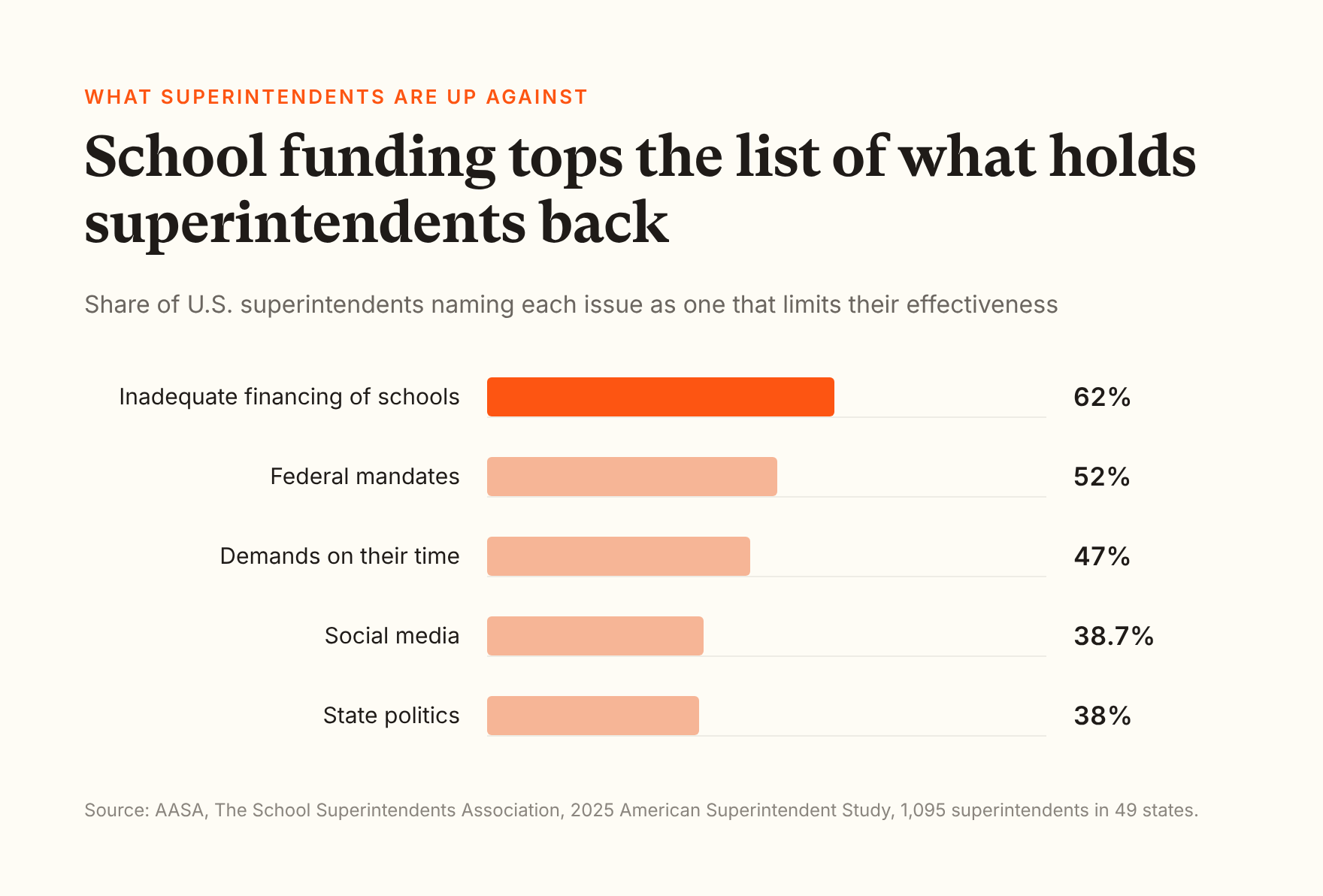
In AASA's 2025 American Superintendent Study of 1,095 superintendents in 49 states, 62% named inadequate financing of schools as an issue limiting their effectiveness, more than any other. Federal mandates (52%), demands on their time (47%), social media (38.7%) and state politics (38%) followed. More than half (54%) said financial issues take up most of their time, up from 45% in 2020, The 74 reported.
This fall has made the money question harder to answer. Federal education programs are funded only through December 11 under a stopgap law signed on September 2, and staff from the office that runs Title I have been moved to the Labor Department, NPR reported on September 24. And board members have seen New York City pause student-facing AI through 8th grade and Los Angeles Unified block it on district devices. Baltimore's superintendent, Sonja Santelises, one of four finalists for AASA's 2026 National Superintendent of the Year, described the new expectation for federal dollars: "It is being able to show the return on the investment."
This post covers the board presentation, and ends with a board report template you can copy, also available as a PDF, to fill in when your pilot ends.
I work at Flint, which makes an AI learning platform for schools. Flint only appears in the "Where Flint stands" line at the end of each section, so you can hold us to the same standard as everyone else. Where Flint doesn't do something, I say so. You also won't find prices in this post, ours or anyone else's.
What will it really cost us?
More than the license. A board wants the full cost over the contract, and proof the district will use what it pays for, which is where districts get caught. A Glimpse K12 analysis of 200,000 software licenses bought by 275 schools in 2017-18 found that, on average, 67% went unused. The data is old, but boards remember idle tools. A technology director at a New Jersey district told us this summer, "We just cut [another AI tool] from our high school because there was just no usage there."
To see how a public buyer puts an AI purchase in writing, read the AI in Education RFP that Erie 1 BOCES in New York published in November 2024. It's a useful model anywhere.
What your board needs to hear: the cost per year and over the full term, everything that's included, what happens at renewal, and the cost per student who actually uses it rather than per seat.
What to check:
- Every cost line in writing: licenses, training, rostering and sign-in setup, support, and anything billed separately.
- The renewal terms, including any price increase and what happens if you leave.
- Whether you can buy through a cooperative contract your district already belongs to.
- The staff time it will take for training, coaching and answering teachers' questions.
- Whether the pilot is free, and what turns it into a paid contract.
Where Flint stands: Flint was one of the vendors awarded a contract through that Erie 1 BOCES RFP, and it's on the consortium's public contract list. Paid Flint licenses include PD sessions and one-on-one teacher onboarding at no extra cost, and Flint's AI Literacy for Teachers course is free.
Where can the money come from?
From more places than most boards expect. In a Dear Colleague letter dated July 22, 2025, Education Secretary Linda McMahon wrote that AI uses "are allowable under existing federal education programs, provided they align with applicable statutory and regulatory requirements," including to "develop or procure AI-powered instructional tools" and "train educators, providers, and families to use AI tools effectively and responsibly." The letter doesn't name programs, so each source still has to fit its own rules.
| Source | What it can pay for | What to watch |
|---|---|---|
| Title I, Part A | AI tutoring and instructional tools, schoolwide in schools where at least 40% of students are low-income, or for identified students elsewhere | Must add to state and local spending, not replace it |
| Title II, Part A | Professional development on integrating technology into teaching | PD must be sustained and job-embedded, not a one-day workshop. Next year's funding is uncertain |
| Title IV, Part A | Software and content to personalize learning, plus PD on using technology | No more than 15% of the technology money can go to devices, equipment and software |
| Title III, Part A | Educational software and instructional materials for English learners | Only for English learner programs |
| IDEA, Part B | Assistive technology a student's IEP requires | Individual, not a classroom-wide purchase |
| Perkins V | Hardware and software for career and technical education | Only for CTE programs |
| State grants | Varies by state (see below) | Few AI-specific rounds are open right now |
| General fund | Anything the board approves | The steadiest source for year two and beyond |
Districts can also transfer Title II-A and IV-A money into Title I-A. The Department of Education's final AI priority, published in April 2026, favors AI proposals in its competitive grants, though it doesn't change what formula money can buy.
State money is thinner. North Carolina's Digital Learning Initiative grant offers districts up to $50,000 and allows software "only when embedded within an approved instructional innovation initiative," though this year's round closed in June. Virginia passed a law this year creating an AI pilot program for instruction and tutoring, but only "with such funds as are appropriated." Ask your state agency what's open. Leave two sources out of the plan: E-Rate doesn't cover applications or content, and the last ESSER deadline passed in March.
Grants often arrive before the plan does. An instructional technology specialist at an Illinois district told us, "We purchased it with grant fund," and "we're trying to give it like this trial ... To see if it can be something that is worthwhile for the long term."
What your board needs to hear: which source pays in year one, which pays in year two if federal money changes, and why the purchase is an allowable use of each.
What to check:
- Your federal programs director has confirmed, in writing, that each source fits its program's rules.
- The budget shows a year-two plan that doesn't depend on a single grant.
- PD is planned as ongoing support across the year, so it can qualify under Title II-A.
- The vendor can invoice against the fund codes and deadlines your business office needs.
Where Flint stands: Flint accepts any grant that's relevant to a district's proposal, whether federal, state or private.
How do we design a pilot that tells us something?
Decide what you want to learn, who's taking part and how you'll measure it before anyone logs in. A good pilot gives your district its own evidence, from a controlled setting, before it commits to anything.
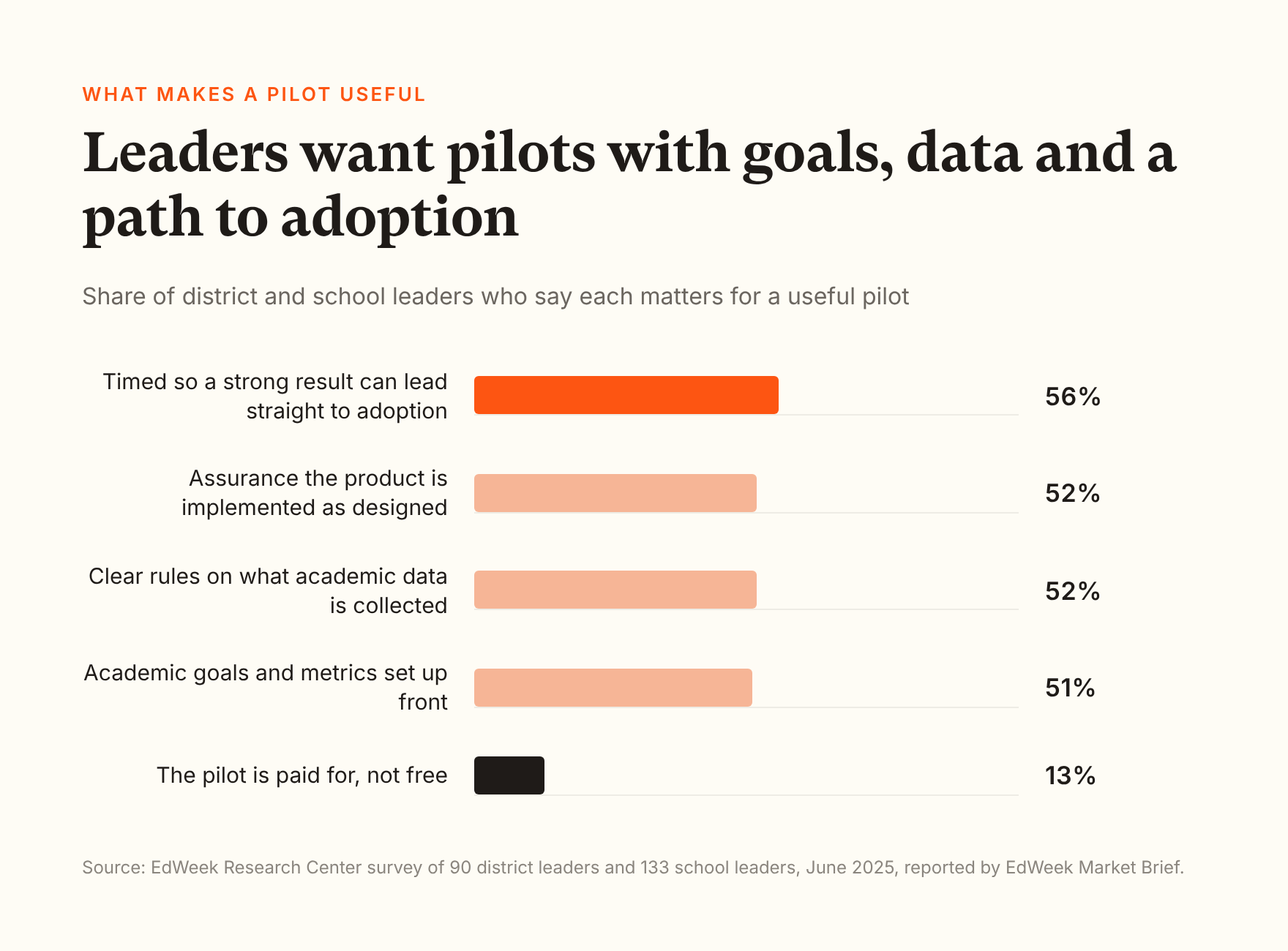
In a June 2025 EdWeek Research Center survey of 90 district leaders and 133 school leaders, 56% said a pilot should be timed so a strong result can lead straight to adoption. 52% wanted assurance it would be implemented as designed, 52% wanted clear rules on what academic data is collected, and 51% wanted academic goals and metrics set up front. Only 13% said it mattered that the pilot wasn't free.
Access isn't the same as use. In two randomized trials of an AI reading tutor run by Stanford researchers and reported by The 74, average weekly use across all students came to just over two minutes in one district and just over five in the other. A pilot that counts logins would have missed that.
Here's what I'd build in:
- One question you can test, such as "Does AI practice help our 7th graders on the fractions unit test?" rather than "Does AI help?"
- A fixed group of named teachers, classes and grades, with a mix of enthusiasts and skeptics. Report anyone added later separately.
- Students as well as teachers. An edtech leader at an Arizona district told us, "I think that the teacher piece is the easier sell," but "the student piece ... is a little more of an uphill battle with the board." Your board will ask about students. If you've paused AI for your youngest grades, leave them out and say why.
- The same pre and post assessment for the same unit in every class.
- A champion at each school who checks in with teachers every week.
- An end date that fits your budget calendar. Most districts finalize budgets around June, after the big spending discussions in March and April, according to EdWeek Market Brief.
We learned some of this the hard way. In the strongest pilot report we've written, students added partway through who were never onboarded dragged the numbers down, and each teacher used their own assessment, so results didn't compare cleanly across classes. Schools with a dedicated champion had the strongest use.
What your board needs to hear: what you're testing, with whom and for how long, and what result would lead you to buy, extend or stop. The decision stays yours, whichever platform you choose.
What to check:
- Administrators can read full student conversations, not only summaries.
- You can export usage data by teacher, student, school and week.
- You can switch features off for specific grades.
- The vendor trains your teachers during the pilot, not only after a purchase.
- The success criteria and end date are agreed in writing before it starts.
Where Flint stands: A Flint pilot covers adoption support, PD for teachers, resources such as a pilot guide and ready-made activity templates, and AI literacy certifications for staff. Administrators can read every student chat with Sparky, Flint's AI tutor, and download usage analytics as CSV files. Schools can turn off open-ended chat for specific grades. Whatever you decide afterward, including choosing another platform, you'll have seen how your own students and teachers used AI.
What should we report back to the board?
Four numbers, which together tell the board whether people used it, used it enough to matter, learned from it and stayed safe.
- Adoption: the share of trained teachers who used it with students, and the share of enrolled students who were active. A high teacher number next to a low student number usually means onboarding broke down.
- Depth of use: average minutes or sessions per active student per week, overall and in the last two weeks. The Stanford trials show what logins alone can hide.
- Learning evidence: the change on your common assessment, with an honest note on its limits, plus two or three anonymized examples of student thinking from the conversations.
- Safety and trust: how many messages were flagged, how each type was handled and how quickly, and any parent questions or opt-outs.
Report problems as plainly as successes, each with the risk it poses at scale and the fix. The technology director at that New Jersey district described the case they make to a skeptical board: "we're supporting technology use when it's instructional and when it's effective." The numbers are how you show it.
What your board needs to hear: the four numbers, what they mean for the decision, and when you'll report again if the board approves.
What to check:
- You can pull each number yourself without waiting on the vendor.
- Your assessment plan was set before the pilot started, not after the results came in.
- Every flagged message can be traced to a conversation and to the adult who followed up.
Where Flint stands: Flint's analytics show active teachers and students, sessions and messages by day, and usage for each person, and district analytics compare schools. Flagged messages appear with a link to each conversation, and administrators can see which staff have finished the AI literacy course. Flint's usage data can't tell you on its own whether students learned more. That takes your assessment. For the research so far, see Does AI help students learn? and Sohan's post on small-group tutoring.
A board report template you can use
This template follows the structure of the strongest end-of-pilot report we've written, with every identifying detail and number removed. Copy it into your own document, replace the bracketed parts and delete anything you didn't measure. If you'd rather print it, the same template is available as a PDF.
Board report template
AI pilot report: template
Lead with four numbers: teacher and student adoption, depth of use per active student, change on a common assessment, and flagged messages and how they were handled. Put the recommendation first, because most board members read the top of page one and then skip to the numbers.
1. The recommendation
- One sentence: what we recommend the board do (adopt, extend the pilot, or stop), for which grades and subjects.
- The question the pilot set out to answer, in the words we used when it started: [question].
- Cost of the recommendation per year and over the full term, and the funding source for each year: [amount, source, years].
2. What we tested
- Tool(s) tested, dates, schools, grades and subjects: [details].
- Who took part: [number] teachers and [number] students were enrolled. Anyone added after the start is reported separately.
- Training given: [number] sessions; [number] of [number] teachers attended at least one; [number] finished AI literacy training.
3. Adoption
- Teachers: [number] of [number] trained teachers ([%]) used it with students at least once; [number] used it in most weeks.
- Students: [number] of [number] enrolled students ([%]) were active. Reasons for any gap: [e.g. never onboarded, school without a champion].
4. Depth of use
- Average minutes or sessions per active student per week: [number]. In the final two weeks: [number].
- Share of use in school hours vs. outside them: [% / %].
- What students used it for most (from reading a sample of conversations): [e.g. practice before a test, feedback on drafts].
5. Learning evidence
- Common pre/post assessment for the same unit: average change [number] points; [%] of students improved.
- How it was measured, and its limits: [e.g. same assessment in every class? comparison group? teacher-made tests?].
- Teacher judgment: what teachers saw in student thinking, with two or three anonymized examples.
6. Safety and trust
- Messages flagged for review: [number]. How each type was handled and how fast: [summary].
- Parent questions, complaints and opt-outs: [number and themes].
- Teacher survey: [%] would keep using it; top concern: [concern].
7. What went wrong, and what we'd change
- For each problem: the challenge, the risk if we scale, and the fix (from us or the vendor), with a date.
8. Next steps
- If approved: rollout dates, training plan, who owns it at each school, and when we report back: [dates].
- What would make us stop: [e.g. fewer than half of teachers using it by midyear].
The vote is where the work starts
Superintendents told AASA that money holds them back more than anything else, and this year's federal picture won't make that easier. A presentation that names the full cost, the source of every dollar and the evidence your own students produced gives your board more than a vendor's promises. It also gives you a way to report back when the renewal comes up and someone asks whether it was worth it.