Sep 29, 2026
Does AI Help Students Learn, or Is It a Fad? What Parents Should Know
Parents are split on whether AI will help their child learn. The research gives a clearer answer than you might expect: it depends on whether the AI guides your child or does the work for them.

Jemel Fanfan | Founding Member at Flint

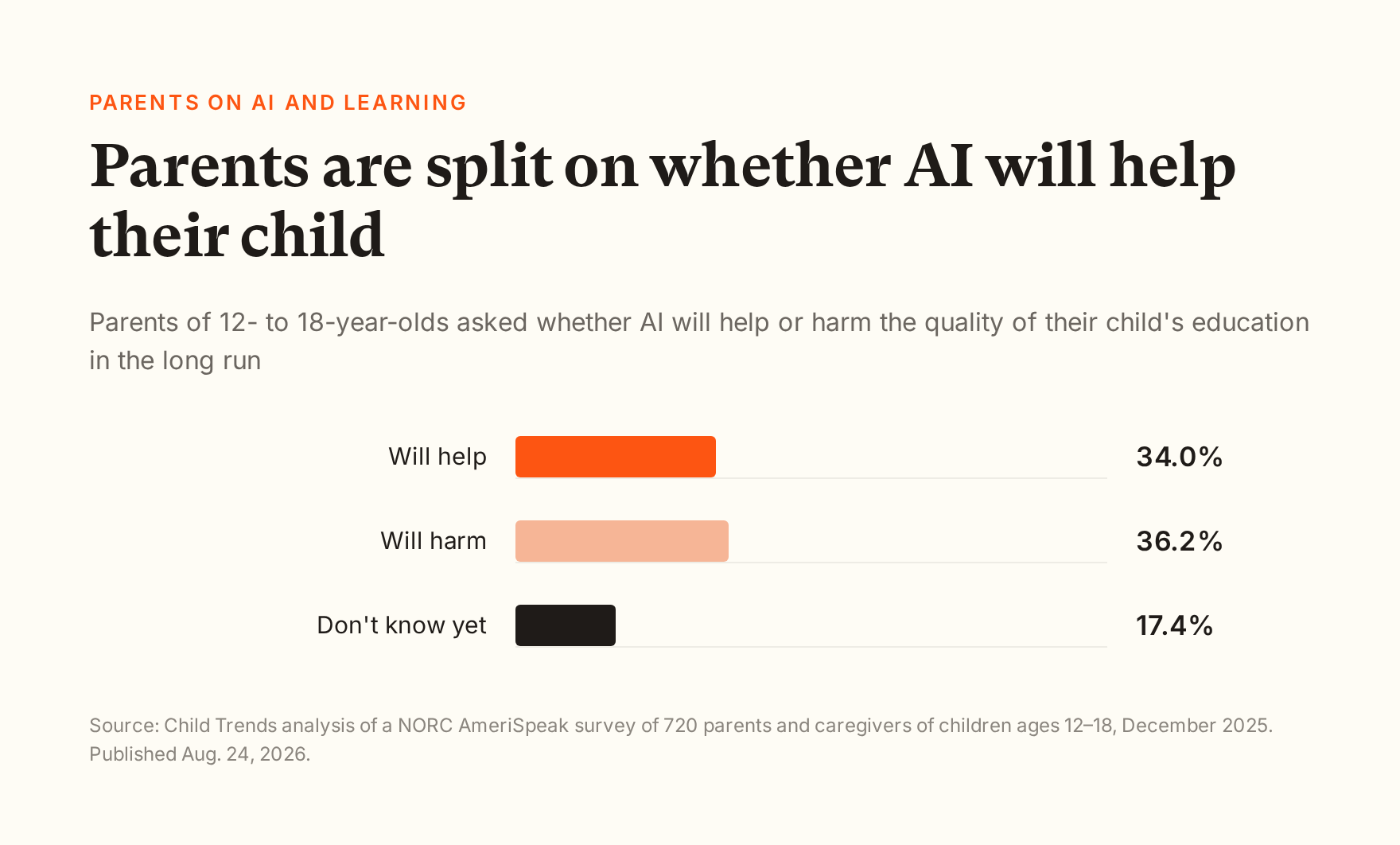
Ask a room of parents whether AI will help their child learn, and you'll get close to an even split. Child Trends asked 720 parents of 12- to 18-year-olds exactly that, in a survey published in August 2026. 34.0% said AI would help their child's education in the long run, 36.2% said it would harm it, and 17.4% said they didn't know yet.
Meanwhile, children aren't waiting for the answer. In Pew Research Center's February 2026 survey, 54% of U.S. teens said they use chatbots to get help with schoolwork, and 1 in 10 said they do all or most of their schoolwork with a chatbot's help.
This is the third post in a series for parents on AI and school, after what counts as cheating and the questions to ask your child's school. It's the one I get asked about most: is any of this actually good for kids' learning?
Does AI help students learn?
It depends on how the AI is built and used. AI that guides students with hints and questions has helped in several studies. AI that hands out answers can raise homework scores while lowering scores on tests taken without it. And nobody knows the long-term effects yet.
That's less satisfying than a yes or a no, but it's what the research says. It also gives parents something useful to watch for, which I'll come back to.
What does the research say about AI and learning?
The clearest study for parents comes from researchers at the Wharton School, published in PNAS in 2025. They gave nearly 1,000 high school math students in Turkey one of three setups for review sessions: only their textbooks, plain ChatGPT, or a version of ChatGPT set up like a tutor that gave hints and wouldn't hand over answers.
On the practice problems, both AI groups did far better. Students with plain ChatGPT scored 48% higher than the textbook-only group, and students with the hint-giving tutor scored 127% higher. Then everyone took an exam without AI. The plain ChatGPT group scored 17% lower than the students who never had AI. The tutor group scored about the same as the textbook-only group.
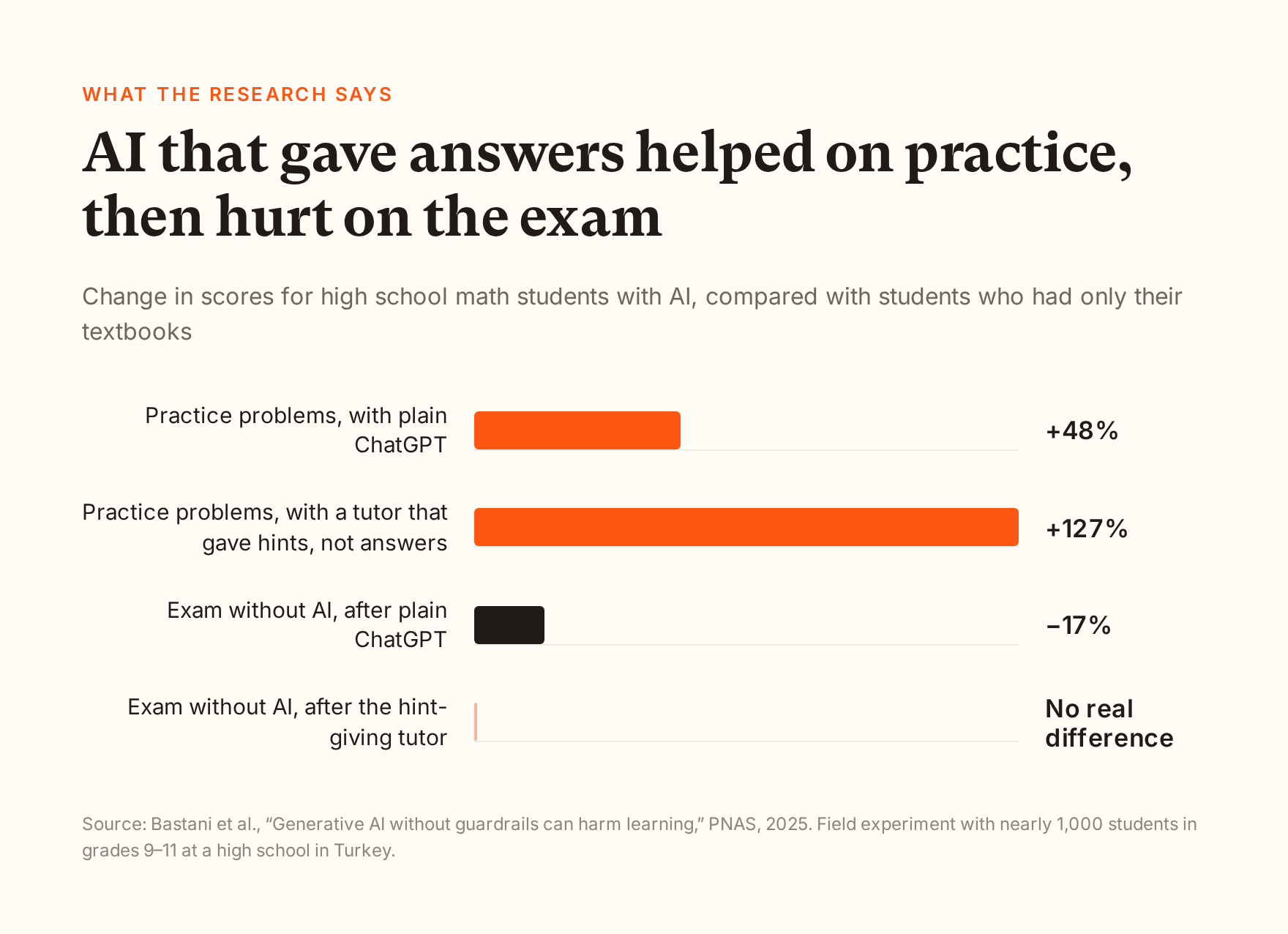
Two things stand out to me as a parent. First, the AI that gave answers made practice look great and made learning worse. Second, the students didn't notice. The researchers found that students with plain ChatGPT didn't think they had learned less, even though their exam scores said otherwise. A good homework grade stopped being a reliable sign that learning happened.
It's one study, at one school, in one subject, and it ran in the fall of 2023 when these tools were new. But it fits a wider pattern. The OECD's Digital Education Outlook 2026, which pulls together research from around the world, put it this way: without teaching guidance, "outsourcing tasks to GenAI simply enhances performance with no real learning gains." It also found that tools "designed or used with an intentional pedagogical purpose tend to show sustained improvements in learning."
There's encouraging evidence too, when the AI is built to teach. In a randomized study at Harvard, published in Scientific Reports in 2025, students in an intro physics course who learned from an AI tutor designed around teaching principles "learn significantly more in less time" than students in an active-learning class. Those were college students working through two lessons, so it doesn't tell us what happens to a 14-year-old over a school year. It does show the design matters.
Does using AI make students lazy?
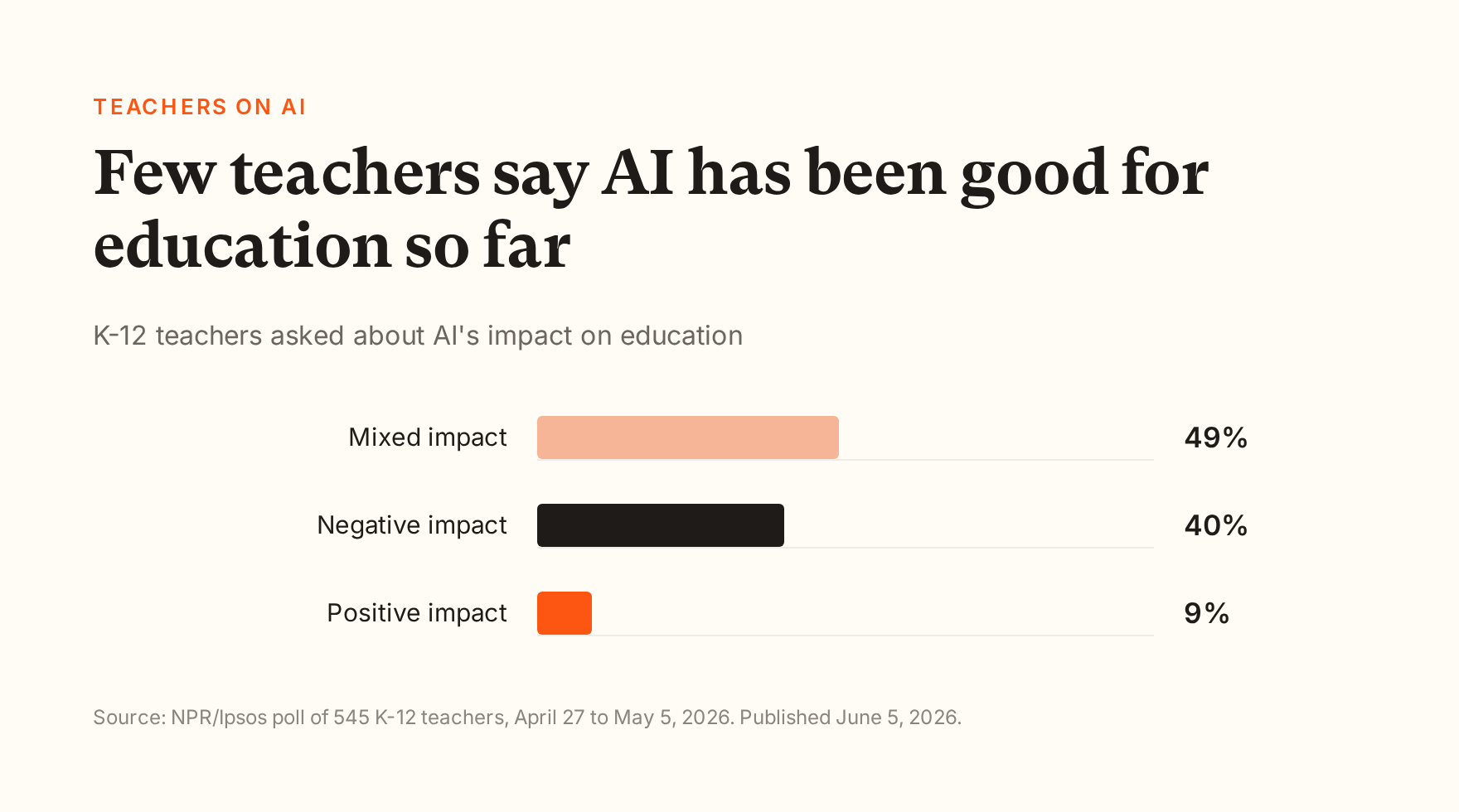
It can, and teachers are worried. In an NPR/Ipsos poll of K-12 teachers this spring, 55% said AI is mostly a shortcut for students to avoid doing more work. Asked about AI's impact on education so far, 49% of teachers said it has been mixed, 40% said negative, and only 9% said positive.
The OECD report named the same risk: handing thinking over to general-purpose chatbots "creates risks of metacognitive laziness." Put simply, when AI does the hard part, students skip the practice that builds the skill. Our look at the latest PISA results found the same shortcut pattern in students' science scores. For school and district leaders, I wrote a separate guide to spotting cognitive offloading in class, with a PD session for coaches.
Is AI in education just a fad?
The tools aren't a fad. Chatbots are a tap away on most phones, they come built into many school laptops, and most teens already use them. What might be a fad is the promise that AI will transform learning on its own.
Education historian Larry Cuban has pointed out that radio, film, television and classroom laptops were each "hyped as 'revolutionary'" in their day. He found no convincing evidence that they raised test scores. Justin Reich, who directs MIT's Teaching Systems Lab, told Inside Higher Ed in September 2026 that "the evidence base is almost nonexistent" for AI's benefits in education, partly because building products and testing them rigorously "takes a really long time."
I think both of them are right to be skeptical, and I work at an AI company. The honest version is that AI tools are here to stay, some are built in ways the early evidence supports, many aren't, and the long-term research hasn't been done. Anyone who tells you AI is scientifically proven to make your child smarter is getting ahead of the evidence.
Will my child learn better with an AI tutor?
Only if the tutor makes your child do the thinking. Here's what I'd look for, based on what the studies above have in common:
- It asks before it tells. A good AI tutor asks what your child has tried and gives hints, not finished answers.
- A teacher set it up. The tools that helped in studies were designed for a lesson, not an open chatbot.
- Your child can do it without the AI afterward. This is the test the Wharton study used, and you can use it at home. Ask your child to explain a problem or redo one without the tool.
- The work still feels like work. If homework has suddenly become effortless, that's worth a conversation.
How Flint approaches this
I work at Flint, so read this section knowing that. Flint is an AI learning platform that schools use, and students use it through their school. There are no parent accounts.
Flint's AI tutor, Sparky, is built on the same idea the Wharton tutor tested. By default, it won't solve a student's assigned problems or write work they could turn in. When a student asks for the answer, it asks what they've tried and guides them with questions, hints and similar examples. Teachers can set how much help it gives for each activity.
Here's what that looked like when a student asked Sparky to solve a quadratic equation for her homework. No real student appears in this screenshot.

The student asks for the answer. Sparky explains the method, then helps her fix her own attempt.
We don't have a controlled study of Flint's effect on learning, so I won't claim one. What we have are reports from teachers. At Wesleyan School, which uses Flint, the STEM department reports that students' coding project scores rose from the 70–79% range to 90–100% after they started using it. That's one department's report, not a study, and it doesn't separate Flint from everything else those teachers did. It's the kind of result I'd want to see tested properly.
What parents can do
You don't need to settle the research debate to help your child. A few things that work at any level of tech comfort:
- Ask your child to teach you something they learned with AI this week.
- Notice whether they can do the homework problems on paper, without a device nearby.
- Ask their teacher which AI tools the class uses and whether they're set up to guide or to answer. My previous post has 10 questions and a printable checklist.
- Treat a sudden jump in homework grades with curiosity, not only celebration.
- Share our guide for students on using AI to study without cheating. It has prompts they can paste into any chatbot to make it give hints instead of answers.
AI can help children learn. It can also make it very easy to skip learning while looking like you did it. The difference is mostly in how the tool is built and how it's used, and that's something parents and teachers can influence.