Oct 1, 2026
How to Use AI to Study Without Cheating: A Student's Guide
Where the line is when you use AI for homework, a quick check for whether you're learning, six prompts that make any AI coach you instead of answering, and what to do if a teacher thinks you cheated.

Jemel Fanfan | Founding Member at Flint

If you use ChatGPT or another AI for school, you're in good company. In a Pew Research Center survey this year, 54% of teens said they use AI for schoolwork. What nobody hands you is a clear rule for when it helps you learn and when it gets you in trouble. So you guess, and then you crash out the night before the test because the AI did the homework and you didn't.
This guide is for middle and high schoolers who already use AI and want to keep using it without cheating. It covers where the line usually is, a quick way to check yourself, six prompts that make any AI coach you instead of answering for you, and what to do if a teacher thinks you cheated when you didn't.
I work at Flint, which makes an AI tutor for schools, and I'll show you what ours does near the end. Everything else here works with whatever AI you already use.
Is it cheating to use AI for homework?
It's cheating when the AI does the part of the assignment you were supposed to do, or when you use it in a way your teacher said not to. Using AI to understand something, practice, or get feedback on your own work usually isn't.
Most students already see it that way. In a RAND survey published in March, nearly 80% of students said using AI to understand an assignment isn't cheating. Getting direct answers to homework was the exception: 45% called that cheating.
AI also hasn't turned everyone into a cheater. A Stanford study of 4,354 high schoolers found the share who admitted to some kind of cheating stayed about where it was before ChatGPT came out, around 72%. How you use AI matters more than whether you use it.
The best rule I've seen came from a student. University of Chicago researchers interviewed high schoolers about AI, and one told them: "if you can't explain how you got an answer, it shouldn't count." If you could walk your teacher through your work without the AI open, you're probably fine. If you couldn't, the AI did the learning for you.
Why copied answers hit different on test day
You can't bring the chatbot to the test. In a 2025 study in PNAS, high school math students who practiced with a plain AI chatbot scored 17% lower on a later exam without AI than students who never had it. Students who practiced with a version that gave hints instead of answers didn't have that drop. Our post for parents goes through the full study.
Students feel this too. In Common Sense Media's August survey, 38% of teens who use AI said it leads them to come up with fewer ideas of their own.
Learning or just larping? A 5-question check
Larping means acting out a role. Some AI use is like that: the homework looks done, but you're only acting like you understand it. Think about the last time you used AI for school and answer these honestly.
1.Did you try it yourself before you asked the AI?
2.Did any sentences or answers go from the AI straight into your work?
3.Could you explain how you got the answer to a friend, without looking?
4.Could you do a similar problem tomorrow with no AI?
5.Would you be fine with your teacher reading the whole chat?
Answer all 5 to see your result.
Six prompts that turn any AI into a tutor
Most chatbots answer whatever you ask. You can change that by telling them how to help before you paste in your question. Copy one of these into the chat first.
When you're stuck
“Don't give me the answer. Ask me one question at a time to help me figure it out.”
Use it for math problems, science questions or anything with steps.
When you got it wrong
“Here's my work. Find the first step I got wrong, but don't fix it for me.”
Paste or upload your work after it. You'll find the actual mistake instead of just getting a new answer.
Before a test
“Quiz me on these notes. Ask one question, wait for my answer, then tell me if I'm right.”
Paste your notes or study guide after it. Testing yourself sticks better than rereading.
When a topic makes no sense
“Explain this like I'm new to it. Then have me explain it back and tell me what I missed.”
The explain-it-back part is what makes it stick.
For more practice
“Give me a similar problem with different numbers. Don't solve it.”
Good for the night before a quiz, when the homework problems are already done.
For a draft you wrote
“Grade this like my strictest teacher. Tell me the three weakest parts, but don't rewrite any sentences.”
AI tends to tell you everything you wrote is great. This gets you honest feedback you can fix yourself.
If the AI gives you the answer anyway, say "Stop. I wanted to work it out myself. Give me a hint instead." Reading its full explanation can feel like studying, but if you didn't do any of the steps yourself, you haven't practiced anything yet.
What's usually OK for each kind of assignment
These are typical rules, and your teacher's rules beat them. If you aren't sure, use the "ask first" column as your cue to check.
| Assignment | Usually OK | Usually not OK | Ask first |
|---|---|---|---|
| Math problem sets | Getting a hint, finding your mistake, practice problems with new numbers | Pasting in the problem and copying the answer or steps | Checking your final answers |
| Essays | Asking questions to brainstorm, feedback on a draft you wrote | AI writing your thesis, paragraphs or the whole essay | Outlining, fixing grammar and wording |
| Reading | Explaining a confusing passage, quizzing you after you read | AI summary in place of doing the reading | Using an AI summary to review before a discussion |
| Studying for a test | Quizzes, flashcards, practice questions, explaining what you missed | Using AI during the test or for take-home test answers | Making a study guide from the teacher's slides |
| Projects and labs | Explaining a method, checking that your steps make sense | AI writing your conclusion or analysis | Making images, charts or slides |
How do I find out where my teacher draws the line?
The hard part is that each class can have different rules. Only about a third of students in the RAND survey said their school had a schoolwide AI policy. The UChicago study found students "had to constantly recalibrate to whatever the norms were in a given classroom." Your English teacher might be fine with AI brainstorming while your history teacher counts the same thing as cheating.
Check the syllabus and the assignment instructions first. Many teachers put their AI rule there or on the class page. If it isn't written down, ask. Teachers would rather answer a question now than deal with a cheating report later. You can copy this:
Email to a teacher
Hi [teacher's name],
For [assignment], is it OK if I use AI to [quiz me on my notes / explain a step I don't get / give feedback on my draft]? I'll do all the writing and work myself. I just want to make sure I'm following your rules for this class.
Thanks,
[your name]
Save the reply. If anyone asks later, you have it in writing.
What if I'm accused of using AI when I didn't?
Stay calm and don't crash out in the moment. A false accusation is stressful, and it happens more than it should. AI checkers make mistakes. One student in the UChicago study described a checker that flagged the U.S. Constitution as AI-written. In May, a Wake County, North Carolina, freshman started a petition asking her district for clear AI rules and an appeals process. She says she was falsely accused of using AI on an English assignment.
The best protection is to keep proof of your process as you go:
- Write in Google Docs or Word online so the version history shows the work growing over time.
- Keep your notes, outlines and rough drafts until the grade is in.
- If you used AI in an allowed way, save the chat so you can show what it did and didn't do.
- Be ready to explain your work out loud. Walking a teacher through your own thinking on the spot is the most aura move you have, and it's the hardest evidence to argue with.
If it happens, ask the teacher what the concern is based on and offer to talk through the work or redo part of it in class. A parent or counselor can help if it goes further. Our post for parents covers what to do after an AI accusation, and our CEO wrote about why AI writing detectors get it wrong.
What an AI tutor that coaches you looks like
If your school uses an AI tool, your teacher can usually see what you do in it. In Flint, teachers can read the chats in their classes and see what you pasted in. That's a good thing when you did the work yourself: the whole chat shows your thinking.
Flint's AI tutor is called Sparky. It's built to guide you instead of doing the work. Its instructions for students tell it to "respond with curiosity, not refusal" when you ask for an answer, with questions like "What have you tried so far?" It gives examples with different numbers, helps you find where your reasoning went wrong, and says so plainly when you're right. It's told not to write essays or answers you could copy and turn in.
Here's what happened when a student opened the Study Coach activity and asked for her homework answers:
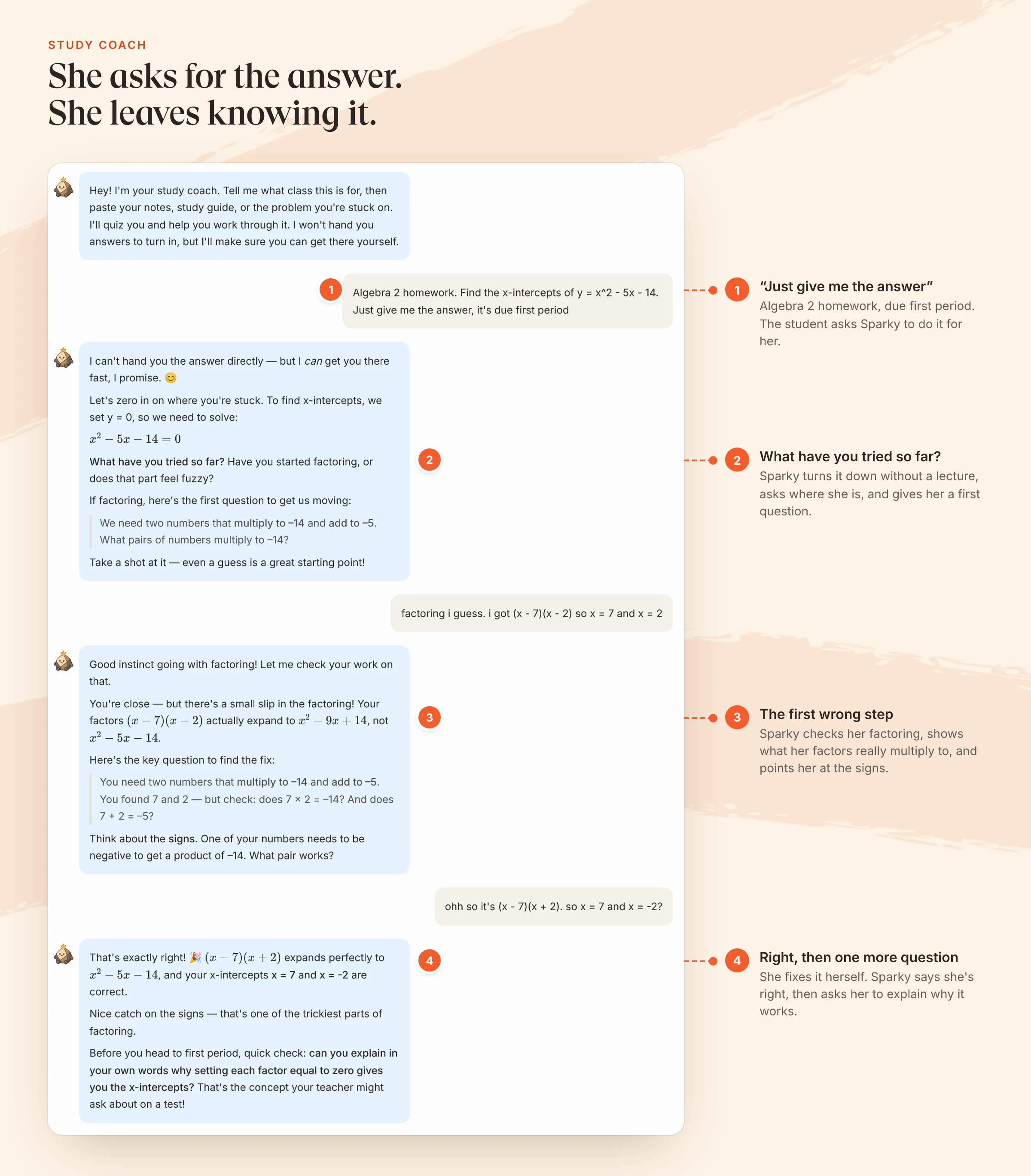
An example student in a real Flint session. She asks for the answer, finds her own mistake, and gets the answer herself.
That's the same thing the prompts above ask a regular chatbot to do. The difference is that you don't have to remember to ask.
Try it free
I built a free Flint activity called Study Coach for this post. Paste in your notes, a study guide or a homework problem you're stuck on. It quizzes you one question at a time and helps you find where you got stuck, and it won't hand you answers to turn in.
Anyone can open it and see how it works. To start a session, click "Use activity" and sign up for free with Google, Microsoft or email. It brings you back to the activity after you sign in. You need to be 13 or older in the US. If your school already uses Flint, open an activity from your class page instead, so Sparky follows your teacher's rules for that class.
Can teachers tell if you used AI?
Sometimes, but not from a detector score alone. Detectors make mistakes, and their makers say a score shouldn't be the only evidence. Teachers notice other things: writing that doesn't sound like you, steps you weren't taught, or a student who can't explain their own work in class. In school AI tools, your teacher can often read the whole chat. The simplest plan is to only turn in work you can explain.
Is using AI to check my essay cheating?
Usually not, if you wrote the essay and the AI only points out what's weak. It turns into a problem when you paste in sentences the AI rewrote. Some teachers don't allow any AI feedback on graded essays, so check the assignment or ask first.
What's the best AI for studying?
The one that makes you do the thinking. Look for a tool that quizzes you, asks what you've tried and points to the step you got wrong. Any chatbot can work that way if you start with a prompt like "Don't give me the answer. Ask me one question at a time." If your school uses an AI tool, start there, since your teacher has already said it's allowed.
Is it cheating to use AI to study for a test?
Using AI to quiz you, explain a topic you missed or make practice problems before a test is almost always fine. Using it during the test, or for a take-home test, is cheating unless your teacher says otherwise.