Sep 28, 2026
Is It Cheating If My Child Uses AI? A Parent's Guide to Academic Integrity
Most teens use AI for schoolwork, and the rules are fuzzy for them too. What counts as cheating, what to do if your child is flagged by an AI detector, and what to ask them tonight.

Jemel Fanfan | Founding Member at Flint

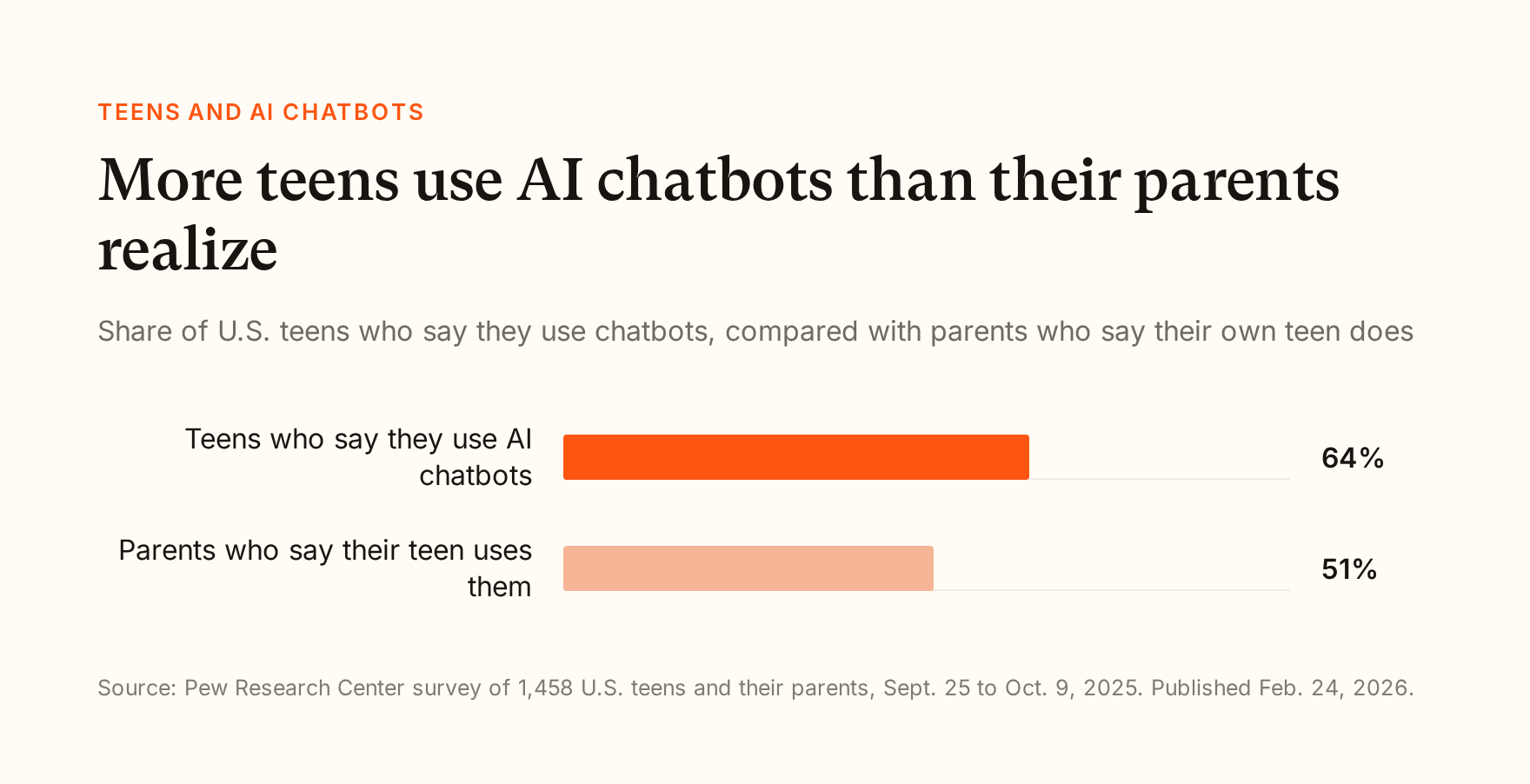
If you have a middle or high schooler, there's a good chance they use AI for schoolwork, and a fair chance you don't know it. In a February 2026 Pew Research Center survey, 64% of U.S. teens said they use AI chatbots like ChatGPT. Only 51% of parents thought their teen did.
Children aren't much clearer on the rules than parents are. When RAND asked students which uses of AI count as cheating, only 45% said getting direct answers to homework does. About a third said their school had a schoolwide AI policy at all. So when your child says "everyone uses it," they're mostly right, and the useful question for a parent becomes how they use it.
This is the first of three posts for parents on AI and school. It covers the question I think matters most right now: where the line is, and what to do when someone says your child crossed it.
Is it cheating if my child uses AI for homework?
It depends on what the teacher asked for. Using AI to do the part of an assignment your child was supposed to do on their own is cheating. Using it the way the teacher allowed, to practice, get feedback, or understand a hard idea, is not.
The simplest test I've found is to ask who did the thinking. An essay assignment exists so your child builds an argument. A math set exists so they practice the steps. If AI came up with the argument or worked the steps, the assignment didn't do its job, even if your child typed every word of the final version.
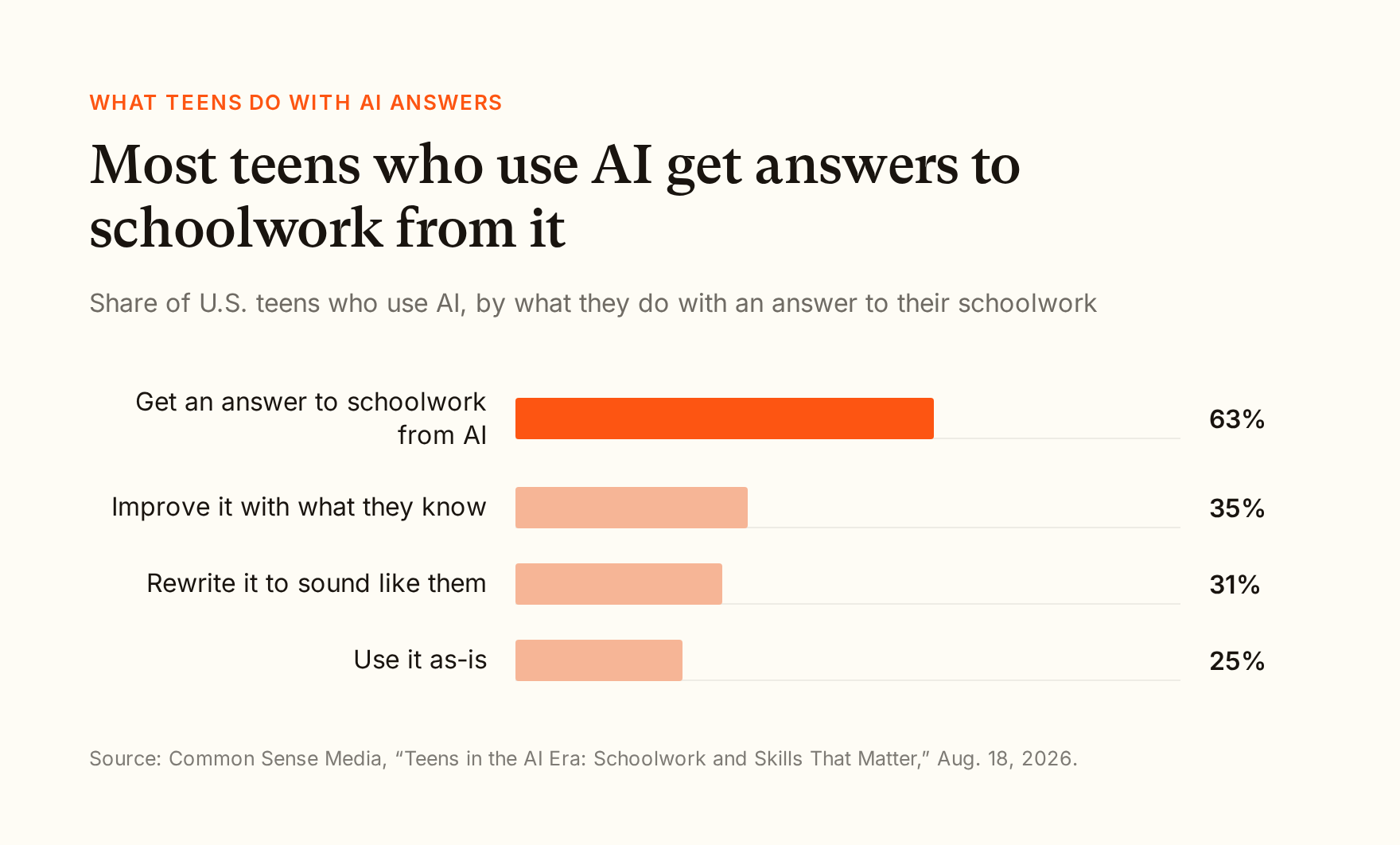
That second case is more common than straight copying. Common Sense Media found in August 2026 that among teens who use AI, 63% get answers to their schoolwork from it. 25% use the answer as-is, 31% rewrite it to sound like themselves, and 35% improve it with what they know. Rewriting feels like effort, which is why it's easy for a teenager to believe it's fine.
Many schools make the line visible with a red, yellow and green system, like this traffic light poster from The Stony Brook School. A rough version:
- Usually fine: asking AI to explain a concept, quiz them before a test, or give feedback on a draft they wrote.
- Ask the teacher first: brainstorming ideas, outlining, or fixing grammar and wording.
- Usually off limits: having AI write the essay, solve the problem set, or answer take-home test questions.
Every teacher sets their own rules, and theirs win. If your child doesn't know the rule for a class, the fix is to ask.
What should I do if my child is accused of using AI?
Stay calm, find out what the concern is based on, and ask for a conversation with the teacher. A score from an AI detector is an estimate, and it shouldn't be the only evidence.
That isn't just my opinion. Turnitin, whose detector many schools use, says in its own guidance that its AI writing model "may not always be accurate" and "should not be used as the sole basis for adverse actions against a student." Researchers at Stanford found that detectors wrongly flag writing by non-native English speakers far more often than writing by native speakers.
These cases are hard for everyone involved. In May, a Palo Alto father sued his son's school district after Turnitin reportedly scored the teen's essay on The Crucible as 76% AI-written. The district defended the teacher's judgment, and the father dropped the suit in September. Nobody outside that classroom knows who wrote the essay, and a percentage couldn't settle it either.
If it happens to your child:
- Talk to your child first, privately. Ask what they did and how, before you assume either way.
- Ask the teacher what the concern is based on. A detector score, something in the writing itself, or both.
- Gather the process. Notes, outlines, and drafts all help. If they wrote in Google Docs, the version history shows how the document grew over time.
- Offer a way to show understanding. A student who did the work can usually talk through it, or redo part of it in class.
- Read the school's AI policy. If there isn't one, that's worth raising politely with the school, too.
If your child did use AI in a way they shouldn't have, treat it as a chance to reset expectations together. With so few schools spelling out the rules, a lot of children who cross the line may not have known where it was.
Is AI doing my child's thinking?
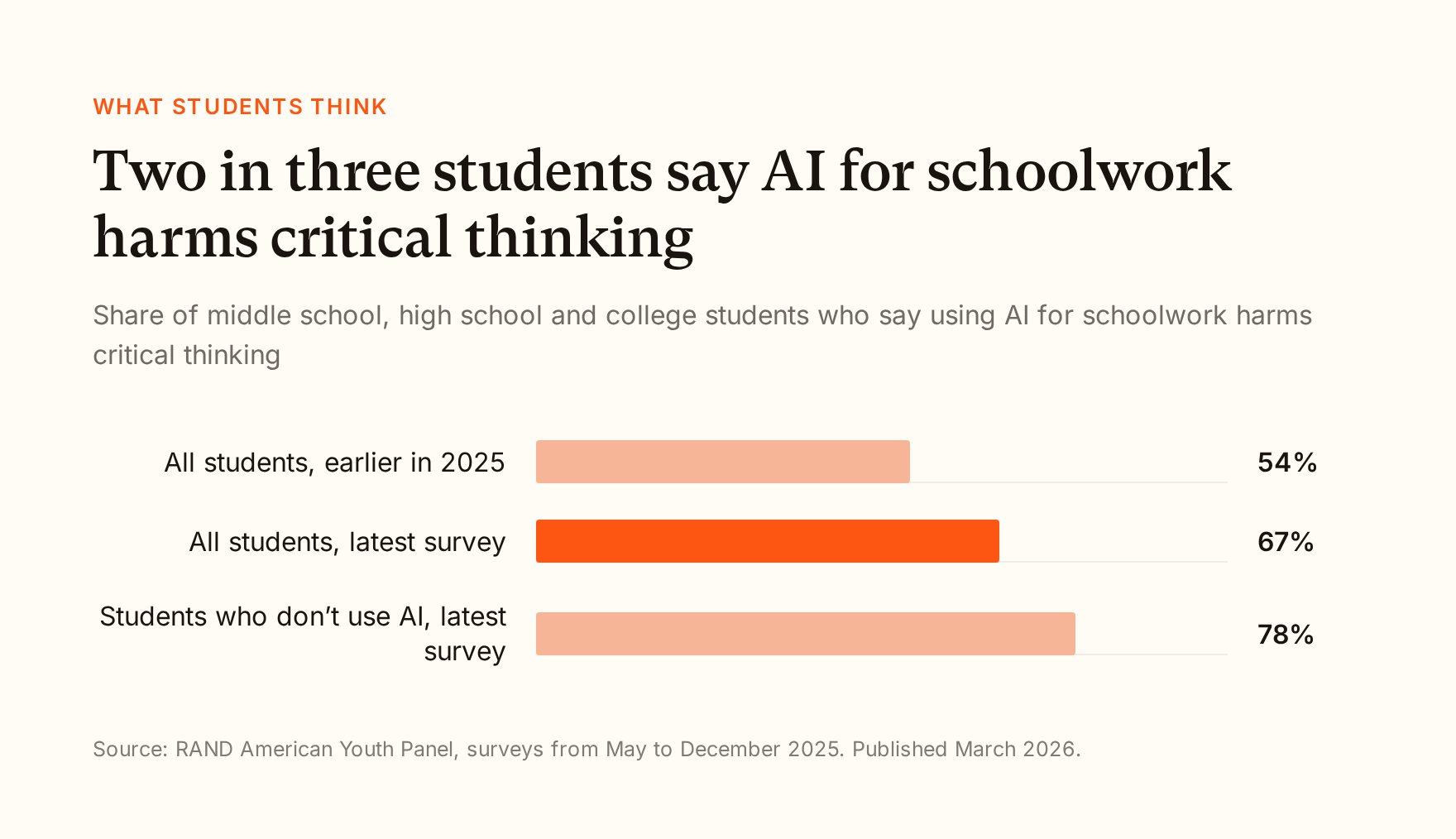
It can, and students are worried about it too. In RAND's survey, 67% of students said using AI for schoolwork harms critical thinking, up from 54% earlier in the same year. Among students who don't use AI, 78% said so.
Most children haven't been taught another way to use it. Only 27% of teens told Common Sense Media that a teacher has ever talked with them about how to use AI safely. Left alone with a chatbot built to answer questions, a teenager will mostly ask it for answers.
How Flint approaches this
I work at Flint, so read this section knowing that. Flint is an AI learning platform that schools use. There are no parent accounts, and students use it through activities their teachers create. I'm including it because it's one example of handling cheating by designing the AI differently rather than trying to catch students afterward.
No real student appears in the screenshots below.
The AI is built to guide instead of answer
By default, Sparky, Flint's AI tutor, won't solve assigned problems or write essays and answers a student could turn in. When a student asks it to just do the work, it's instructed to respond with questions like "What have you tried so far?" and to help from there with guiding questions, explanations and similar examples.
Here's what that looked like when a student asked Sparky to write her thesis statement for a persuasive essay on banning phones in school:

The student asks for the answer. Sparky says no and asks her a question instead.
Teachers decide how much help it gives
Each teacher writes instructions for their own activities, and Sparky follows them. A teacher can let it help more directly for practice, or hold it back for a graded essay.
For the thesis workshop above, the teacher's guidelines for Sparky read: "This is practice for a graded essay. Do not write thesis statements, topic sentences, or paragraphs for students, even if they ask. Ask guiding questions about their position and reasons. You may explain what makes a thesis strong and give an example on a different topic." The same screen lets the teacher set the grade level and whether Sparky's replies are concise, balanced or thorough.
A math teacher running a review before a test might write something looser, like letting Sparky walk through a similar problem step by step. The rules follow the assignment, the same way they would if a human tutor were in the room.

The teacher writes the rules for each activity. Here, Sparky may coach but not write.
Teachers can see the process
Teachers can read every conversation in the activities they create, and they can see any text a student pasted into Flint's chat box. The work is visible, so nobody has to guess from a score.
In the session below, the teacher can scroll through every turn: the moment the student asked Sparky to write her thesis, her own reasons for a ban, and the sentence she wrote herself, "Schools should ban phones during class because they distract students and make it harder to learn." If a question about who did the work ever came up, the teacher could point to the conversation instead of a percentage.

What the teacher sees: the full conversation, from the request for an answer to the student's own thesis.
Flint doesn't sell AI detectors
In 2023, our CEO Sohan Choudhury wrote about why AI writing detectors don't work and committed that Flint would never build or sell one.
Here's what that can look like in a real classroom. KyleAnne Kiraly, a Grade 10 teacher, described on LinkedIn how her students started a comparative essay with mind maps on paper, then spent 10 minutes talking their ideas through with Flint, which asked them questions instead of writing for them. Then they went back to pen and paper to write their thesis statements. "It's not about extremes," she wrote. "It's about using the tools at our disposal, with intention and moderation."
Flint has limits you should know about. It only sees what happens inside Flint. It can't stop a student from opening another chatbot in a different tab, which is why the conversations at home still matter most.
Questions to ask your child
You don't need to be an AI expert to have this conversation. Try a few of these:
- "What does your teacher say about using AI in this class?"
- "Can you show me how you used AI on your last assignment?"
- "If your teacher asked you to explain this, could you do it without looking?"
- "What part of this did you figure out yourself?"
- "When has AI actually helped you understand something?"
- "Has AI ever given you a wrong answer? How did you notice?"
Listen more than you lecture. The goal is for your child to be able to say, in their own words, where the line is and why it's there.
If they'd rather read it from someone other than a parent, we wrote a guide for students on using AI to study without cheating, with a self-check and prompts that make any chatbot coach instead of answer.
Next in this series: the questions to ask your child's school about how it uses AI.