ComparisonNov 5, 2026
Flint vs. Albert.io (2026): Question Bank or AI Practice for AP and Test Prep?
Albert.io gives you 180,000+ expert-written practice questions to assign. Flint gives students AI activities built on your own materials, with essays and free responses graded against your rubric. Here's which fits AP and test prep at your school.

It's March, and your AP students need two kinds of practice before May: hundreds of multiple-choice questions in the exam's style, and essays and free responses with feedback they can act on. One teacher can't write the first or grade enough of the second.
Albert.io and Flint each do one of those well. Albert is a bank of expert-written practice questions you assign, with explanations for every answer and pre-built practice exams. Flint is a platform where you build AI activities on your own materials, and students write, talk and get feedback from Flint's AI, Sparky, graded against your rubric while you watch. This page compares them for an AP or secondary teacher, and for school leaders deciding whether to keep paying for both. School leaders comparing whole platforms should start with our K-12 platform guide.
The short version
- Pick Albert if you want a large, ready-made bank of AP, SAT, ACT and state-test questions written by people, with explanations, full-length practice exams and standards reports.
- Pick Flint if you want students to practice writing and explaining, on your prompts and materials, with every response graded against your rubric for you to check.
- If your school pays for both, list what teachers actually use each one for. Albert covers question drills, and Flint covers essays, free responses and discussion.
How we evaluated
We make Flint, so we're biased. Weigh what we say about Flint with that in mind.
The Albert facts come from Albert's website, pricing pages, help center and privacy policy, all read on November 5, 2026. Each one links to its source. We didn't use a paid Albert account, so we haven't judged the quality of its questions.
The Flint facts come from our help center, our pricing page, our AI essay grader and Flint's public library. The AP activities named below are public, so you can open them yourself.
What each one is
Albert: expert-written questions you assign
Albert's homepage describes "adaptive skills practice + premium question banks for all subjects and exams in grades 3-12. Created by human experts since 2011." Its teacher page counts "180,000+ exclusive, original items," with question banks for "AP®, SAT®, ACT®, PSAT®, PreACT®, state exams, Electives, Core, and more." The AP question banks cover "30+ AP® subjects," and the same page says pre-made unit and full-length assessments "mimic the real test's scope, distribution, and difficulty."

The Albert homepage (albert.io), captured November 5, 2026.
Every Albert question has a written explanation that students see whether they answered right or wrong. Albert says people still write its content: "As of 2026, human experts still review, edit, and quality-control everything we publish in our question banks" (Albert for students).
Teachers build assignments by searching the banks, by assigning from a subject, or with Smart assign, where Albert picks the questions from criteria the teacher sets. Content is aligned to Common Core and, for many states, to state standards. Albert has state-test practice for exams including STAAR, FAST, CAASPP, Regents and Keystone. Its free Adaptive subjects choose each student's next question and estimate their proficiency.
Flint: AI activities built on your materials
A Flint activity starts with what you already teach. You upload your prompt, sources, notes or past papers, describe what students should practice, and attach a rubric. Each student then works through the activity one-on-one with Sparky, which asks questions, points them back to the sources and leaves the writing to them. You see every session as it happens.
For AP work, three kinds of activity matter most:
- A Lesson with Sparky activity, where students practice a free response or essay in conversation and get rubric feedback when they submit.
- A File Upload activity, where students hand in a finished essay or document and Sparky grades it against your rubric.
- A Test or Quiz activity, where questions are scored one by one.
Auto-grading grades each rubric category, and you can change any grade or add your own feedback. You can also turn auto-grading off and grade yourself. For AP English Language, our essay grader scores on the College Board's three rows: thesis, evidence and commentary, and sophistication.
Flint's public library already has AP activities that any teacher can open and try:
- AP English Language FRQ Practice & Grader: students pick a synthesis, rhetorical analysis or argument prompt and get line-by-line feedback and a score.
- AP Lang Synthesis Essay Feedback
- AP Lit Poetry Analysis Guide
- AP US History Key Concept Evaluation and Review, Periods 1-9
- AP World History Revision Tutor
- AP Chem Unit 2 Review, with multiple-choice and free-response practice
Read an activity before you assign it, and check that its prompts match this year's exam.
Free responses and essays
This is where the two products differ most for an AP teacher.
Albert's help center says: "Free response questions are graded by you, not by Albert. When a student answers an FRQ, it waits for your grade. You score it against the question's rubric, add feedback, and release grades when you are ready for students to see them." Albert's AP page also mentions "in-app grading with AI assistance and teacher feedback," and section 19 of its privacy policy says students' open-ended answers "may be evaluated by an automated scoring system that uses large language models" to suggest a score and feedback that a teacher reviews and can override. We couldn't find which Albert plans include the suggested scores, so ask Albert before you count on them.
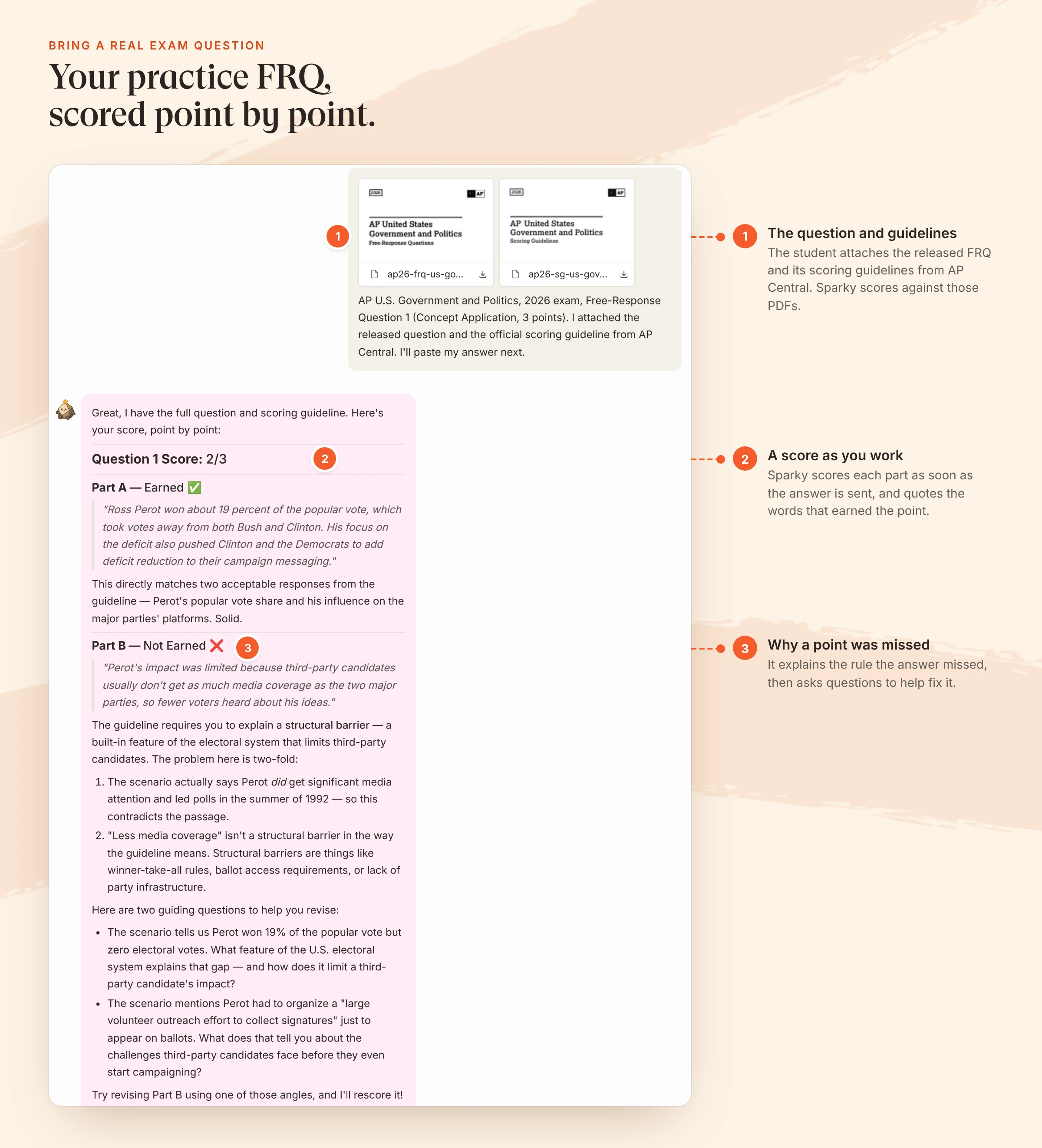
Sparky scores a practice answer to Question 1 from the 2026 AP U.S. Government exam against the College Board's scoring guidelines. From our AP exam study plan.
In Flint, the free response is the activity. A student drafting an APUSH long essay can ask Sparky what makes a thesis defensible, get pushed to use a second piece of evidence, and submit. Sparky then grades the essay against your rubric, row by row, with the reason for each score. You review the grades before you rely on them. Students see Sparky's feedback, and you choose whether they also see the rubric and numeric scores.
| An AP Lang class writes a synthesis essay | Flint | Albert |
|---|---|---|
| The prompt and sources | Yours, uploaded to the activity, or a public library activity you copy | Albert's free-response questions |
| While students write | Sparky answers questions and points them back to the sources, without writing for them | Students write on their own |
| After they submit | A rubric grade per row, with reasons, for you to check | The answer waits for your grade; Albert's AP page also mentions AI-assisted grading |
| What you see | Every session live, and a class summary once three students submit | Assignment, student and standards reports |
Multiple-choice practice
Albert is stronger here, and the gap is large. It has 50,000+ written AP items, according to its AP page, with explanations for each answer, unit and full-length tests modeled on the real exam, and reports by question and standard.
Flint has no question bank. In a Test or Quiz activity, you supply the questions and Flint scores each one. That works for a unit check on what you taught this week. It won't replace a bank of tested, exam-style items.
Side-by-side
| Flint | Albert | |
|---|---|---|
| Content | Your materials, plus activities in Flint's public library | 180,000+ expert-written items; 30+ AP subjects |
| Free responses and essays | Graded by Sparky against your rubric; you can change any grade | Graded by the teacher against the question's rubric; AI-suggested scores described in Albert's privacy policy |
| Multiple choice | Questions you supply, in a Test or Quiz activity | Large bank with explanations and full-length practice exams |
| AI tutoring while students work | Yes, one-on-one with Sparky | None described on Albert's site |
| Adaptive practice | Sparky adjusts to each answer in conversation | Free Adaptive subjects pick each next question |
| State tests | No ready-made state-test banks | Practice for exams in 12 states |
| LMS | Rostering through Edlink; grades sent to Canvas, Google Classroom or Schoology once support turns it on | SSO, rosters and grade sync for Canvas, Schoology and Brightspace; Google Classroom, Clever and ClassLink |
| Free plan | Teachers and their students, no student limit; up to 3 teachers and admins | Adaptive ELA, math and science, grades 3-12 |
| Paid plans | Per school, from $3,000£2,234 a year (150 accounts) | $18 per student a year for schools, $15 for districts, plus $1 for Pro |
Pricing
Albert publishes its prices. Its school pricing page lists $18 per student per year for schools and $15 for districts, with a 1,000-student minimum and lower prices at volume. That covers all question banks, including test prep. The Pro upgrade adds $1 per licensed student for the gradebook, school and district reports, item analysis, common assessments and the secure browser. A single-teacher license is $99 a year for up to 100 students or $199 for up to 200, and it "Does NOT include test prep subjects like SAT®, ACT®, state exams, or AP®." Students can buy one AP subject for $79, and those subscriptions don't renew automatically.
At those prices, a high school buying Albert with Pro for 600 students pays $11,400 a year.

Albert's school and district pricing page (albert.io/pricing-schools), captured November 5, 2026.
Flint is free for teachers and their students, with no student limit and up to 3 teachers and admins per free workspace. An AP teacher can run essay practice with every section this week without a purchase. School plans are priced by accounts, from $3,000£2,234 a year for 150 to $6,500£4,841 for 500, with prices above that on request. They add unlimited teachers and admins, SIS and LMS syncing, school-wide analytics and a named customer success manager.
Privacy
Albert's privacy policy, last updated July 10, 2026, says it is ISO 27001 compliant, has signed the Student Privacy Pledge, requires parental consent for students under 13, and does not sell user information for targeted advertising. It says students' written answers "are not used to train or improve any model."
Flint holds student conversations, because students work in it. A class owner can open any session in the class, and a school admin can search every chat in the school. Student conversations are not passed to AI companies such as OpenAI for model training. When a student writes something that matches a moderation category, such as self-harm, the assigned staff member gets an email. Our certifications and data agreements are on the security page.
Where Albert is stronger than Flint
- Ready-made questions. 180,000+ items written and checked by people, with an explanation for every answer choice.
- Exam-style practice tests. Unit and full-length AP tests built to match the real exam's mix and difficulty.
- State tests. Practice for state exams in 12 states, including STAAR, FAST, Regents and Keystone.
- Free adaptive practice. Grades 3-12 ELA, math and science at no cost, with no license needed.
- Standards reports. Every question is mapped to standards, so reports show which standards a class has mastered.
- Published per-student pricing for any size of school.
Where Flint is stronger than Albert
- Writing practice with feedback. Students draft essays and free responses with Sparky's help, and every submission is graded against your rubric for you to check.
- Your own materials. Activities run on your prompts, sources and rubrics, so practice matches what you taught.
- Live view of every student. You see each session as it happens, and alerts flag students who are confused or not engaging.
- Beyond test prep. The same platform handles discussions, simulations, world-language speaking practice and the rest of the year's work.
- Free for a whole class. One teacher can use Flint with every student, with no license.
Using both
Keep Albert for multiple-choice drills and practice tests, and use Flint for the writing. A common week: students take an Albert unit quiz on Monday, and on Wednesday they write the matching free response in a Flint activity, where Sparky grades it against the College Board rubric for you to review. If Albert's free-response questions are where your grading time goes, moving those to Flint is the cheapest test of whether it saves you hours.
Flint is free for teachers and their students, or book a demo and we'll build an AP activity with you on your own prompt.
FAQ
Does Albert.io grade free-response questions with AI?
Albert's help center says free-response questions are graded by the teacher, against the question's rubric, and that grades reach students only when the teacher releases them. Albert's AP page mentions in-app grading with AI assistance, and its privacy policy says open-ended answers may get a suggested score and feedback from a large language model, which a teacher reviews and can override. Albert's pages don't say which plans include the suggested scores.
How much does Albert.io cost?
Albert's adaptive practice for grades 3-12 ELA, math and science is free. A single-teacher license is $99 a year for up to 100 students and $199 for up to 200, and it does not include AP, SAT, ACT or state-test content. Schools pay $18 per student per year and districts $15 (minimum 1,000 students), plus $1 per student for the Pro upgrade with the gradebook and school reports. Students can buy one AP subject for $79.
Can Flint replace Albert.io for AP prep?
For essays, free responses and review conversations, yes: Flint grades them against your rubric and you check every grade. For large banks of expert-written multiple-choice questions and full-length practice exams, no. Flint has no item bank, so teachers supply their own questions. Many AP teachers would keep Albert for multiple-choice drills and use Flint for writing.
Is there a free Albert.io alternative for AP essay practice?
Flint is free for teachers and their students, with no student limit. Teachers can build AP essay and free-response activities on their own prompts and rubrics, or start from public AP activities in Flint's library, such as AP English Language FRQ Practice & Grader.
