Oct 14, 2026
First day of school activities for 2027-28: 22 ideas by grade
Twenty-two first day of school activities sorted by grade band, each with the time it takes, what you need and what students do, plus the routines worth teaching on day one.

Teddy Lane | School Success Lead at Flint

Most lists of first day of school activities name an idea in a line and leave the planning to you. This one is written out by grade band: kindergarten to 2nd grade, 3rd to 5th, middle school and high school. Each activity says how long it takes, what you need and what students do, so you can pick two or three and run them tomorrow. After the lists come the routines worth teaching on day one, and a short section on icebreakers.
A first day that works at any grade has five parts
Whatever you teach, a first day goes more smoothly when students know what to do from the moment they walk in. A plan for a 50-minute class, or the first hour of an elementary day:
- A task waiting at the door or on the desk (5 minutes). Students sit down to something they can start alone, like writing their name the way they want it said. You take attendance while they work.
- Names, yours and theirs (5 to 10 minutes). Say your name, write it on the board and tell students what to call you. Start learning their names with the activity in step 1.
- One routine, taught and practiced (10 minutes). Pick the routine you'll need first, usually the attention signal or how to get help. Show it, then have the class do it.
- A short piece of real work (15 to 20 minutes). Students should leave having done something in your subject, so they know what the class is like.
- A close (5 minutes). Tell them one thing that happens tomorrow, and use the leaving routine you want all year.
The activities below fill steps 1, 4 and 5 for each grade band.
Make a first-day scavenger hunt for your class
Sparky builds a scavenger hunt you can project, with questions about your own room, routines and policies. It asks for your grade, subject and the routines to include first, so the questions are about your class.
We sent the card's starter message on Flint's staging site and answered Sparky's questions as a 7th grade life science teacher whose class plays in teams of four. We listed nine routines and policies, from the late-work rule to where the eyewash station is. Sparky built a clue game to project: a welcome screen, nine clue cards with a progress bar, a Reveal Answer button on each card and a finish screen. Teams talk over each clue, then you reveal the answer. To turn it into a real hunt, have one student from each team walk to the spot before you click Reveal Answer.
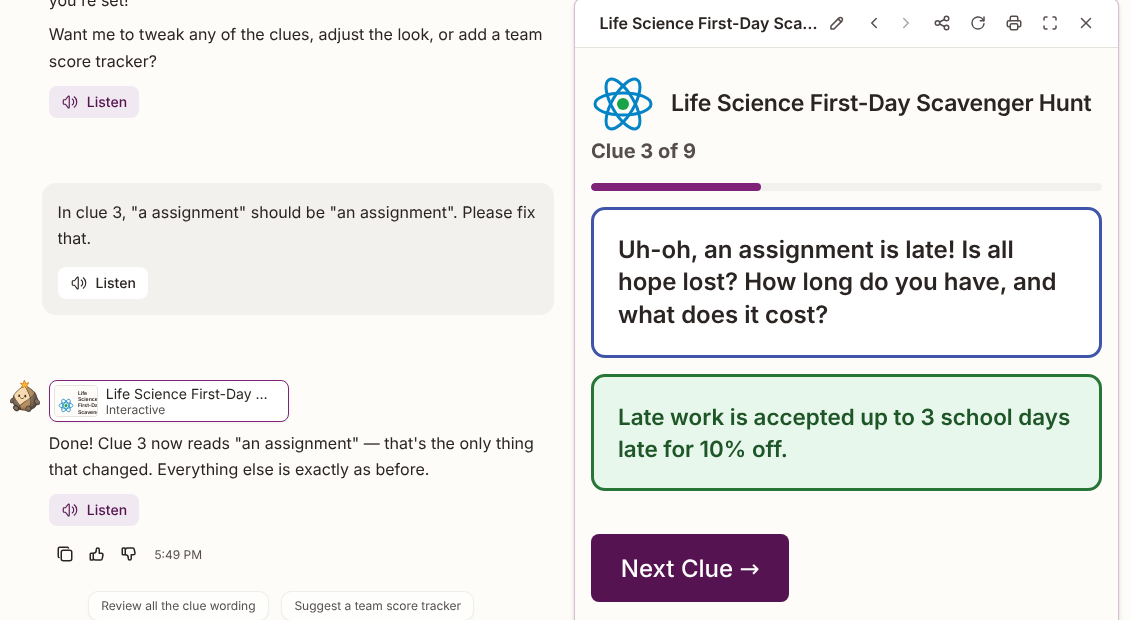
Made in Flint: a first-day scavenger hunt for 7th grade life science
Clue 2: "You finished your paper work. Where does it go so it doesn't vanish into the void?"
Answer: "Paper work goes in the tray for your period on the back counter."
Clue 5: "Two-part clue! Part 1: When do your goggles come off during a lab? Part 2: Splash emergency, where is the eyewash station?"
Answer: "In labs, goggles stay on until everyone has finished cleaning up; the eyewash station is next to the sink."
Clue 9: "Final secret: how is your grade built? Make a team guess for the four categories, then check!"
Answer: "Grades: tests 40%, labs 30%, classwork 20%, homework 10%."
…
Every answer matched the details we gave. In the first draft, clue 3 began "Uh-oh, a assignment is late!" When we asked Sparky to change it to "an assignment", Sparky fixed that clue in the same game. Clue 1 also gives teams "60 seconds", but the game has no timer, so time that one yourself or ask Sparky to add a countdown.
Kindergarten to 2nd grade: short, physical and repeated
Most children this age can't read written directions yet, and a long sit on the carpet on day one ends in wriggling. Keep each activity to 10 to 20 minutes, with movement between them.
Where does it live?
Time: 10 minutes. You need: a basket with eight things from around the room, such as a library book, a pencil, a glue stick, a take-home folder, a lunchbox and a coat hook tag.
Sit the class on the carpet with the basket. Pull out one object and ask, "Where does this live?" One child carries it to its spot while everyone watches. When it gets there, say the rule in one sentence: "Library books go back in the bin with the cover facing out." Children learn the room by putting things away in it, which is what they'll do every day after.
Practice coming to the carpet
Time: 10 minutes. You need: a name or a colored spot for each child on the carpet.
Walk to the carpet the way you want children to, sit in a spot and fold your hands. Ask the class what they noticed. Have two children do it, then the whole class. Practice coming from the tables, from the door and from the cubbies, three times each. The carpet is where most of the day starts, so it is worth the ten minutes.
A read-aloud about nerves, then a check-in
Time: 15 minutes. You need: a picture book about starting school, such as First Day Jitters by Julie Danneberg, in which the nervous character turns out to be the teacher.
After reading, ask children to hold up one to five fingers to show how they feel about school today, five for great. Hold up your own number and say why. Children who hold up one or two are the ones to sit near at lunch.
Our "I can" class book
Time: 20 minutes. You need: a half sheet for each child with "I can" printed at the bottom, crayons and a stapler.
Each child draws one thing they can already do, such as ride a bike, count to 20 or help make dinner. Walk around and write the words each child tells you on the line, or let children who can write do their own. Staple the pages into a book and read it to the class at the end of the day. You also get a first look at how each child holds a crayon and writes their name.
Name puzzles
Time: 15 minutes. You need: each child's name written large on a sentence strip, cut apart between the letters and put in an envelope with the name on the front.
Children open their envelope and put their name back together, checking the front if they need to. Then they count the letters and line up their envelopes on the floor in rows by number of letters, making a floor graph. Ask which row is longest. Kindergartners may need you to say each letter with them; 2nd graders can write the number on a sticky note.
Practice going home
Time: 10 minutes, at least an hour before dismissal. You need: a colored tag for each child, one color each for bus, car, walker and after-school care.
Pin on the tags in the morning. In the afternoon, practice packing the take-home folder, stacking the chair and lining up by color, twice, before the real bell. On the first day, getting every child onto the right bus matters more than anything else on this list.
3rd to 5th grade: build the habits you'll use all year
Students this age can read short directions, work in groups for 20 minutes and enjoy a challenge. Use the first day to try out the group work, writing and math routines you plan to use all year.
The class data wall
Time: 30 minutes. You need: sticky notes in four colors and four sheets of chart paper, each with one question and an empty bar graph: How many people live in your home? How did you get to school today? How many hours did you sleep last night? What's your favorite subject?
Each student puts one sticky note on each graph. Then split the class into four groups, one per graph, and have each group write two true sentences about it, like "More of us came by bus than by car." The class learns about each other, and you find out who can read a bar graph.
The teacher's mystery bag
Time: 15 minutes. You need: a bag with five objects from your life, such as a race medal, a photo of your pet, a ticket stub, a favorite book and a recipe card.
Pull out one object at a time. Pairs write a guess about you and the reason for it on a whiteboard or scrap paper: "I think you like running because that's a medal." Then tell the story behind the object. It's inference practice, and students learn about you before you ask them to share anything.
The cup stack challenge
Time: 20 minutes. You need: for each group of four, six plastic cups and a rubber band with four pieces of string, each about two feet long, tied around it.
Each student holds one string. Together they pull the strings to stretch the rubber band open, lower it over a cup and ease off so it grips. Without touching the cups with their hands, the group stacks them into a pyramid of three, two and one. Afterward, ask each group: "What did you do when two people pulled different ways?" Write their answers on the board as the start of your group-work expectations.
Three things I want you to know
Time: 15 minutes. You need: a half sheet with three numbered lines and a box labeled "When I'm stuck, this helps me."
Students write three things they want you to know about them and fill in the box. These are private, so say you're the only one who will read them. Write a one-line reply on a sticky note on each by Friday. You also get a short writing sample from every student.
Beat the clock
Time: 10 minutes. You need: a timer the class can see.
Pick a move you'll make every day, like going from desks to group tables with a pencil and notebook, or lining up for lunch. Show how it should look, then time the class doing it. Write the time on the board and try again. Keep the record up all week; the class will want to beat it.
Choose a book for tomorrow
Time: 20 minutes. You need: your classroom library and a bookmark for each student.
Show how you choose a book: read the back, read the first page, and put it back if it isn't right. Then let students browse in small groups while the others start a quiet task. Each student leaves with one book and writes its title on the bookmark. Independent reading can start on day two because everyone already has a book.
Middle school: structure that keeps anyone from being put on the spot
Middle schoolers care a lot about where they sit and who sees them try. Give them clear structure: assigned seats, a task to start right away, and activities where the group's work is shown rather than one person's.
A seat by card, with a task on the desk
Time: 5 minutes. You need: a deck of playing cards, a matching card taped to each desk and an index card on each desk.
Greet each student at the door and hand them a card. They find the desk with the matching card and follow the directions on the board: on the index card, write your name the way you want it said, how to say it if people often get it wrong, and one thing that helps you learn. Random seats on day one spare students the choice of where to sit. Once you know the class, make a seating chart with Flint's seating chart maker.
The how-our-class-works scavenger hunt
Time: 20 minutes. You need: a sheet of ten questions for each pair, or the scavenger hunt Sparky makes to project (see the example above).
Pairs answer questions they can only answer by looking around the room and in the syllabus: Where do you turn in finished work? What do you do if you're absent? Where are the extra pencils? In science, include where the eyewash station is. Go over the answers together. Students learn the procedures by finding them, not by listening to you read them.
Survival on the Moon
Time: 40 minutes. You need: the list of 15 items and NASA's ranking from the Canadian Space Agency's Survivor: Moon activity.
The scenario: a crew has made an emergency landing 50 km from its lunar base and can carry only some of its supplies. Each student ranks the 15 items alone (10 minutes). Then groups of four agree on one ranking (15 minutes). Reveal NASA's ranking and have students score their lists: for each item, the difference between their rank and NASA's, added up, where lower is better. Compare individual scores with group scores and ask what happened in the groups that did best. The space agency's version runs 90 minutes with presentations; this cut fits a class period.
Name tents that write back
Time: 5 minutes a day for the first week. You need: an index card for each student, folded into a tent.
Students write their name on the front and a question or comment for you on the inside. Collect the tents at the end of class and write a short reply on each. Students read your reply when they sit down the next day and add a new note. By Friday you know every name and have had a short conversation with each student.
Best class, worst class
Time: 20 minutes. You need: two colors of sticky notes.
On one color, students write something that made a class they loved work well. On the other, something that made a class hard to learn in. No names of teachers or students. Post them on the board, sort them into groups with the class, and turn the four biggest groups into the class's agreements. For more on setting expectations, see our guide to classroom management strategies.
High school: start with your subject
Many high schoolers spend the first day hearing the same syllabus in six classes. Teach something real in the first 20 minutes, then cover the logistics with a task instead of a lecture.
Teach something on day one
Time: 15 to 20 minutes. You need: depends on your subject.
Choose a problem everyone can start and nobody finishes in a minute:
- Math: four 4s. Using exactly four 4s and any operations, make every whole number from 0 to 10. For example, 44 ÷ 44 = 1 and (4 + 4 + 4) ÷ 4 = 3. Pairs race to fill the list, and the last few numbers start an argument about what counts.
- English: a six-word story. Students write their summer, or their life so far, in exactly six words. Then they swap with a partner and change one word to make it stronger.
- History: a photo with no caption. Project a historical photograph without its caption. Students write what they see, what they think is happening and what they want to know. Then reveal the caption and date.
- Science: diet soda or regular? Put an unopened can of regular soda and one of diet in a clear tub of water. In most cases the diet can floats and the regular sinks. Students predict, watch, and then explain in groups. The answer comes down to density: the sugar in the regular soda makes it heavier for the same volume.
Syllabus questions instead of a syllabus reading
Time: 15 minutes. You need: the syllabus and eight questions for each pair.
Write questions students would ask in October: "You're out sick Tuesday. Where do you find what you missed?" "Your essay is two days late. What happens?" Pairs find the answers in the syllabus. Then go over only the questions pairs got wrong. If you're still writing your syllabus, Flint's syllabus generator drafts one when you describe your course.
The index card
Time: 5 minutes. You need: an index card for each student.
Ask for the name they go by and how to say it, the best way to reach them, what takes up their time after school (a job, a sport, looking after siblings) and one thing that would make this class worth taking. Read every card that night. Many high schoolers will tell you on an index card what they won't say out loud.
Ask me anything, anonymously
Time: 10 minutes. You need: slips of paper and a box.
Students write any question for you, about you or the class, without their name. Draw slips and answer ten out loud, skipping anything too personal with a smile. Students find out who you are, and how you answer shows them what can be asked in your room.
A goal with a plan
Time: 10 minutes. You need: an index card for each student.
Use WOOP, a goal-setting method based on psychologist Gabriele Oettingen's research: Wish, Outcome, Obstacle, Plan. Students write one wish for this class, the best outcome if it comes true, the obstacle inside them most likely to get in the way (putting things off, their phone) and a plan in the form "If [obstacle], then I will [action]." Keep the cards and hand them back at the first progress report.
The routines worth teaching on the first day
Students of every age need to know how your room works, and they learn it faster by doing it than by hearing it. Teach two or three of these on day one and the rest in the first week:
| Routine | What students need to know |
|---|---|
| Coming in | Where to sit, where the first task is, what to do with bags and phones |
| The attention signal | What you'll say or do when you need the room, and what they do in response |
| Getting help | What to do when they're stuck and you're busy with someone else |
| Turning in work | Where paper goes, or where to submit online, and what to do with late work |
| Using materials or devices | Where supplies live, how to get them and how to put them back |
| Leaving | Who dismisses the class (you, not the bell), and what the room should look like |
Responsive Classroom's Interactive Modeling is a reliable way to teach each one. In short: say what you're about to show and why, show it the way you want it done, ask students what they noticed, have one or two students show it, ask again what they noticed, then have everyone practice while you give feedback. For middle school they suggest a shorter version: describe it, model it, let students practice, and give feedback right away. Practice the attention signal several times on day one, in the middle of real talk, so students know it works when the room is loud.
Icebreakers: keep them short and optional
An icebreaker can fill five minutes on the first day, but it shouldn't be the whole plan, and some students dread them. Choose ones where students can answer by moving or with one word, so nobody has to tell a personal story. Flint's icebreaker generator writes icebreaker prompts and activities for your grade and group.
For a broader plan for the start of the year, Flint's back-to-school page has free resources and a downloadable guide for using Flint from the first day.
FAQ
What should I do on the first day of school?
Have a task waiting when students walk in, learn names, teach one routine and practice it, do 15 to 20 minutes of real work in your subject, and close by telling students what happens tomorrow. Choose activities for your grade: short and physical for kindergarten to 2nd grade, group challenges for 3rd to 5th, structured tasks for middle school, and a real problem in your subject for high school.
When is the first day of school in 2027?
It depends on your district. A Pew Research Center analysis of over 1,500 districts found US public schools start anywhere from late July to after Labor Day. In the 2023-24 school year, more than two-thirds of students in Alabama, Kentucky, Mississippi and Tennessee started the week of August 7, while about three-quarters of students in New York, New Jersey and Pennsylvania started after Labor Day. Check your district's calendar for the exact date.
What are good first day activities for high school that aren't icebreakers?
Start with a problem in your subject, such as the four 4s puzzle in math or a captionless historical photo in history. Then cover the syllabus with questions pairs answer from the document, and collect an index card from each student with their name, how to reach them and what takes up their time after school.
How do you make the first day of kindergarten go well?
Keep each activity to 10 to 20 minutes, move between them, and practice the routines children need most: coming to the carpet, putting things away and going home. Practice dismissal with color-coded tags at least an hour before the bell, so every child gets on the right bus or to the right pickup spot.
How many activities should I plan for the first day?
For a 50-minute class, plan one opening task, one main activity and one routine, plus a spare in case the main activity runs short. For a full elementary day, plan an activity of 10 to 30 minutes for each block, with a routine taught before each transition.